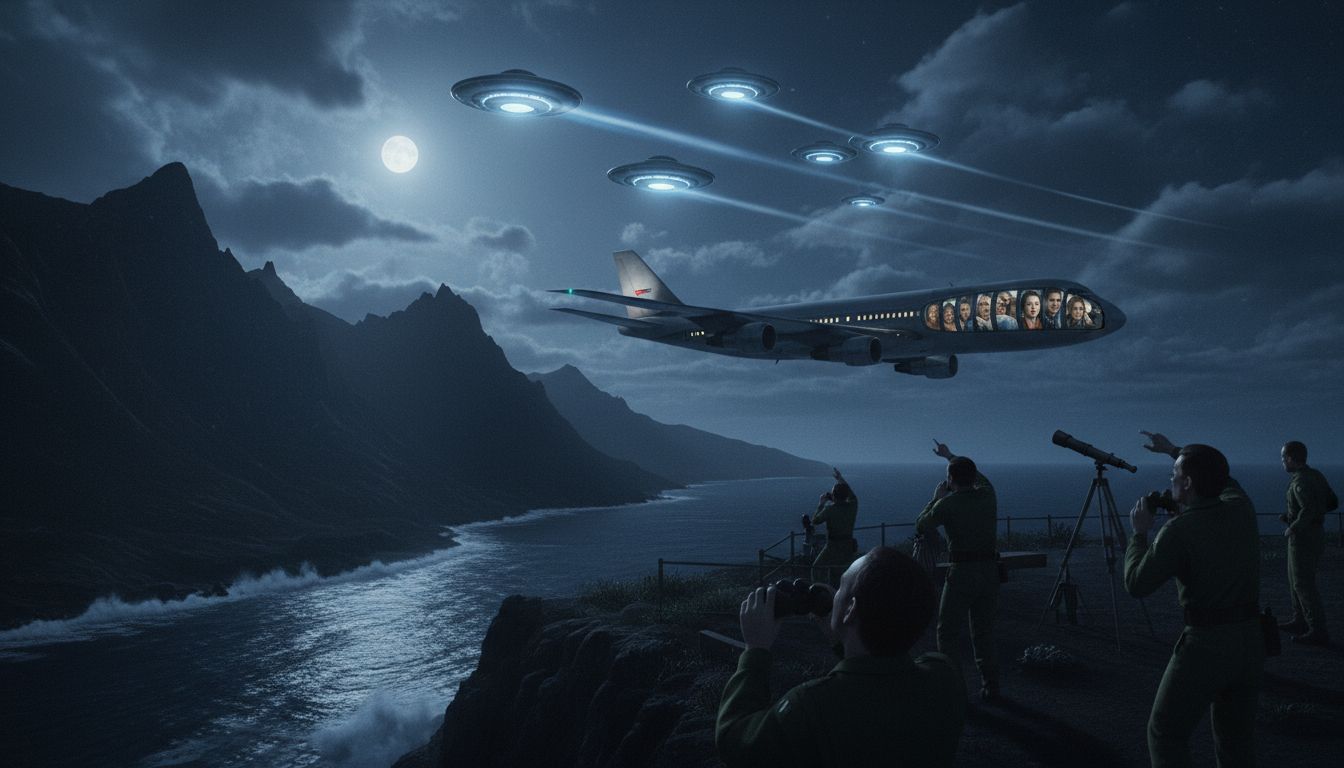
On 22 June 1976, a convoy of aircraft and a crowd of onlookers over the Canary Islands reported seeing two luminous objects maneuvering in close proximity. The incident, now known as the 1976 Canary Islands UFO sighting, was recorded by a mixture of civilian tourists, airline passengers, and a substantial contingent of Spanish military personnel stationed on the archipelago. According to the compiled witness list, roughly 1,200 military staff and 800 civilians observed the phenomenon, while two amateur filmmakers captured moving images that have since become a focal point for researchers. The footage, described by the British couple who filmed it as “two bright, silver‑coloured discs pulsing with light and darting erratically,” has been repeatedly analyzed by both independent investigators and, more recently, by a small team of aerospace engineers commissioned by a European research institute.
The eyewitness accounts share a consistent narrative: the objects hovered at an altitude that appeared to be within visual range, then one seemed to pursue the other in a slow, deliberate arc across the sky. “It was like watching two giant coins being tossed back and forth,” recalled Lieutenant Carlos Méndez, a Spanish Air Force officer who was on duty at the nearby airbase. “They emitted a steady, almost hypnotic glow, and no sound could be heard, even though the wind was calm.” Civilian witnesses echoed similar descriptions, noting the metallic sheen and the absence of conventional aircraft features such as wings or exhaust plumes. The British couple’s film, though grainy by modern standards, shows the objects emitting a pulsating light that brightened and dimmed in a pattern that some analysts have likened to a form of communication.
In the decades that followed, the sighting has been examined through several interpretive lenses. Proponents of an extraterrestrial hypothesis point to the objects’ uncharacteristic flight patterns and the sheer number of independent observers as evidence of a genuine unknown aerial phenomenon. Conversely, aerospace historians have suggested that the objects could have been experimental aircraft, possibly linked to Cold‑War era reconnaissance programs conducted by either the United States or the Soviet Union. A 2023 paper published by the European Centre for Airspace Security noted that “the technology described in the testimonies—silent propulsion, rapid acceleration, and lack of visible control surfaces—does not match any known platform of the 1970s,” yet it also cautioned that classified projects from that period remain largely undocumented. Skeptics have further proposed natural explanations, ranging from rare atmospheric luminous events to reflections off high‑altitude clouds, though none have satisfactorily accounted for the synchronized observations by both military radar operators and visual witnesses.
The renewed interest in the Canary Islands case aligns with the broader resurgence of UAP (Unidentified Aerial Phenomena) scrutiny worldwide. In 2023, the U.S. Office of the Director of National Intelligence released a preliminary assessment acknowledging that a subset of UAP reports exhibit flight characteristics beyond current technological capabilities. While the 1976 incident predates modern sensor suites, the archived radar logs from the Spanish Air Defense network, released under a transparency request last year, show anomalous returns coincident with the visual sightings. Researchers have used these data points to argue that the event merits inclusion in comparative studies of historical UAP cases, alongside more recent encounters such as the 2004 USS Nimitz footage and the 2021 Pentagon‑released videos.
Despite the passage of nearly five decades, the Canary Islands sighting remains a touchstone for both enthusiasts and skeptics. The combination of a large, diverse witness pool, contemporaneous film evidence, and lingering unanswered questions continues to fuel scholarly debate. As Dr. Elena Ruiz, a senior analyst at the International UAP Research Consortium, observed in a recent interview, “The 1976 event reminds us that the sky still holds mysteries that challenge our understanding of aeronautics, security, and perception. Whether we ever identify the objects or not, the incident underscores the importance of rigorous documentation and open inquiry in the study of unexplained aerial phenomena.”