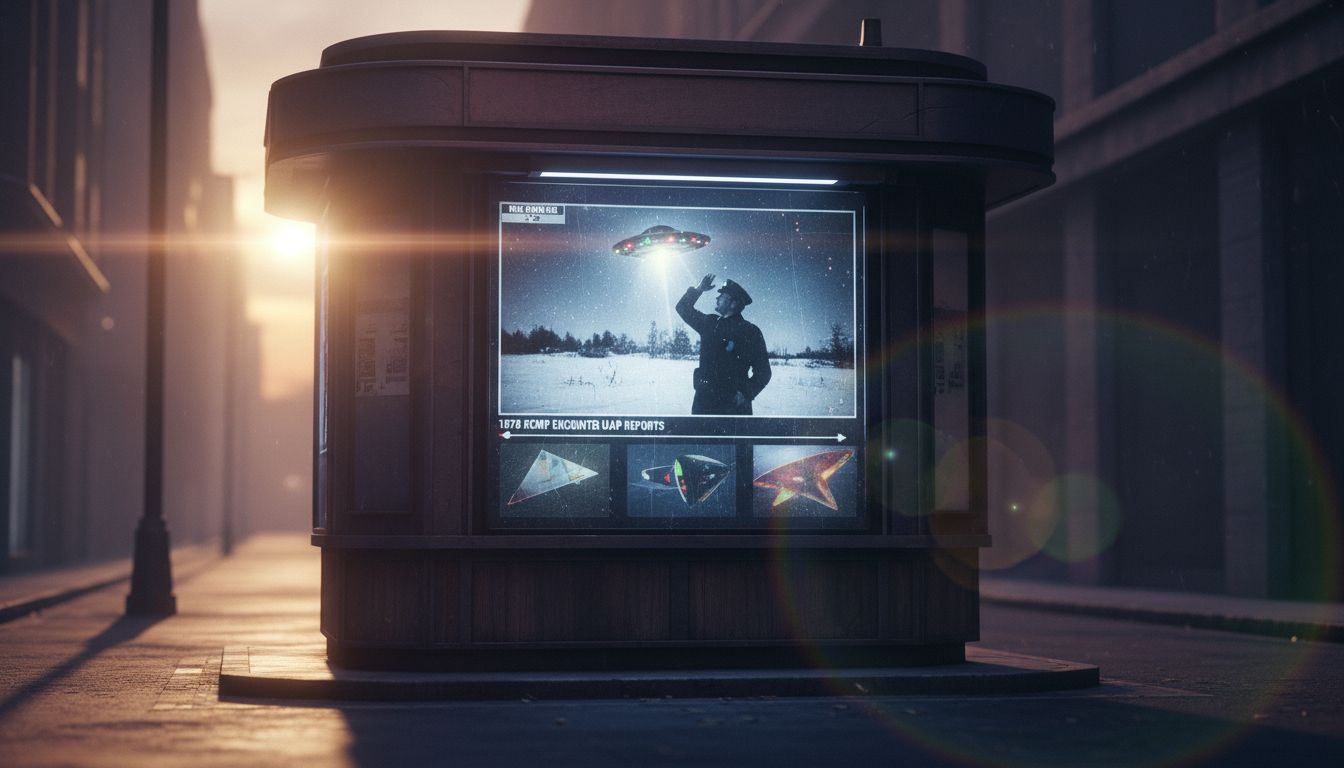
On the night of January 26, 1978, a routine patrol in the small Newfoundland town of Clarenville turned into one of Canada’s most frequently cited unidentified aerial phenomena cases. At approximately 23:00 hours, Corporal James Blackwood of the Royal Canadian Mounted Police responded to a civilian call reporting a “strange object” hovering above the town. According to Blackwood’s own testimony, recorded in an RCMP incident report, he observed a large, brightly lit disc about 300 feet away, silent and seemingly rotating in place before accelerating away at a speed that “defied any aircraft I had ever encountered.” The report, filed shortly after the encounter, concluded that the object could not be identified as a helicopter, conventional airplane, or any known civilian or military craft.
Blackwood was not alone in his observation. Several residents who were outside their homes at the same time corroborated his account, describing a primary luminous object accompanied by smaller, faster‑moving lights that appeared to orbit it. The RCMP compiled these statements in a supplemental witness log, noting that the sightings were “consistent in description and timing.” Although the official investigation did not result in a definitive identification, the file was retained in the RCMP’s Unidentified Aerial Phenomena (UAP) archive, a repository that was later opened to public scrutiny under Canada’s Access to Information Act. The existence of the file, now digitized and accessible through the Government of Canada’s open data portal, has allowed researchers to verify that the incident was taken seriously by law‑enforcement authorities at the time.
In the decades since Clarenville, the case has resurfaced whenever new UAP reports dominate headlines. The U.S. Office of the Director of National Intelligence’s 2021 Unidentified Aerial Phenomena Report, which catalogued 144 sightings by military personnel, highlighted the importance of “systematic data collection” and “inter‑agency cooperation,” echoing the procedural steps taken by the RCMP in 1978. More recently, a series of nocturnal sightings reported across the Atlantic provinces in the spring of 2025—some captured on low‑resolution video and submitted to the Canadian Space Agency’s UAP task force—have prompted renewed interest in historical cases. Analysts have drawn parallels between the Clarenville description of a rotating, silent object and the “tic‑tac” shape documented by U.S. Navy pilots in 2004, noting similar flight characteristics such as rapid acceleration and lack of audible propulsion.
Skeptics continue to propose conventional explanations. Some aviation historians suggest that the 1970s saw experimental aircraft testing under Project Blue Book’s North‑American counterpart, while others point to atmospheric phenomena like ball lightning or rare meteorological reflections. However, the RCMP’s own assessment ruled out known aircraft and weather conditions, and no radar returns were recorded from nearby air traffic control stations, a fact that complicates purely terrestrial theories. The lack of a plausible conventional source has kept the Clarenville incident in the realm of “unexplained” rather than “debunked,” a distinction that matters for policymakers debating the allocation of research funds toward UAP studies.
Beyond the technical details, the Clarenville sighting underscores why systematic investigation of anomalous aerial events remains relevant. As former RCMP officer and current UAP researcher Dr. Marianne Lavoie notes, “When a sworn law‑enforcement officer reports an encounter that cannot be matched to known technology, it forces us to ask whether our current detection and reporting frameworks are sufficient.” The 1978 case, now part of a growing historical record that includes both Canadian and international incidents, provides a baseline for comparing modern sensor data with past eyewitness accounts. In an era where satellite constellations and advanced radar can capture high‑fidelity information, the Clarenville encounter serves as a reminder that human observation, when documented rigorously, still holds value in unraveling the mysteries of our skies.