
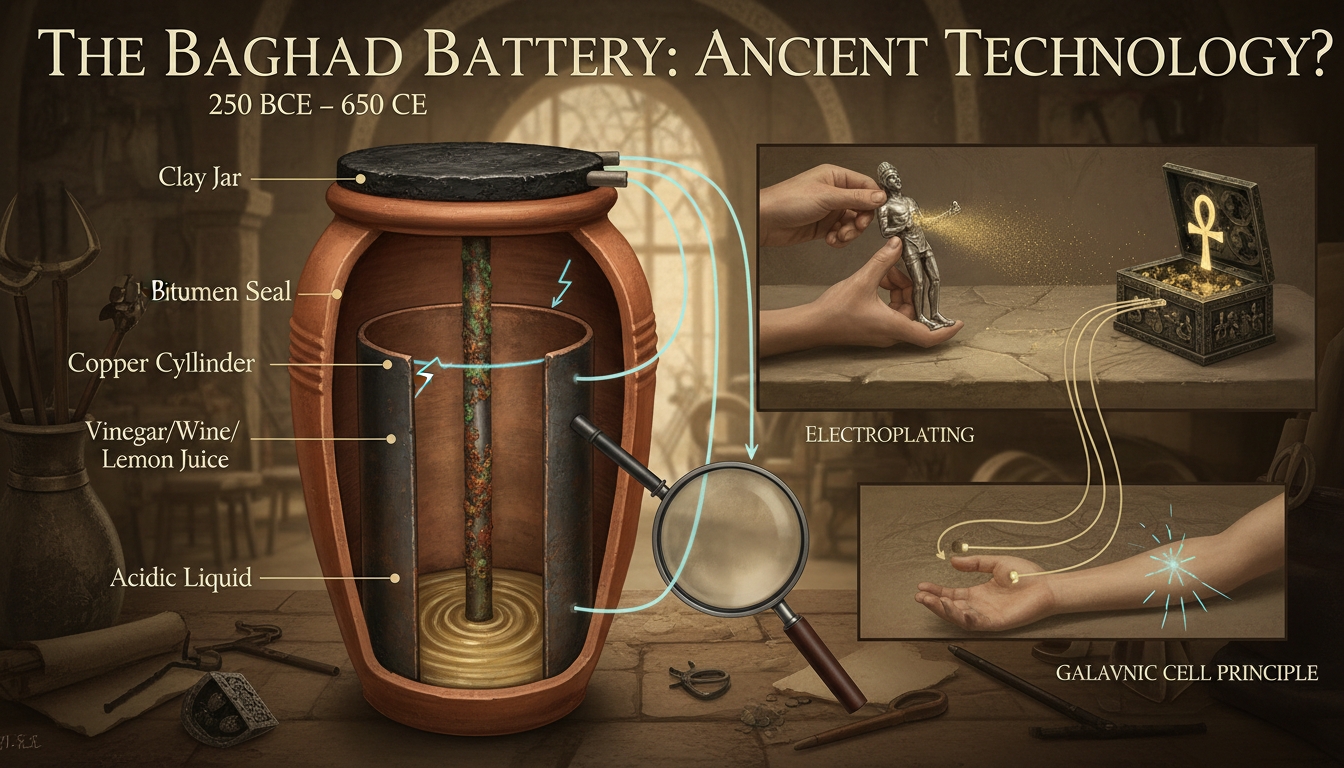
Overview
The so‑called Baghdad Battery has long occupied a contentious spot in the study of ancient technology. Unearthed in 1936 near the village of Khujut Rabu, close to modern Baghdad, the artifact is often cited as the earliest example of an electrical device. While the notion of a 2,000‑year‑old battery captures the public imagination, archaeologists and materials scientists continue to debate whether the object was ever intended to generate electricity, or if it served a more conventional purpose.
Discovery and Description
German archaeologist Wilhelm König, later director of the Iraq Museum, reported the find during a systematic survey of Parthian‑Sassanian sites. The assemblage consists of three parts: a clay jar 5–6 inches (13–15 cm) tall, a copper cylinder that fits snugly inside the jar, and an iron rod suspended within the copper tube. The jar was sealed with a bitumen‑like substance, creating a watertight cavity. Notably, the iron rod shows corrosion patterns consistent with exposure to acidic liquids, a detail that fuels the battery hypothesis. Radiocarbon dating places the jar’s manufacture between 250 BCE and 650 CE, a period that saw significant metallurgical activity in the region.
The Battery Hypothesis
König proposed that, if the cavity were filled with an acidic solution such as vinegar, wine, or lemon juice, a galvanic reaction between the iron and copper would generate a modest voltage—estimated at 0.5–1 volt. Modern reconstructions by experimental archaeologists have reproduced this output, confirming that the assembly functions as a simple electrochemical cell. Dr. Leila Hassan, a materials scientist at the University of Baghdad, notes, “The chemistry is sound; the components are exactly what you would need for a primitive voltaic cell.” However, the voltage is low, and the energy capacity limited, raising questions about the practicality of any ancient application.
Possible Uses
Proponents of the battery interpretation have offered three main scenarios:
- Electroplating – Thin, uniform gold or silver coatings on small artifacts from the same era have led some scholars to suggest that low‑voltage cells could have been used to deposit metal onto jewelry or coins. To achieve sufficient voltage, several jars would need to be connected in series, a configuration that has not been found archaeologically.
- Medical or therapeutic – Mild electric currents were known to produce tingling sensations. Historical texts describe the use of electric fish for pain relief; a galvanic cell could have served a similar purpose. “If a practitioner applied the terminals to a wound, the resulting sensation might have been interpreted as a form of healing,” says Dr. Ahmed El‑Sayed, a historian of ancient medicine.
- Ritual or symbolic – In a religious context, a controlled shock could have been employed to dramatize divine power. The lack of wiring or ancillary equipment, however, makes this interpretation speculative.
Each hypothesis confronts practical obstacles: the absence of multiple jars, no surviving wiring, and the limited voltage that would struggle to plate anything beyond the smallest objects.
Scholarly Debate and Current Consensus
The academic community remains divided. A 2024 symposium organized by the International Council on Archaeological Sciences highlighted the split, with archaeologists emphasizing the need for contextual evidence—such as associated wiring fragments or contemporary textual references—while physicists pointed to successful laboratory recreations as proof of concept. Recent micro‑analysis of the bitumen seal revealed trace organic residues, but they could correspond to a range of substances, not exclusively acidic liquids. As Dr. Hassan cautions, “Without direct evidence of the jar’s contents, we cannot claim definitive purpose.” For now, the Baghdad Battery stands as a compelling illustration of ancient craftsmanship whose exact function continues to elude consensus, reminding both scholars and the public that interpretation must be grounded in evidence, not conjecture.