Overview
A new geospatial analysis released on February 28, 2026 suggests that the United States’ west‑coast sightings of Unidentified Aerial Phenomena (UAP) are not randomly distributed. The study, conducted by Warsaw‑based attorney and independent researcher Antoni Witkowski, examined more than 80,000 geotagged reports from the National UFO Reporting Center (NUFORC) spanning several decades. By overlaying these reports on high‑resolution NOAA bathymetric maps, Witkowski identified a striking concentration of sightings directly above deep‑sea submarine canyons off California and Washington. The findings have prompted renewed calls from both civilian analysts and military officials for greater transparency of sonar and radar data.
Data Analysis and Findings
Witkowski’s statistical model compared reported sighting frequencies with expected rates based on local population density and air‑traffic activity. The results showed “magnet‑like” clustering over canyons with steep gradients exceeding 60 meters per kilometer. La Jolla Canyon near San Diego recorded 820 sightings, far above the model’s prediction of 55. Similar anomalies appeared at Mugu Canyon, Monterey Canyon, and in Puget Sound, each registering several hundred reports versus single‑digit expectations. By contrast, the analysis found no meaningful correlation between UAP reports and underwater canyons on the U.S. East Coast or Gulf Coast, despite comparable population levels. The disparity suggests a geographic factor rather than a simple reporting bias.
Historical and Military Accounts
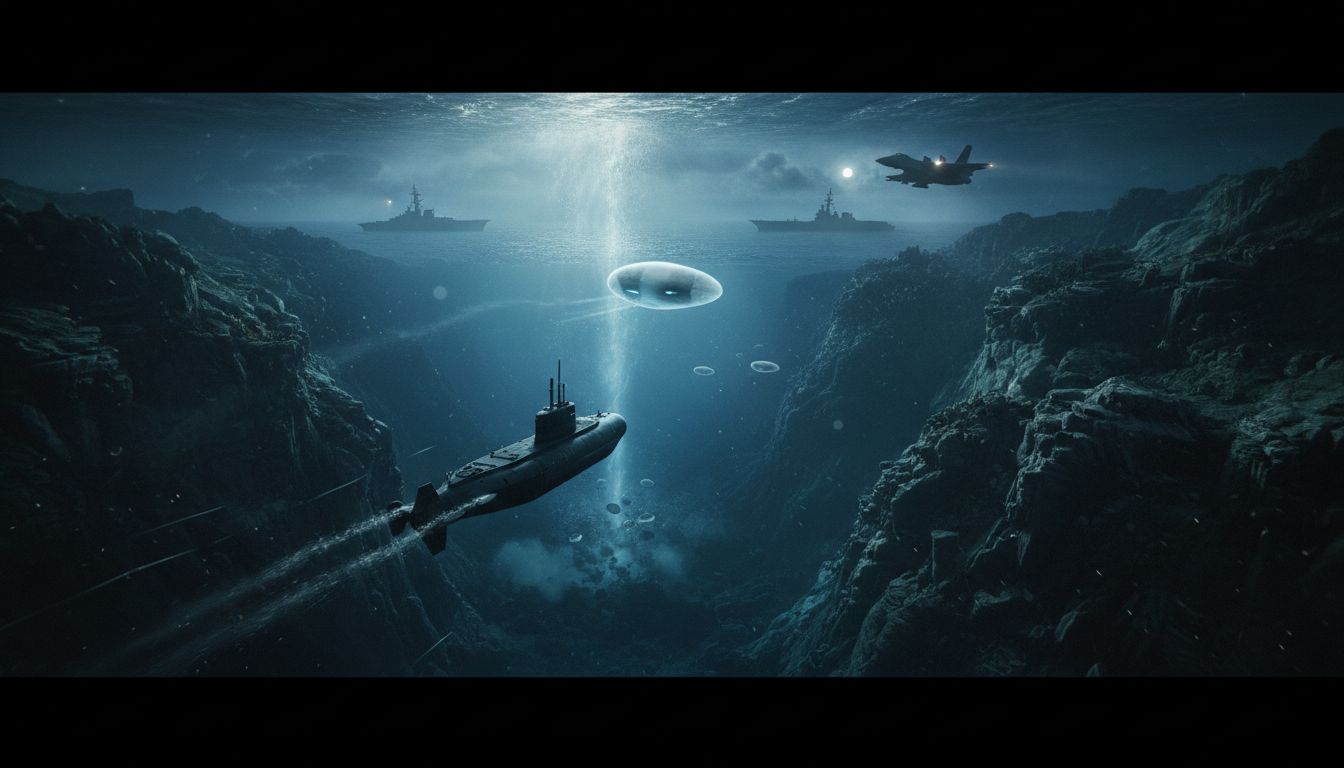
The statistical pattern aligns with several documented incidents that place UAP activity in the same maritime corridors. In April 1966, Lee Hansen, a U.S. Navy photographer, captured 16 mm film of a metallic, 20‑meter‑long object near Catalina Island that appeared to transition between air and water—a capability later discussed by futurist Arthur C. Clarke and ufologist Richard Dolan. The 2004 USS Nimitz encounter, recounted by Commander David Fravor, involved a “tic‑tac” shaped craft descending from 80,000 feet to sea level within seconds; radar and sonar from the carrier USS Princeton recorded speeds exceeding 400 knots underwater. More recent Navy sensor logs from the USS Omaha (2019) and USS Jackson (2023) describe spherical objects diving into the ocean without generating a surface wake, with Senior Chief Alexander Wiggins noting “multiple self‑luminous tic‑tac objects rose straight out of the water and accelerated in perfect synchronization.”
Expert Reactions
The study has drawn attention from both civilian researchers and senior military officers. Rear Admiral Tim Gallaudet, a longtime advocate for UAP transparency, stated, “If the data show a repeatable pattern over submarine canyons, we owe it to the public and to national security to investigate with dedicated sonar sweeps.” Witkowski himself cautioned against premature conclusions, emphasizing that “the statistical significance does not identify the nature of the phenomena; it merely highlights where the anomalies are most frequent.” Scientists not involved in the study have echoed the need for rigorous, peer‑reviewed research, noting that oceanic thermoclines and acoustic