Overview
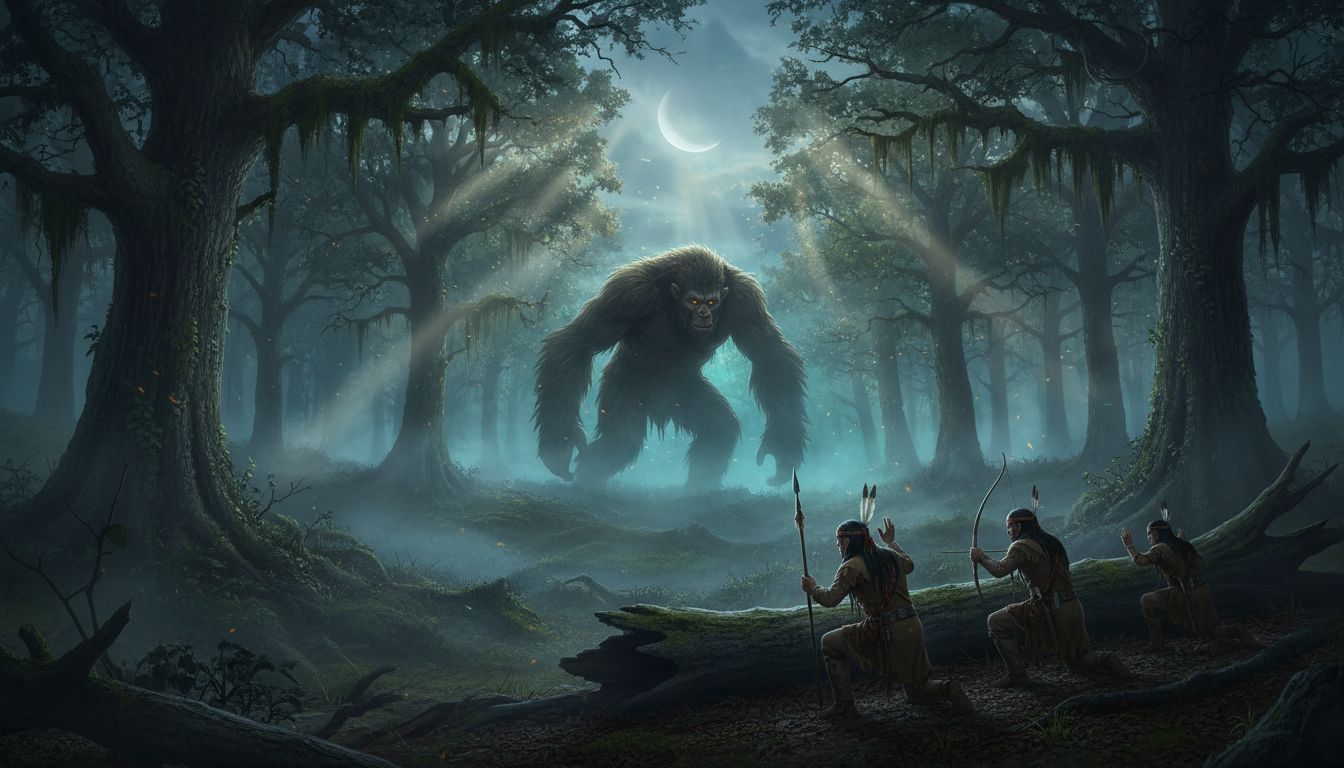
A tale that circulates in modern folklore describes a violent clash in 1855 between members of the Choctaw Nation and a group of “hairy giants” in what is now southeastern Oklahoma. The story, often called the “Choctaw‑Bigfoot War,” portrays night‑time attacks, missing children, and a multi‑day battle in the dense forests near the Red River. While the narrative is vivid, historians and anthropologists have found no contemporaneous records—military reports, newspaper articles, or tribal minutes—that substantiate the event. The account appears primarily on contemporary folklore sites, such as mysticsciences.com, and is treated by scholars as a piece of oral tradition that emerged long after the mid‑19th century.
Historical Context
By the mid‑1800s the Choctaw people had been forcibly relocated from their ancestral lands in Mississippi to Indian Territory, a journey known as the Trail of Trails. In 1855 the nation was rebuilding villages, cultivating farms, and establishing a new social order under the leadership of chiefs such as Greenwood LeFlore and his half‑French descendant Joshua Le Flore. The region’s “rolling forests and rugged river valleys” were indeed home to abundant wildlife, but documented threats to the community at that time were primarily disease, scarcity of supplies, and occasional raids by outlaws—not encounters with cryptic, giant hominids. The Choctaw oral tradition does contain stories of “Tall Man” or “Hairy Man of the Woods,” beings described as “between animal and supernatural spirit.” These legends pre‑date European settlement and likely served as cautionary tales about the dangers of the wilderness.
The Legend’s Details
According to the modern retelling, the year 1855 saw “strange cries” echoing through the trees, horses found dead with broken bones, and children disappearing from isolated cabins. The creatures—referred to in some versions as “Nahullo,” a term the Choctaw sometimes use for “large foreigners”—were portrayed as pale, hulking giants covered in coarse hair. The story claims that a mixed hunting party of roughly thirty men, led by a figure named Joshua Le Flore, pursued the beings into caves and ravines. It describes “warriors dragged from horses, dogs thrown aside like twigs, and rifle shots echoing through the woods,” culminating in the alleged rescue of the missing children and the burial of “monstrous bodies too large to easily bury.” The narrative also mentions a legendary chief dubbed “Chief Oklahoma,” though no historical record links that name to any 1850s Choctaw leader.
Sources and Credibility
The primary source for the war narrative is a 2025 article on mysticsciences.com, a site that focuses on paranormal and fringe topics rather than peer‑reviewed scholarship. The piece offers no citations to 19th‑century newspapers, tribal council minutes, or U.S. Army reports—documents that would be expected if a conflict of this magnitude had occurred. Researchers at the Oklahoma Historical Society have confirmed that the only documented Choctaw‑related incidents in the 1850s involve land disputes and treaty negotiations, not encounters with cryptid entities. Folklorist Dr. Elaine McPherson of the University of Oklahoma notes that “the blending of indigenous myth with the American Bigfoot craze of the late 20th century creates a hybrid legend that feels authentic but lacks archival support.” This assessment aligns with the broader pattern of contemporary folklore adapting older tribal stories to fit popular cryptozoological motifs.
Cultural Significance
Even without historical verification, the Choctaw‑Bigfoot War reflects how communities reinterpret ancestral narratives to address modern anxieties. For the Choctaw Nation, the story underscores themes of resilience and protection of the vulnerable—values that resonate with the tribe’s historic experience of displacement and survival. At the same time, the legend taps into the wider American fascination with Bigfoot, illustrating how regional folklore can be reshaped by national pop culture. As scholars continue to document authentic Choctaw oral histories, distinguishing between traditional myth and recent invention remains essential for preserving cultural integrity while acknowledging the allure such stories hold for the public imagination.