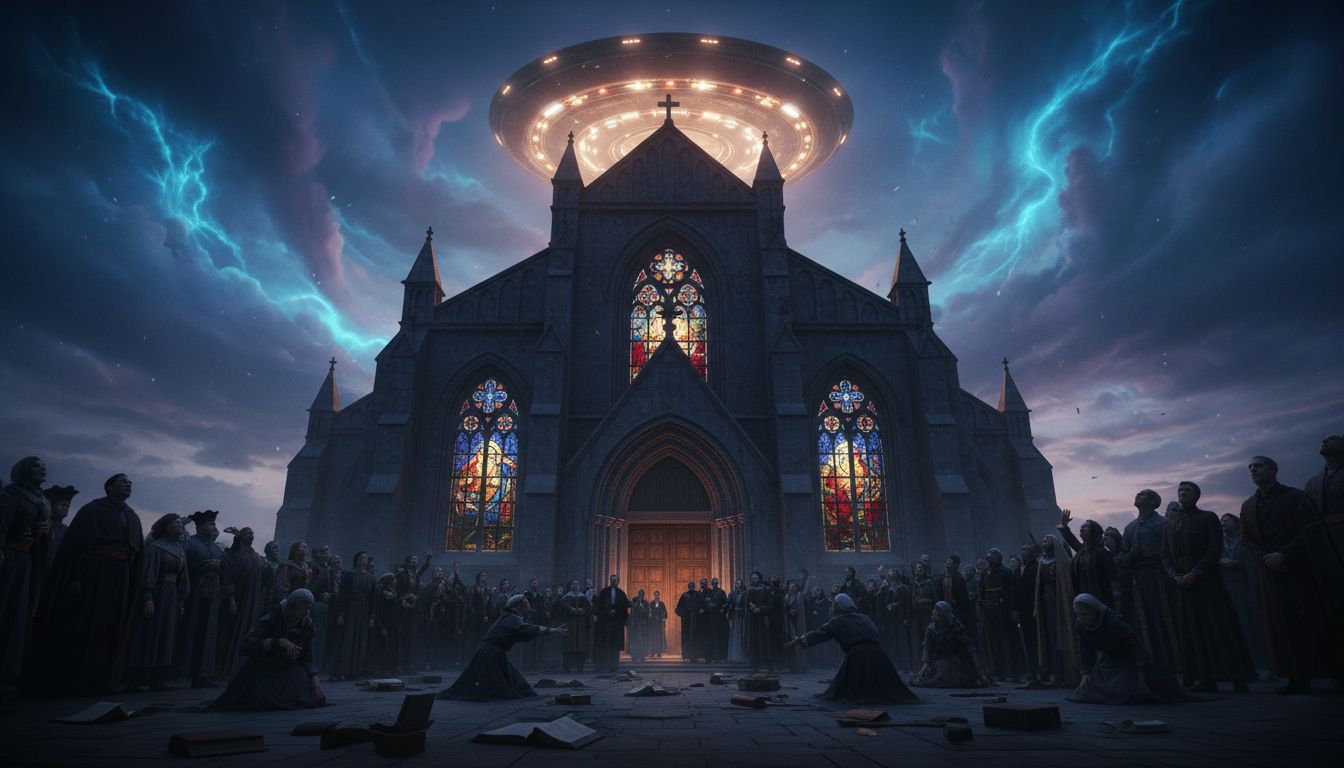
Overview
A full‑spectrum UFO disclosure—one that moves beyond Pentagon video releases and congressional hearings to undeniable proof of non‑human intelligence and technology—could trigger a cascade of institutional upheaval. Analysts and scholars who study the intersection of national security and cultural authority argue that such an event would not merely rewrite scientific textbooks; it would strike at the foundations of organized religion and the defense‑industrial complex, both of which have long been intertwined with American political power. The debate, long confined to fringe forums, is now gaining traction among policy experts who warn that secrecy serves a purpose beyond mere classification.
Religious Authority and the Threat to Human Exceptionalism
For centuries, American religious institutions have supplied metaphysical certainty and a moral framework that reinforces national identity. From colonial churches that organized community life to the Cold‑War era framing of the United States as a “nation under God” opposing “godless communism,” faith has been a strategic asset. The 1954 addition of “under God” to the Pledge of Allegiance and the 1956 adoption of “In God We Trust” as the national motto illustrate how theological language was deliberately woven into state rhetoric.
If humanity were confronted with concrete evidence of extraterrestrial intelligence, scholars contend that the doctrine of human exceptionalism—the belief that humans occupy a unique, divinely‑ordained place in the cosmos—would be challenged. Religious leaders would likely be forced to reinterpret sacred texts, a process that could strain congregational cohesion and financial support. “The shock to doctrinal foundations would be comparable to the Reformation,” notes Dr. Elaine Whitaker, a professor of religious studies at Georgetown University, “but on a global scale.”
Defense Contractors and the Economics of Secrecy
The national security apparatus has evolved into one of the world’s largest economic ecosystems. Companies such as Lockheed Martin, Raytheon, Northrop Grumman, Boeing, and General Dynamics dominate federal defense spending, a reality first highlighted by President Dwight D. Eisenhower’s 1961 warning about the “military‑industrial complex.” Their business models rely on sustained perception of external threats and the confidentiality of advanced technologies.
A transparent disclosure of alien technology could render many classified programs obsolete, undermining the revenue streams that support thousands of jobs and regional economies. Analysts at the Center for Strategic and International Studies argue that “the exposure of superior, non‑human capabilities would destabilize the procurement cycle that underpins the defense sector,” potentially prompting a wave of layoffs, contract cancellations, and a re‑evaluation of national defense priorities.
Institutional Interdependence and Power Architecture
Religion and defense have historically reinforced each other within American power structures. During the Cold War, religious rhetoric bolstered anti‑communist sentiment, while defense spending justified a militarized stance against perceived existential threats. This symbiosis created a dual legitimacy: spiritual certainty on one side, existential protection on the other.
UFO secrecy, therefore, functions as a “protective veil” for both realms. By keeping the possibility of superior external intelligence out of public discourse, policymakers preserve the narrative that human agency remains the ultimate arbiter of security and destiny. The substack essay “The Disclosure Problem” emphasizes that the “architecture of power” depends on this veil to maintain continuity and public dependence.
Potential Outcomes and the Path Forward
Should a definitive disclosure occur, experts predict a period of institutional turbulence. Religious bodies may experience splintering as congregations grapple with reinterpretations of scripture, while defense firms could face a rapid shift toward civilian‑focused research and development. Some policymakers advocate for a staged release of information, paired with interdisciplinary advisory panels that include theologians, ethicists, and technologists, to mitigate societal shock.
In the meantime, the conversation remains largely academic, yet the stakes are clear: the management of UFO information is less about curiosity and more about preserving the stability of entrenched power structures. As the debate moves from speculative blogs to congressional hearings, the balance between transparency and institutional preservation will define the next chapter of American governance.