Overview
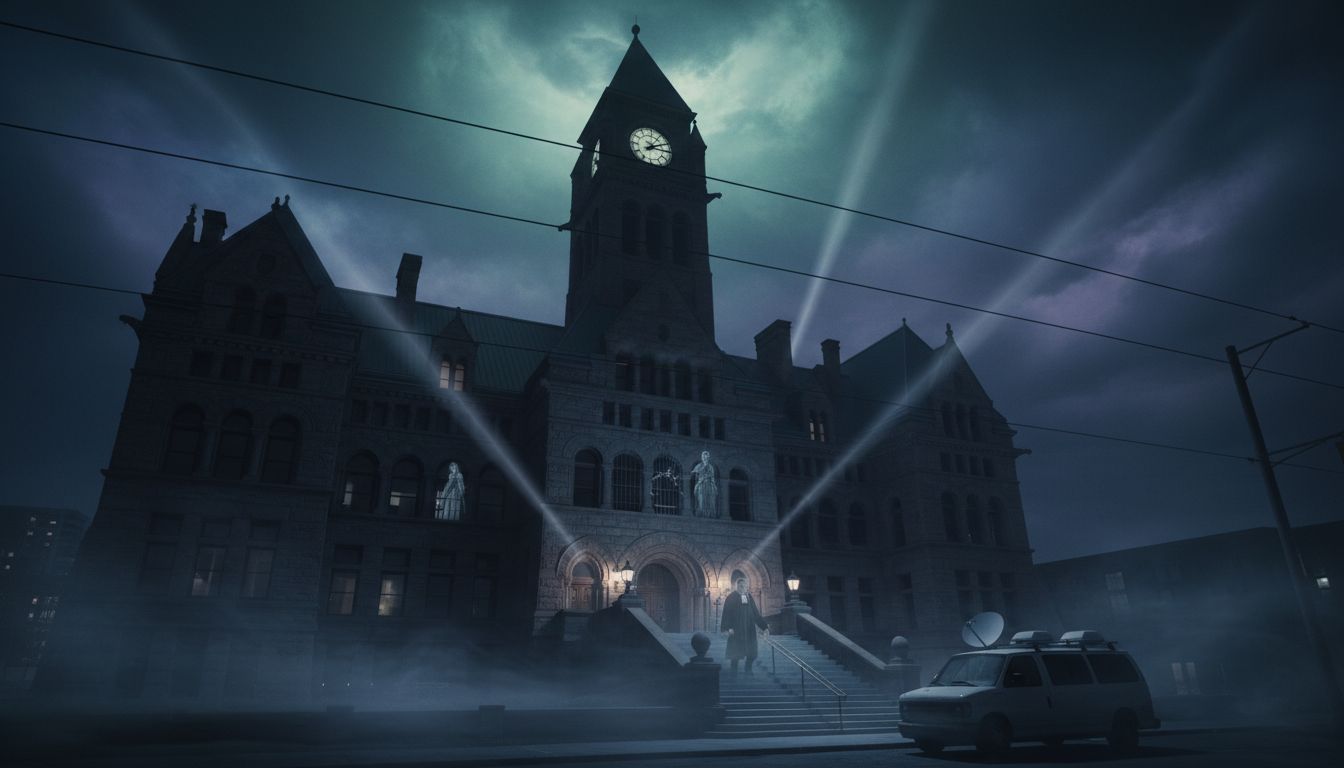
Old City Hall, the Romanesque‑style landmark that dominates the intersection of Queen and Bay, has long been celebrated for its architectural grandeur and civic history. Built between 1889 and 1899 under the direction of architect E.J. Lennox, the 300‑foot clock tower made the structure one of Toronto’s tallest buildings for nearly two decades. Designated a National Historic Site in 1984, the edifice served as the city’s municipal headquarters until 1966 and continues to house courtrooms, municipal offices, and occasional film productions. In recent years, however, the building has attracted a different kind of attention: reports of unexplained noises, apparitions and “phantom judges” have led many to label it one of Toronto’s most haunted sites.
Historical Context
The building’s layered past provides a plausible backdrop for its spectral reputation. Originally replacing an earlier city hall on the same site, Old City Hall functioned simultaneously as a city council chamber, a courthouse, and, for a brief period, a detention facility. The lower levels once contained holding cells for individuals awaiting trial, including several men sentenced to death before capital punishment was abolished in Canada in 1976. Although the last execution in the province occurred at a different location, local lore ties the spirits of those early prisoners to the building’s basement corridors. Architectural features such as the vaulted stairwell—once used by judges in full robes—have become focal points for anecdotal sightings.
Reported Phenomena
Visitors and staff have described a range of experiences that echo classic hauntings. Security personnel note that certain floors feel “unusually cold” after midnight, and some have refused to patrol the basement after hearing “soft footsteps” that stop when approached. A recurring story involves a translucent figure in a judicial robe appearing on the main staircase; witnesses claim the apparition briefly brushes against the banister before vanishing. In addition, faint chanting and the distant clank of a gavel have been reported in courtroom chambers during off‑hours. While these accounts are anecdotal, they have been documented in local paranormal surveys and featured in media segments focusing on Toronto’s historic sites.
Expert Commentary
Historians caution against conflating folklore with documented fact. Dr. Margaret Chen, a professor of Canadian urban history at the University of Toronto, explains, “Buildings that have served multiple civic functions—especially those involving law enforcement and capital cases—often become repositories for collective memory. That memory can manifest as ghost stories, which are a form of cultural expression rather than proof of the supernatural.” Similarly, Toronto Police Service spokesperson Lieutenant Aaron Patel remarks, “Our officers are trained to treat any reports of disturbances seriously, but we have found no evidence of foul play or safety hazards related to these claims.” Paranormal investigators, however, argue that the building’s acoustics and historic architecture can amplify ordinary sounds, creating the illusion of unexplained activity.
Preservation and Public Interest
Despite the eerie narratives, Old City Hall remains a vibrant civic hub. The City of Toronto has undertaken recent renovations to improve accessibility and energy efficiency while preserving the building’s historic fabric. Tours now include a “Heritage and Hauntings” segment, allowing the public to learn about both the architectural significance and the folklore that surrounds the site. As tourism officials note, the blend of history and mystery “draws a diverse audience, from architecture enthusiasts to curious tourists seeking a glimpse of Toronto’s hidden stories.” Whether the reported hauntings are rooted in fact or folklore, they contribute to a broader conversation about how historic spaces are remembered and re‑imagined in contemporary urban life.