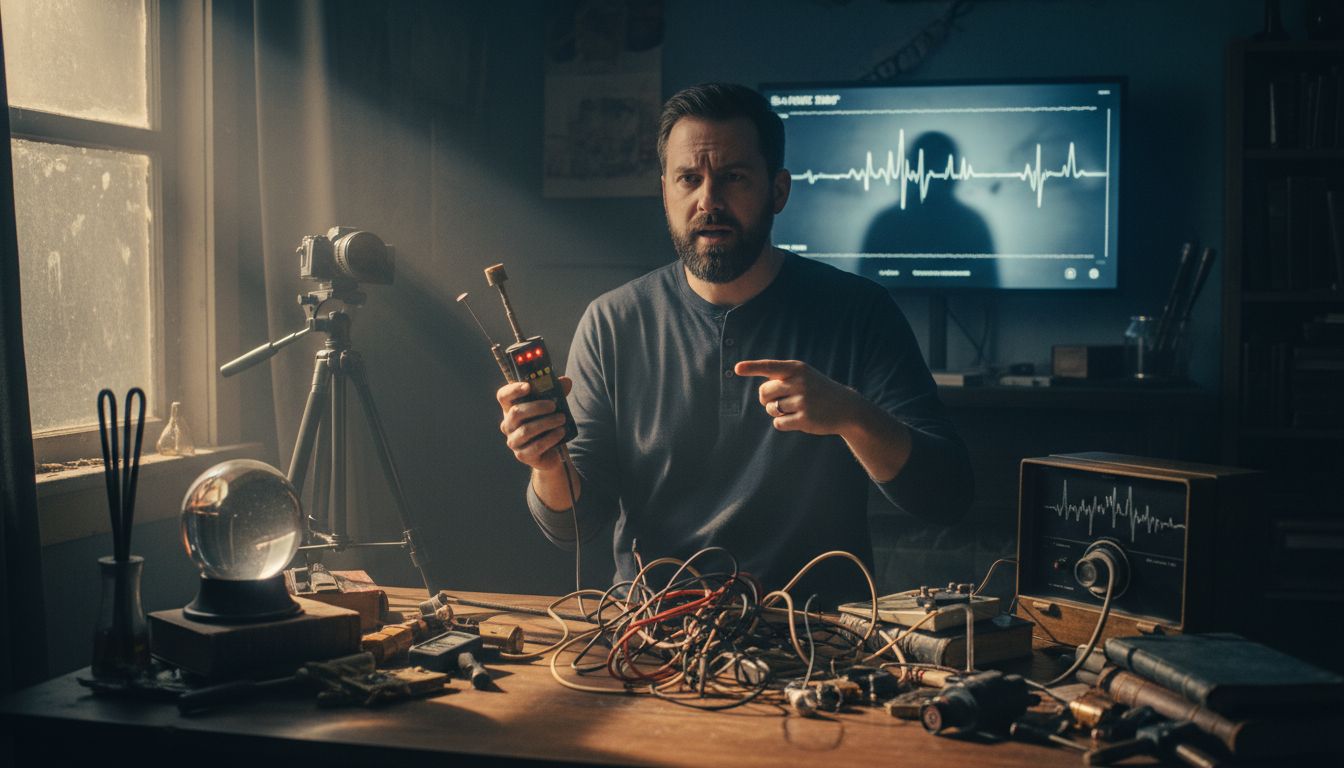
Kenny Biddle, a seasoned skeptic and chief investigator for Skeptical Inquirer magazine, delivered a pointed critique of the gadgets commonly used in paranormal investigations during a recent presentation. Drawing on more than 30 years of experience in investigating extraordinary claims, Biddle highlighted the scientific shortcomings of devices such as electromagnetic field (EMF) meters, which are a staple on popular ghost hunting television shows.
Biddle began by establishing his credentials in the field of skeptical inquiry, noting his long tenure as a writer and his status as a research fellow with the Committee for Skeptical Inquiry (CSI). He emphasized his commitment to promoting critical thinking and scientific literacy, particularly in the face of extraordinary claims involving ghosts, monsters, and other phenomena. "If you don't know what something is, you don't know the qualities of that thing. So if you don't know the qualities, you cannot measure it," Biddle told his audience, setting the stage for his critique of ghost hunting technology.
A focal point of Biddle's talk was the widespread use of EMF meters in paranormal investigations. He explained that the common claim among ghost hunters is that spirits can manipulate or interact with electromagnetic fields, and that spikes in EMF readings are frequently interpreted as evidence of ghostly presence or communication. However, Biddle pointed out that there is no scientific evidence to support the notion that ghosts can affect electromagnetic fields. In fact, he stressed, the very nature of ghosts remains undefined, making it impossible to determine what, if anything, should be measured.
Biddle also addressed the technical limitations of the devices themselves. Most EMF meters used in ghost hunting only measure the strength of a magnetic field, not the full electromagnetic spectrum. Furthermore, these meters typically operate on a single axis, meaning that to obtain an accurate reading, investigators must rotate the device along all three axes—a step rarely observed in televised investigations. "When you see them walk in real quick and just walk around a semicircle and then walk out of the room, they are not doing science. They are doing pseudoscience," Biddle remarked, drawing laughter from the audience.
To illustrate his points, Biddle demonstrated how everyday electrical appliances, such as a refrigerator compressor, can easily cause spikes in EMF readings. He cautioned that interpreting these spikes as evidence of the paranormal is misleading and more likely to result from mundane sources like wiring in the walls. The flawed methodology and misunderstanding of the equipment, Biddle argued, often lead to false positives and reinforce pseudoscientific beliefs.
Throughout his presentation, Biddle encouraged his audience to approach paranormal claims with skepticism and critical thinking, rather than relying on expensive but scientifically unproven gadgets. He concluded by inviting further questions, reaffirming his commitment to public education and open dialogue about investigative methods in the paranormal field.