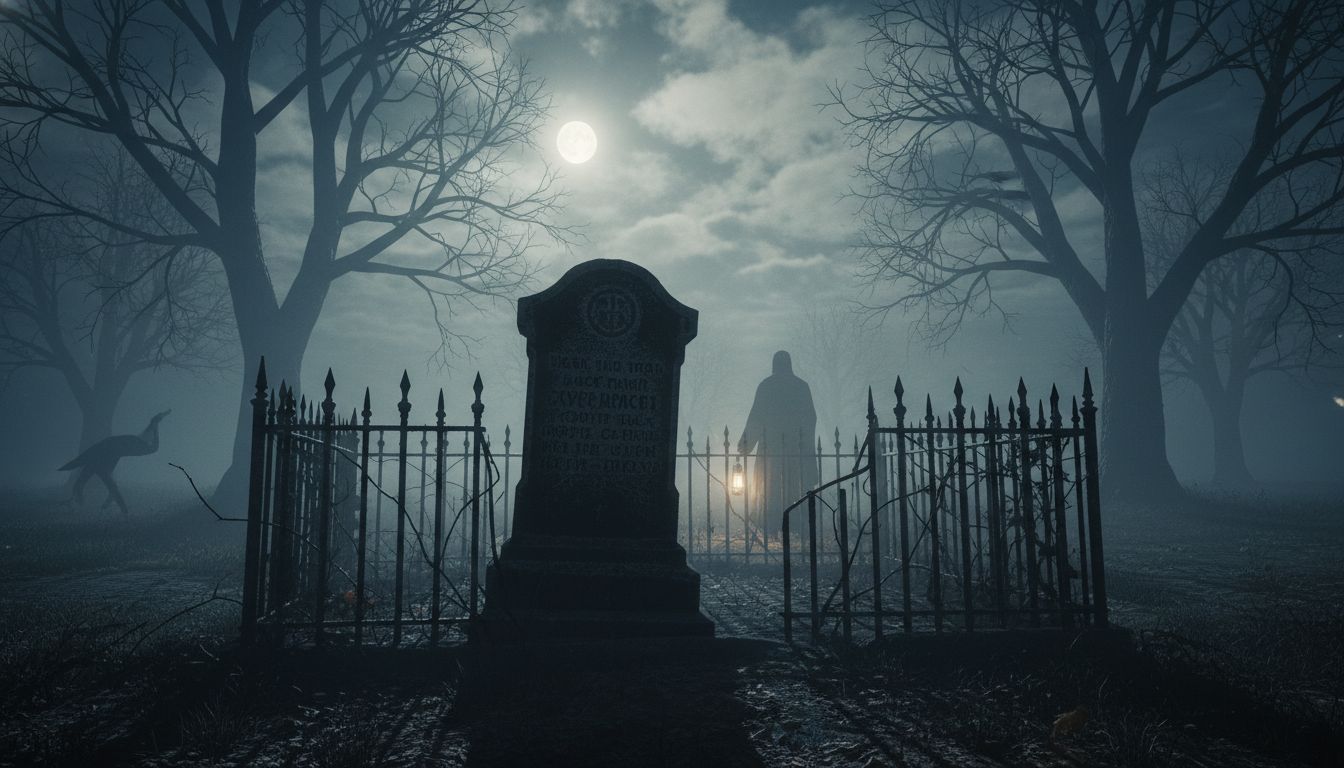
Deep in the woods of West Greenwich, Rhode Island, a modest stone in the Plain Meeting House Cemetery bears an inscription that has haunted locals for more than a century: “I Am Waiting and Watching For You.” The grave belongs to Nellie Louisa Vaughn, who died at age 19 in 1889, yet the line of text has long been misread as a warning from a vampire. Historians now agree the legend grew out of a broader regional panic rather than any evidence of the supernatural, and recent vandalism that removed the original marker has revived the story of a restless spirit seeking to clear her name.
Vaughn’s life and death were unremarkable by the standards of the era. Census records list her family as modest farmers, and her death certificate cites “consumption” – the 19th‑century term for tuberculosis – as the cause. The cryptic epitaph was likely a poetic expression of mourning chosen by her relatives, a common practice in New England cemeteries of the period. However, the grave’s isolation and the eerie wording soon attracted curiosity. By the 1970s, local newspapers reported that the site was “vandalized and shrouded in rumor,” noting that weeds would not grow and the stone appeared to sink into the earth – observations that fed the imagination of ghost‑story enthusiasts.
The misidentification of Vaughn’s grave as a vampire’s tomb is rooted in the infamous Mercy Brown case of 1892, just three years after Vaughn’s burial. In Exeter, Rhode Island, Mercy Brown’s family suffered multiple deaths from tuberculosis, prompting townspeople to exhume her body. They found her heart still full of blood, a finding that was interpreted through the lens of folk belief in “revenant” disease. The community removed her heart and liver, burned them, and gave the ashes to her ailing brother in a desperate attempt to halt the contagion. The episode was widely reported in newspapers across the United States and even abroad, and literary scholars have noted that Bram Stoker likely drew on the Mercy Brown story when crafting Dracula. The sensational coverage created a template for “vampire panic” in New England, where any unexplained death or unusual grave marker could be linked to the undead.
In the decades that followed, the folklore surrounding Mercy Brown spilled over onto other local graves, including Vaughn’s. Oral histories collected by the Rhode Island Historical Society indicate that by the 1930s residents began to whisper that Vaughn’s stone was “the second vampire’s tomb,” despite the absence of any contemporary accusations. “People were looking for a narrative,” said Dr. Helen Carver, a professor of American cultural history at the University of Rhode Island. “When the Mercy Brown story entered the public consciousness, it became a kind of template that was applied retroactively to other mysterious graves.” Carver adds that the epitaph’s ominous tone made it an easy target for reinterpretation.
The most recent chapter in the saga began last summer when vandals toppled Vaughn’s original headstone, removing the inscription entirely. The act sparked a flurry of social‑media posts claiming that “Nellie’s spirit now roams the woods, angry at being mislabeled as a monster.” While no empirical evidence supports the presence of a ghost, the incident underscores how fragile historical memory can be when it is intertwined with folklore. The West Greenwich town council has since approved a replacement marker that restores the original wording and includes a brief note clarifying the historical context, aiming to “respect the deceased and dispel myth.”
The case of Nellie Vaughn illustrates how a combination of 19th‑century medical misunderstanding, sensational journalism, and later cultural reinterpretation can transform an ordinary burial into a legend of the undead. As researchers continue to untangle fact from fiction, the emphasis remains on preserving the factual record: Vaughn was a young woman who succumbed to tuberculosis, not a vampire. The renewed effort to install an accurate headstone serves both as a corrective to decades of mythmaking and as a reminder that the stories we tell about the past often reveal more about our present anxieties than about the individuals they portray.