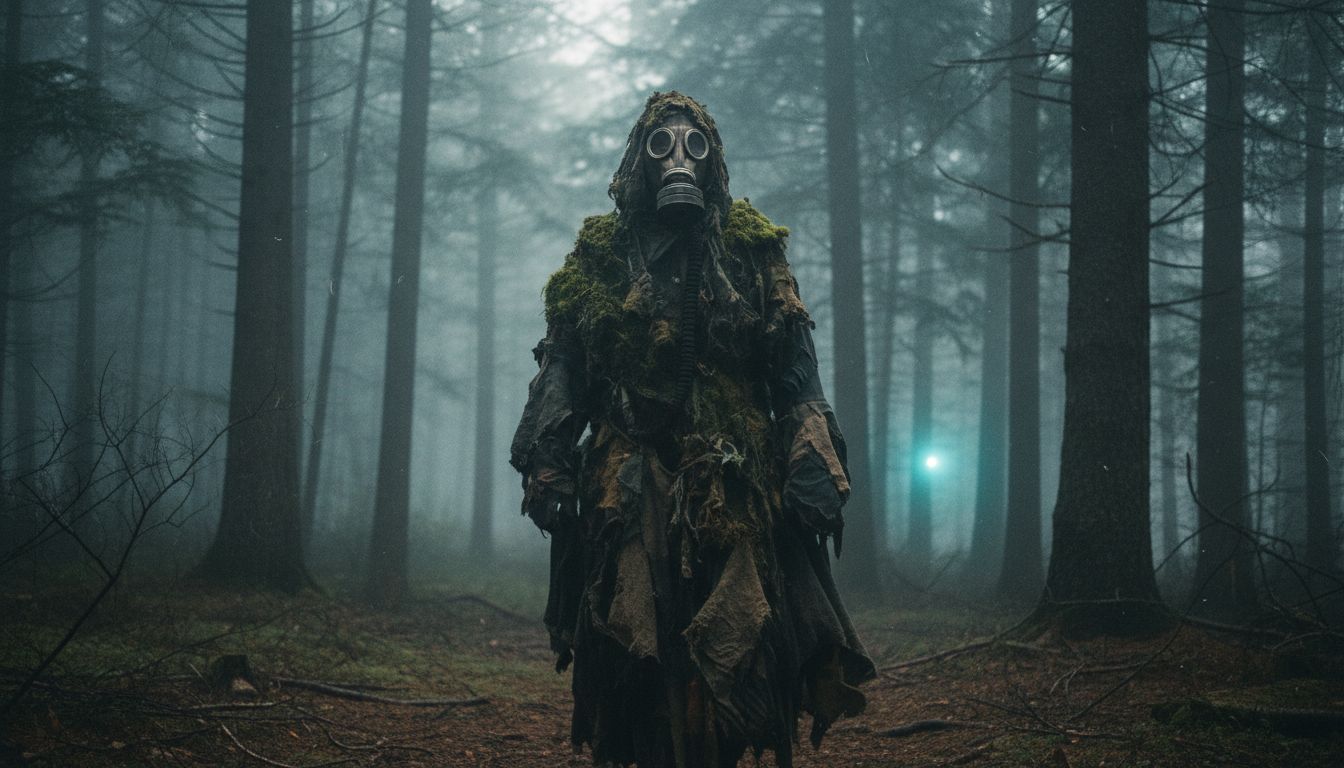
For more than two decades a solitary figure has haunted the forest paths surrounding the hamlet of Maules in the Gruyère district of western Switzerland. Residents and hikers describe the apparition as a tall, silent silhouette clad in an olive‑green, military‑style boiler suit and a dark cloak, its head completely concealed by an antiquated gas mask reminiscent of World War I chemical‑war equipment. The first documented sightings date to 2003, although some locals recall similar encounters as early as the late 1990s. The figure, dubbed “Le Loyon” or the “Ghost of Maules,” has never spoken, chased, or directly interacted with observers; it simply appears at a distance, pauses, and then vanishes into the mist‑shrouded understory.
The recurring nature of the sightings has turned the legend into a modern urban myth. In June 2004, a woman who was gathering wildflowers in a clearing near the trail recounted how the masked individual startled her, dropped her bouquet, and fled without a word. “I thought it was a prank at first, but the mask was old, the suit was heavy,” she told a regional newspaper, adding that the experience left her “with a lingering sense of being watched.” Similar accounts have emerged from hikers who report the figure most often on Sundays, moving along a specific forest path that locals avoid after dark. The consistency of the description—a six‑foot‑plus silhouette, camouflage attire, and the unmistakable gas mask—has reinforced the community’s belief that the phenomenon is more than a fleeting hallucination.
Local authorities have been reluctant to intervene, citing the lack of concrete evidence. The cantonal police have logged the reports but have not opened a formal investigation, noting that no physical traces, such as footprints or discarded items, have ever been recovered. “We treat these calls as we would any missing‑person or trespassing report,” said Inspector Marc Dubois of the Fribourg police department. “Without tangible evidence, the case remains in the realm of folklore rather than criminal inquiry.” Nevertheless, the legend has prompted practical changes: parents advise children to stay away from the woods after dusk, and several hiking clubs have rerouted their trails to bypass the area most associated with Le Loyon.
Experts in Swiss folklore point to a broader cultural context that may explain the endurance of the story. The Gruyère region, known for its medieval towns and world‑renowned cheese, also harbors a rich tapestry of myths involving forest spirits, mountain ghosts, and hidden hermits. Dr. Elise Keller, a professor of cultural anthropology at the University of Lausanne, notes that “the image of a faceless, masked figure taps into deep‑seated anxieties about anonymity and the unknown in a landscape that is both beautiful and isolating.” She adds that similar legends—such as the “Waldmann” of the Black Forest in Germany—often arise in communities where the natural environment is integral to daily life, yet can feel impenetrable.
Skeptics have offered more prosaic explanations. Some suggest that Le Loyon could be a reclusive individual—perhaps a former military personnel or a performance artist—who uses the camouflage suit and gas mask as a personal statement or for environmental protest. The region has seen occasional anti‑logging demonstrations, and a masked presence could serve as a symbolic warning to protect the forest. Others propose that the phenomenon is a case of collective misperception amplified by media coverage; once a story gains traction, subsequent witnesses may interpret ambiguous shapes as the familiar “ghost” they have heard about.
Regardless of its origins, the legend of Le Loyon continues to shape the social fabric of Maules. The figure has become a point of curiosity for tourists, prompting a modest increase in visitor numbers to the nearby Château de Gruyères, while also reinforcing a collective caution that has persisted for generations. As the forest remains cloaked in mist each spring, the silent, masked wanderer endures—whether as a real, albeit elusive, individual, or as a living embodiment of the region’s enduring mythic imagination.