Overview
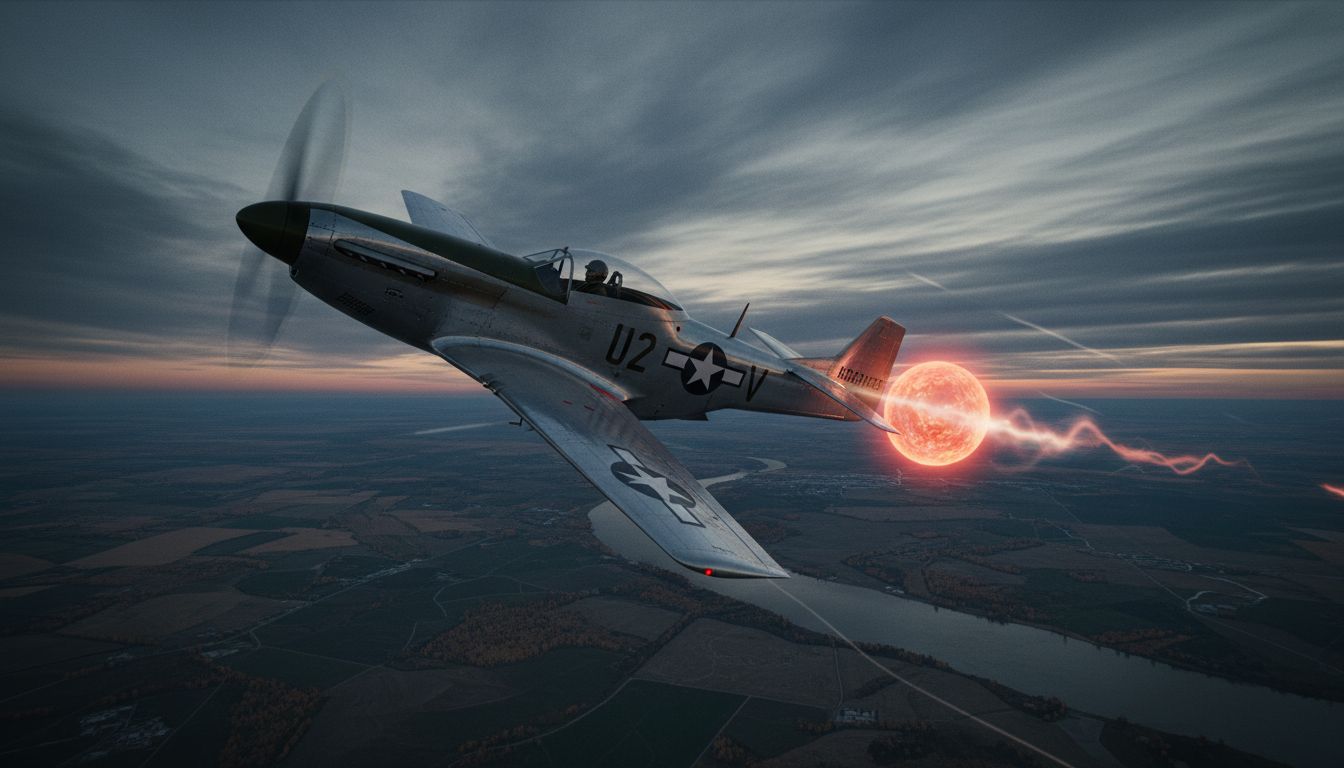
On the night of October 1, 1948, Lieutenant George F. Gorman, a 26‑year‑old U.S. Air Force pilot, was conducting a routine night cross‑country flight in a P‑51 Mustang over Fargo, North Dakota. While cruising at roughly 4,500 feet, he reported seeing a small, bright point of light on the horizon that soon proved to be far from ordinary. The encounter, now known as the Gorman UFO dogfight, lasted 27 minutes and has remained one of the most detailed pilot‑reported UFO sightings from the early Cold War era.
Encounter Details
According to Gorman’s after‑action debrief, the object initially appeared as a “small bright light” about six to eight inches in apparent diameter, emitting a white glow surrounded by a faint halo that illuminated nearby clouds. As he altered his course to investigate, the light began to move erratically—darting side‑to‑side, ascending and descending almost instantaneously, and responding to his own maneuvers. Gorman accelerated his Mustang to approximately 350 mph, a speed well within the aircraft’s capabilities, yet the orb matched every change in heading and altitude without visible propulsion, wing surfaces, or exhaust.
Radio transmissions captured during the flight show Gorman’s growing concern:
“Tower, this is Mustang 503, I’ve got a visual on a strange light at ten o’clock, about two miles, moving fast. Confirm you see anything?”
The tower replied with uncertainty, reporting no radar contacts. Throughout the 27‑minute “dogfight,” Gorman described the orb as “dancing around the sky,” alternating between hovering, rapid vertical climbs, and sudden lateral shifts that would have required extreme g‑forces for any conventional aircraft of the period. Ground observers also reported a moving light, but none experienced the close‑range interaction that Gorman described.
Official Investigation
The incident was forwarded to Project Blue Book, the Air Force’s official UFO study group. In its 1969 report, the project classified the sighting as “unidentified,” noting that radar data from Hector Field showed no corroborating contacts and that the description did not match any known aircraft or weather balloon trajectories. Some analysts within Blue Book suggested the possibility of a misidentified weather balloon or a celestial phenomenon, but the report also recorded Gorman’s own strong disagreement with that assessment, emphasizing the object’s rapid accelerations and silent operation—characteristics inconsistent with known balloon behavior.
Context and Significance
Gorman’s encounter occurred during a period of heightened military vigilance, just months after the Roswell incident and amid growing public fascination with aerial mysteries. Unlike many civilian reports, this case involved a trained fighter pilot, a high‑performance aircraft, and documented radio communication, lending it a degree of credibility that has kept it in scholarly discussions for decades. Researchers such as Dr. Jacques Vallée have cited the Gorman dogfight when arguing that some mid‑20th‑century sightings exhibit flight dynamics beyond contemporary technology, while skeptics point to the lack of physical evidence and the possibility of optical illusion under night‑flight conditions.
Ongoing Debate
More than seven decades later, the Gorman UFO dogfight continues to be referenced in both academic and popular UFO literature. The National Archives hold the original Blue Book files, which have been digitized for public access, allowing new analysts to re‑examine the flight logs, pilot statements, and tower transcripts. Some modern investigators propose that the phenomenon could represent a sensor‑based anomaly—for example, a high‑altitude ionized plasma event—while others maintain that the encounter remains an unexplained aerial phenomenon (UAP) that warrants further study, especially in light of recent Pentagon UAP disclosures.
Regardless of interpretation, Lieutenant Gorman’s 1948 flight stands as a well‑documented, pilot‑firsthand account that challenges conventional explanations and underscores the enduring mystery surrounding unidentified aerial encounters.