Overview
The National Museum of Ireland – Decorative Arts & History now occupies the former Collins Barracks on Dublin’s historic Dún Uí Choileáin site. While the museum showcases centuries‑old artefacts, a parallel narrative persists: staff and visitors repeatedly report unexplained sounds and fleeting silhouettes that they attribute to the complex’s long military past. The claim that “ghosts of war” still linger has become a recurring theme in local folklore and recent media coverage, prompting both curiosity and cautious inquiry from heritage professionals.
A Site Steeped in Military History
Constructed in 1702 as the Royal Barracks, the stone‑walled compound served as the headquarters for British garrisons for more than two centuries. In 1922 the facility was transferred to the Irish Free State and renamed Collins Barracks after Michael Collins, the newly appointed commander‑in‑chief of the Irish Army. Over its operational life the barracks witnessed recruitment drives, parade drills, and the tragic loss of soldiers during the Napoleonic Wars, the Crimean conflict, and the First World War. The sheer volume of personnel—estimated at several thousand over the centuries—has left an indelible imprint on the architecture, from the vaulted courtyards to the east‑wing storage rooms now repurposed for museum collections.
Contemporary Accounts of Anomalous Activity
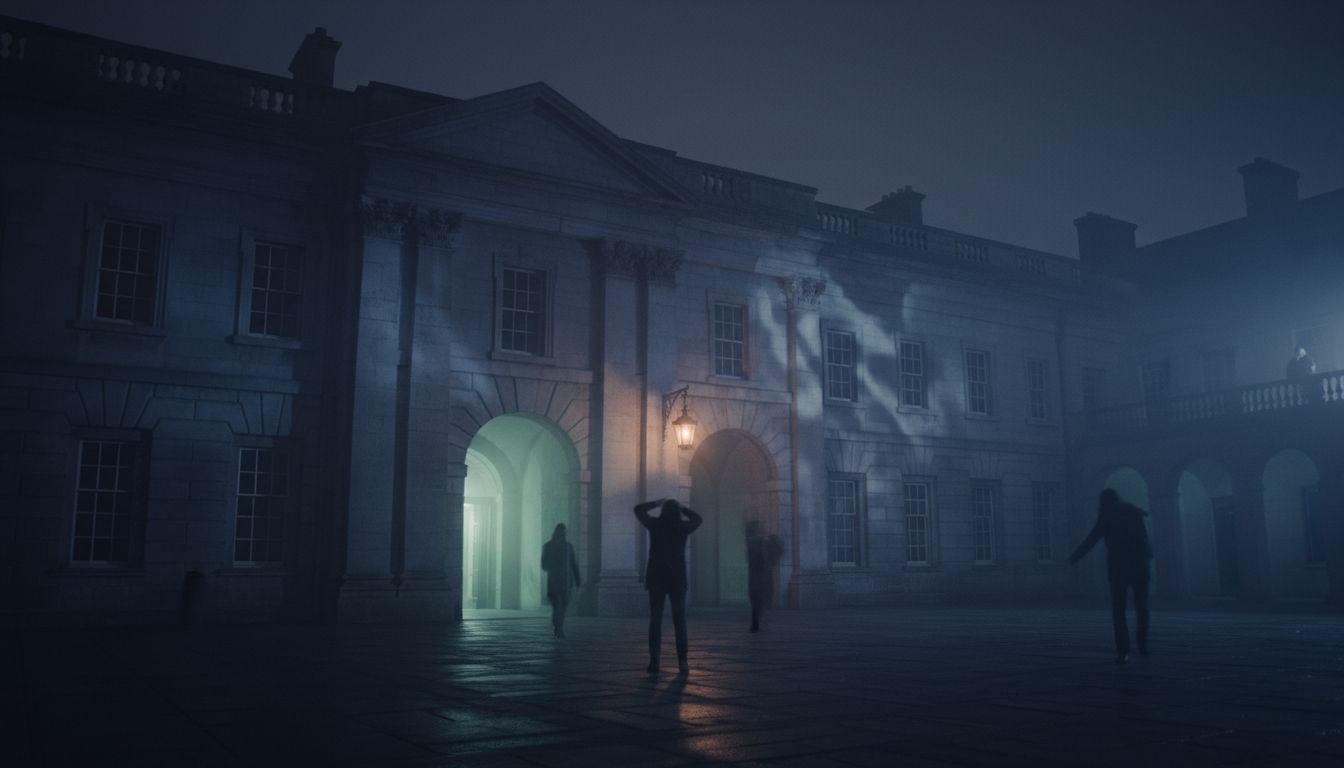
In recent months, night‑shift security officers and occasional museum guests have described phenomena that echo the site’s martial heritage. One guard, speaking on condition of anonymity, recounted hearing “the heavy tread of unseen boots marching through the courtyards” during otherwise silent evenings. Another visitor reported “the sound of horses snorting and hooves striking stone” near a former stables area that no longer exists. Several truck drivers delivering artefacts claim to have seen “spectral soldiers in Napoleonic uniforms, their faces pale beneath the moonlight, patrolling the grounds as if still under orders.” Although these anecdotes lack corroborating audio‑visual evidence, they are documented in the museum’s internal incident log, which now includes a dedicated “unusual occurrences” entry.
Historical Echoes: The 1925 Phantom March
The notion of hauntings at Collins Barracks is not a modern invention. The Christmas 1925 edition of the Irish Army newspaper An t‑Óglach published a first‑hand account of an officer on night duty who observed “ranks of ghostly British soldiers assembling in the courtyard, preparing to march away.” According to the report, the phantoms fell into step and vanished toward the gates, “returning to Blighty.” A separate, frequently cited story describes a “Quartermaster”—a British officer from the First World War—appearing solidly in the east wing before dissipating into the cold air. These early 20th‑century narratives provide a historical baseline that contemporary witnesses often reference when describing their own experiences.
Context, Response, and Ongoing Interest
Heritage professionals at the National Museum acknowledge the folklore but stress that the primary mission remains the preservation and interpretation of Ireland’s material culture. Dr. Siobhán McKenna, a historian specialising in military sites, notes, “Buildings with such layered histories naturally attract stories that blend memory and imagination. While we have no empirical proof of paranormal activity, the accounts reflect a collective connection to the past.” The museum has instituted a discreet “quiet‑hours” protocol, allowing staff to report any disturbances without disrupting visitors. Meanwhile, paranormal researchers continue to catalogue the site’s reports, adding Collins Barracks to a growing inventory of historically significant locations where folklore and heritage intersect. Whether the sounds are echoes of stone or remnants of memory, the dialogue between history and legend endures, ensuring the former barracks remains a focal point for both scholarly study and public intrigue.