Overview
Near the historic farm of Foss á Síðu in southern Iceland, a spectral canine known locally as the Hörgsland‑Móri is said to have haunted a single family for nine generations. The legend, which dates back to the 17th‑century settlement era, continues to surface in eyewitness accounts and local folklore, keeping the story alive for residents and visitors alike.
Historical Context
Foss á Síðu, a farm that traces its roots to the 9th‑century Viking settlement of Iceland, is famed for the nearby waterfall that can appear “upside‑down” when wind thins the flow. The region’s oral tradition is rich with tales of Móri—male vengeful spirits traditionally described as rust‑brown in clothing. Unlike ordinary ghosts, a Móri is believed to be a resurrected soul seeking retribution, a concept that parallels the older Fylgja and Draug classifications. The female counterpart, called a Skotta, is rarely mentioned in the Foss á Síðu narratives.
The Legend of Hörgsland‑Móri
According to the most detailed version, the haunting began with Oddur Árnason, a priest at Arnarbæli from 1676 to 1689, and his wife Katrín, daughter of Reverend Jón Daðason. The couple’s children—including a daughter named Ingibjörg—experienced a tragic winter when Oddur attempted to cross the frozen river and never returned. Local lore holds that Oddur’s unresolved death gave rise to a Móri spirit that later became attached to the Berg family, who inherited the farm. The spirit was dubbed Hörgsland‑Móri or Bergs‑Móri because it was believed to have followed Reverend Bergur, the last Berg family member residing at Hörgsland, to Foss á Síðu.
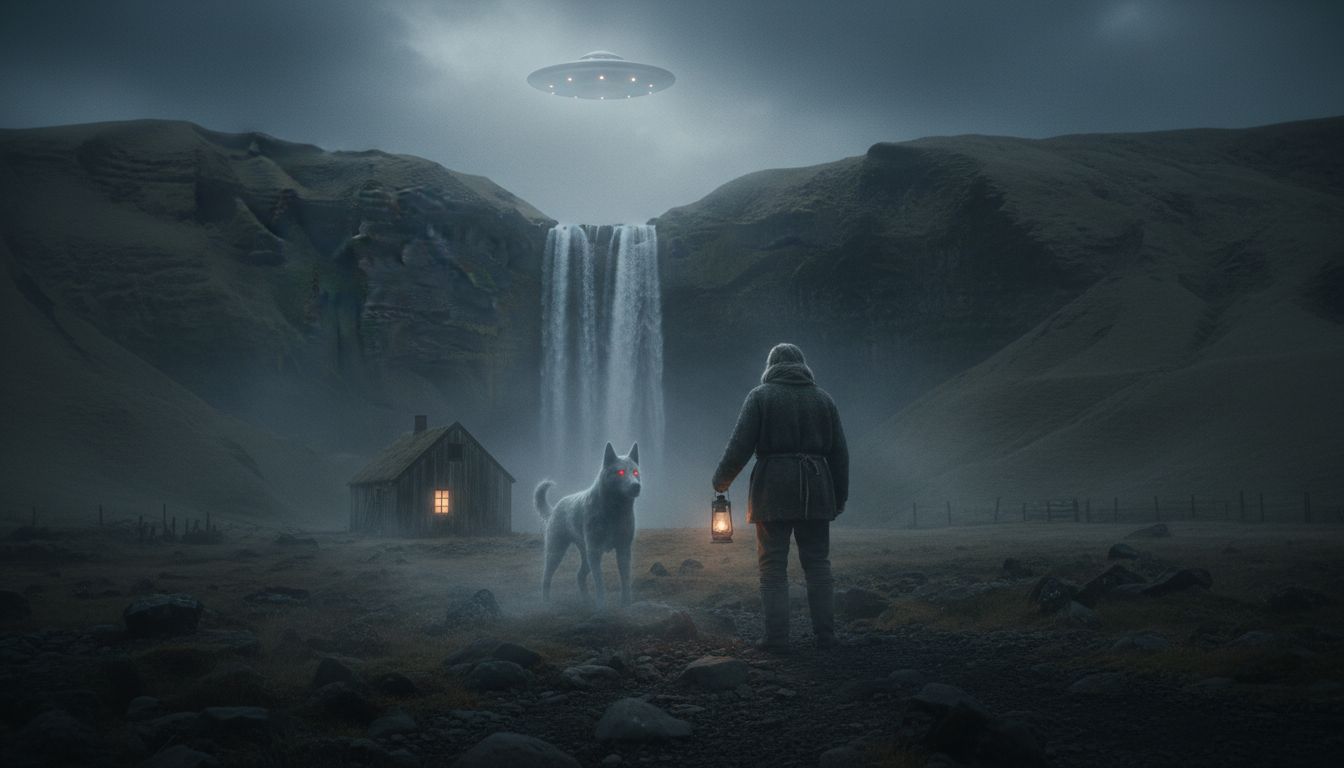
The ghost is described as a large, rust‑colored dog that roams the farmyard and the mist‑shrouded waterfall. Over the centuries, the tale has been passed down through nine generations of the same lineage, each reporting sightings of a lone canine silhouette disappearing into the spray or leaving faint, paw‑print‑like impressions on the wet rocks.
Contemporary Reports
In recent months, tourists and local farmers have reported brief encounters with the phantom dog. Einar Jónsson, a third‑generation farmer at Foss á Síðu, told our correspondent, “We hear a low growl on windy evenings, and sometimes a shape flickers near the water. It’s never aggressive, but it feels like a reminder of the past.” Similarly, Sigríður Ásgeirsdóttir, a guide who leads hikes to the waterfall, said, “Visitors often ask about the ‘ghost dog.’ I tell them it’s part of the farm’s heritage, and a few claim they’ve seen a shadowy figure moving along the mist.”
No physical evidence—such as photographs or measurable phenomena—has been documented, and the Icelandic police have not opened any investigations. Nevertheless, the story contributes to the region’s growing reputation as a destination for folklore tourism, alongside other Icelandic legends like the Huldufólk (hidden people).
Expert Insight
Folklorist Dr. Guðmundur Þórsson of the University of Iceland notes that the Hörgsland‑Móri exemplifies how personal tragedy can evolve into communal myth. “When a community experiences a loss that cannot be explained, the narrative often takes on a supernatural form,” he explains. “The Móri motif appears in several Icelandic sagas, serving both as a cautionary tale and as a way to keep family histories alive.” Dr. Þórsson adds that the persistence of the story may also reflect Icelanders’ deep connection to the landscape, where natural features like waterfalls are imbued with cultural meaning.
What Lies Ahead
As interest in Icelandic folklore grows, the Hörgsland‑Móri may see renewed attention from both scholars and tourists. While the tale remains unverified by scientific means, it continues to shape the identity of Foss á Síðu and its inhabitants. For the Berg descendants and the wider community, the spectral dog is less a source of fear and more a living reminder of centuries‑old lineage, woven into the mist that crowns the waterfall each day.