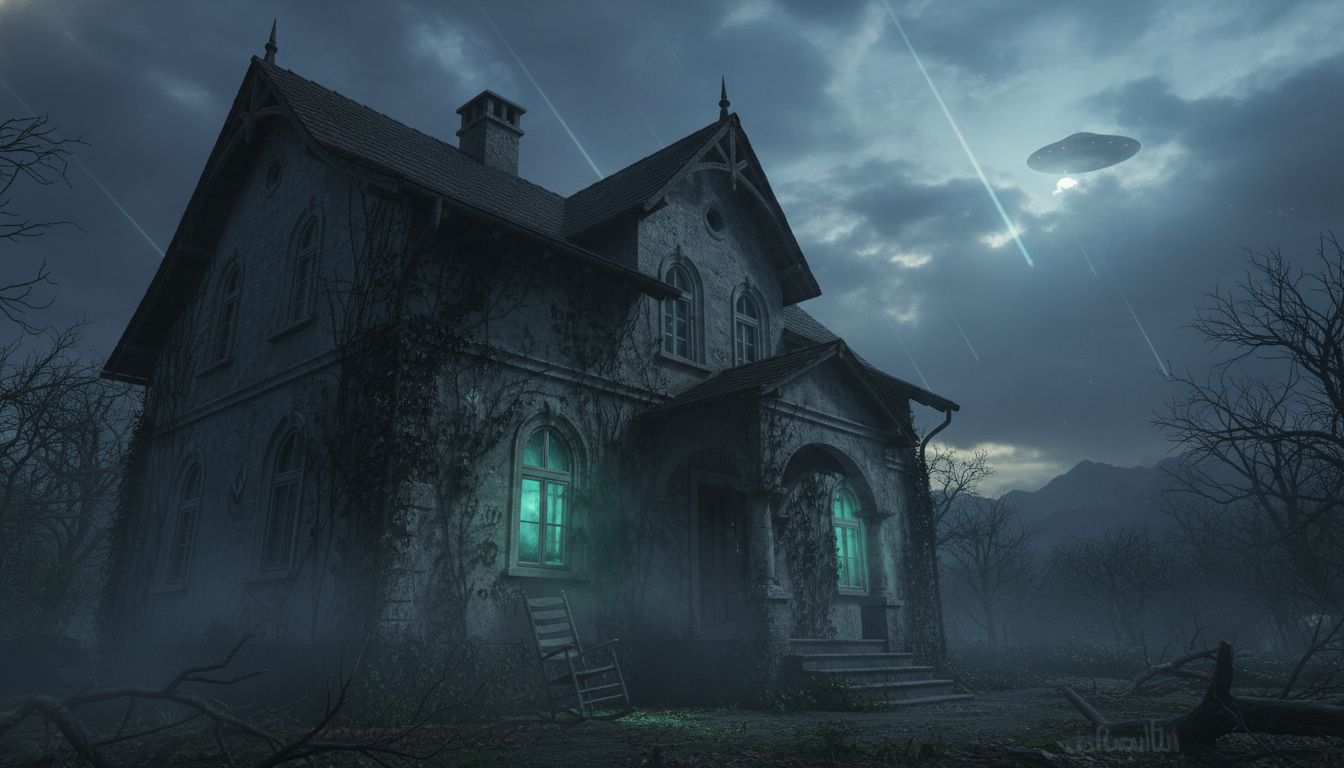
The Joller House on the outskirts of Stans, a modest 19th‑century farmhouse, entered the annals of Swiss folklore after a series of unexplained noises drove the family of lawyer‑archivist Melchior Joller from the town in the mid‑1840s. Contemporary reports, preserved in the Nidwalden State Archives, describe a pattern of “violent knocking and scratching” that seemed to emanate from within the walls themselves. Joller, a respected local official who also served a brief term in the National Suisse, documented the disturbances in a pamphlet titled Darstellung selbsterlebter mystischer Erscheinungen (“Narrative of Personally Experienced Strange Phenomena”), noting that the sounds occurred at irregular intervals, often during the night, and intensified when family members were present in the same room. The pamphlet, published in 1846, was circulated among a small circle of liberal intellectuals and has become a primary source for historians studying the case.
The family’s ordeal coincided with a period of political tension in Nidwalden. Joller’s liberal newspaper had attracted criticism from the Catholic clergy, and his marriage to Karoline Wenz in 1842 placed him at the center of a growing social network that was increasingly polarized. Some contemporary observers suggested that the stress of public scrutiny may have amplified the family’s sensitivity to ordinary house noises. “When a household is under constant pressure, even the creak of timber can be magnified into something ominous,” noted Dr. Elisa Keller, a cultural historian at the University of Zurich, who has examined the Joller files. Keller’s assessment reflects a broader scholarly view that psychological strain often plays a role in reported hauntings, especially in tightly knit communities where reputation carries significant weight.
Physical investigations of the building, undertaken after the house was listed for demolition in the early 2000s, revealed a complex structural history that could account for many of the reported phenomena. The farmhouse was originally constructed in the late 18th century by Joller’s grandmother, Veronika Gut, using timber frames and a stone foundation typical of the region. Over the decades, renovations introduced a series of hollow wall cavities and a network of ventilation shafts that, when exposed to wind or temperature fluctuations, produced resonant knocking sounds. An engineering report commissioned by the Stans municipality in 2008 concluded that “the acoustic amplification within the cavity walls, combined with seasonal wood expansion, is sufficient to generate the irregular percussive noises described in the 1840s accounts.” Nevertheless, the report also acknowledged that the precise timing of the sounds—often aligning with family arguments or political events—could not be fully explained by structural factors alone.
The Joller case has attracted attention from both paranormal researchers and skeptics. The Swiss Society for the Study of Unexplained Phenomena (SSSUP) conducted a limited field study in 2009, deploying motion‑sensitive microphones and infrared cameras in the empty lot where the house once stood. While the equipment recorded occasional low‑frequency thuds, the investigators could not link these to any supernatural source, and the data were later deemed inconclusive. “We must differentiate between unexplained and unexplainable,” said Dr. Hans Meier, lead researcher for the SSSUP, emphasizing that the lack of definitive evidence does not confirm a paranormal cause.
Despite the demolition of the Joller House in 2010, the story persists in local memory and academic discourse. The incident remains one of Switzerland’s earliest documented poltergeist reports, illustrating how architectural quirks, personal stress, and historical context can intertwine to create a lasting mystery. As archival material continues to be digitized and interdisciplinary studies expand, the Joller haunting serves as a reminder that some historical phenomena resist tidy explanations, inviting both rigorous inquiry and cautious curiosity.