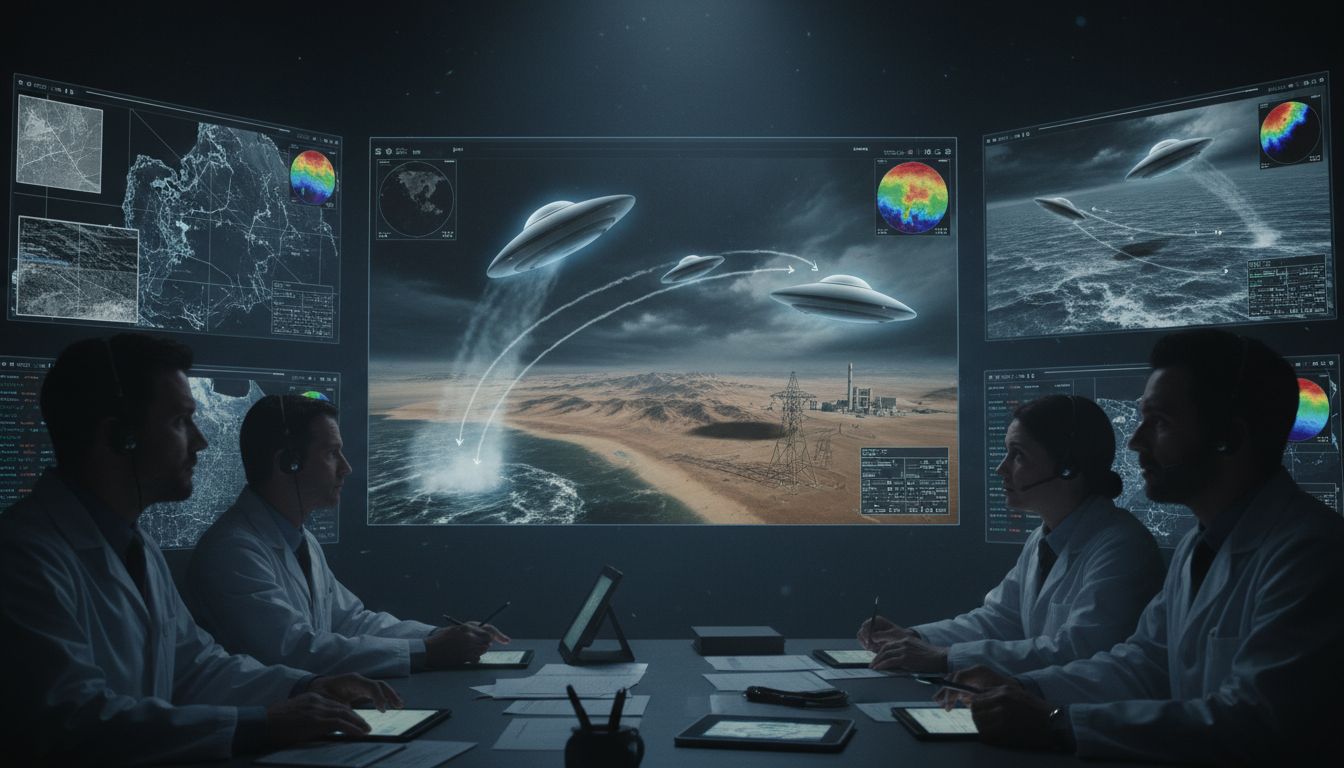
In the past two years, a series of high‑resolution satellite observations have added a new dimension to the study of unidentified aerial phenomena (UAP). Instruments such as PlanetScope’s 3‑meter optical array and the Geostationary Operational Environmental Satellite (GOES) series have recorded three distinct events that stand out for their flight characteristics: a luminous sphere over the central Pacific on 12 January 2023, a silent triangular formation above northern Canada on 24 February 2023, and a cylindrical object traversing the Mediterranean on 15 March 2023. In each case, the objects displayed rapid acceleration, maneuverability, or thermal signatures that do not correspond to known aircraft, weather systems, or space debris, prompting a formal review by the National Oceanic and Atmospheric Administration (NOAA) and partner agencies.
NOAA’s UAP task force, established in 2022 after congressional pressure for greater transparency, has applied machine‑learning classifiers to terabytes of archived imagery to flag anomalies that deviate from expected patterns. Dr. Elena Morales, senior atmospheric scientist at NOAA, explained that “the algorithms look for sudden changes in reflectance, velocity vectors, and thermal gradients that cannot be accounted for by conventional meteorological or aeronautical sources.” The Pacific sphere, for example, accelerated from a stationary position to a speed of roughly 2 km s⁻¹ within a span of three seconds, all while emitting a faint infrared glow that suggested an internal heat source yet showed no exhaust plume. Similarly, the Canadian triangular craft maintained a constant altitude of 25 km, moving silently across a region of dense cloud cover, and the Mediterranean cylinder performed abrupt 90‑degree turns and momentary stops that would generate extreme g‑forces if achieved by known propulsion methods.
To corroborate the satellite data, NOAA cross‑referenced the sightings with ground‑based reports and radar logs. In the Pacific case, a commercial airliner on a nearby route logged a brief loss of signal at the same timestamp, though pilots reported no visual contact. In northern Canada, a network of aurora monitoring stations recorded a brief spike in electromagnetic interference concurrent with the satellite’s visual detection of the triangular object. The Mediterranean event coincided with a maritime vessel’s log noting an unexplained “bright, elongated shape” hovering near the horizon for approximately 45 seconds. While these ancillary data points do not constitute definitive proof of an extraterrestrial origin, they reinforce the need for systematic investigation.
The scientific community remains cautious. Dr. Michael Chen, aerospace engineer at the University of Colorado Boulder, emphasized that “extraordinary claims require extraordinary evidence.” He noted that atmospheric phenomena such as ball lightning, rare plasma formations, or classified hypersonic tests can sometimes mimic the visual signatures captured by space‑based sensors. Nonetheless, the consistency of rapid acceleration without observable thrust, silent high‑altitude operation, and abrupt directional changes across three geographically disparate events suggests that conventional explanations are insufficient without further data. Researchers are now employing spectroscopy to analyze the objects’ emitted wavelengths, hoping to identify material composition or energy signatures that could rule out known technologies.
The broader implications of these satellite‑detected UAPs extend beyond the immediate mystery. If future analyses confirm that the observed objects operate on principles outside current aeronautics, they could inform propulsion research, materials science, and even national security policy. Conversely, a rigorous attribution to terrestrial sources would underscore the value of satellite surveillance in cataloguing rare atmospheric events. As NOAA continues to refine its detection pipelines and share findings with the scientific community, the agency’s approach exemplifies a measured balance between open inquiry and methodological rigor, keeping the conversation grounded in evidence rather than speculation.


