In the early 19th century, the New England countryside was gripped by a series of “vampire panics” that blended medical mystery with folk superstition. While the most widely publicized cases—such as Mercy Brown of Rhode Island and Sarah Tillinghast of Exeter, New Hampshire—have entered the broader folklore canon, a lesser‑known episode unfolded on a farm straddling the Rhode Island–Connecticut border in the town of Foster. According to a recent feature on the Moon Mausoleum website, the Young family’s tragedy began when their eldest daughter, Nancy Young, died of consumption (now identified as tuberculosis) on 6 April 1827 and was interred in a newly walled burial plot adjacent to the homestead.
Within months of Nancy’s burial, other members of the Young household—including her sister Almira—developed the same wasting symptoms that had claimed Nancy. Contemporary observers, lacking an understanding of germ theory, interpreted the pattern as evidence of a post‑mortem predator. “They believed she was sucking the life out of her siblings,” the article notes, reflecting a common belief in New England that a deceased relative could feed on the vitality of the living from beyond the grave. The fear was not merely anecdotal; it prompted tangible action. Levi Young, the family patriarch, reportedly caught his daughter in a moment of apparent improvement, only to have the illness return, reinforcing the conviction that an unseen force was at work.
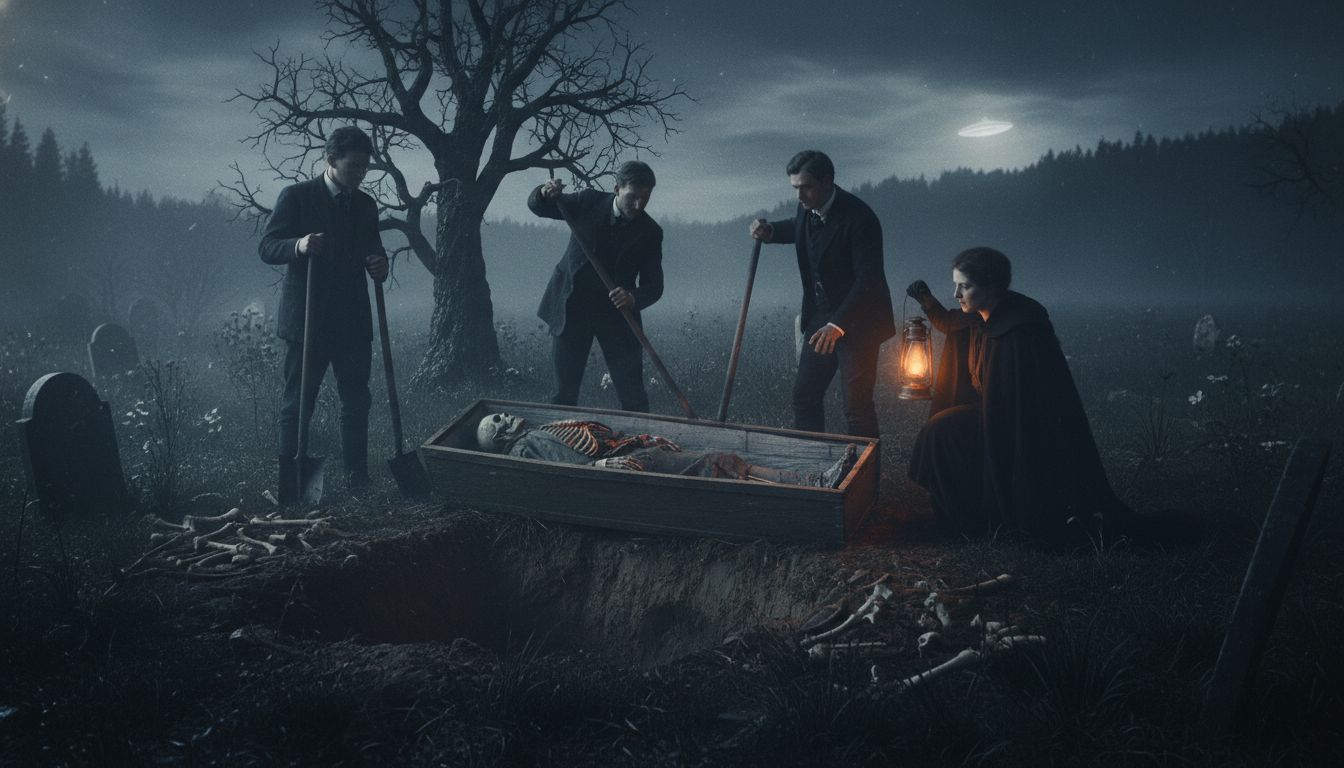
Faced with a succession of unexplained deaths, the Youngs turned to a practice that had become a ritual response in the region: exhumation. In 1828, local lore records that Levi Young ordered the disinterment of Nancy’s corpse. The body was examined for classic signs of vampirism—such as fresh blood at the mouth or a lack of decomposition—before it was taken to a fire and burned, a method intended to sever any alleged supernatural connection. This act mirrors the handling of Mercy Brown’s remains in 1892, where neighbors also burned the body to halt what they perceived as a curse. Both incidents illustrate how communities substituted ritual for medical intervention when faced with an epidemic that modern science now attributes to Mycobacterium tuberculosis.
Historians of American folklore emphasize that these “vampire” responses were rooted in a convergence of poverty, limited healthcare, and the cultural transmission of European superstitions. Dr. Emily Harrington, a professor of early American history at Brown University, explains that “the fear of the dead feeding on the living was a way to make sense of a disease that seemed to jump from person to person without any visible cause.” In rural Rhode Island, where families like the Youngs relied on subsistence farming and had minimal access to physicians, the line between illness and the supernatural was especially thin.
The story of Nancy Young, while lacking the extensive documentation of other New England cases, provides a poignant snapshot of how desperation can shape collective belief. The Moon Mausoleum article, which draws on local oral histories and period newspaper snippets, underscores that the Young family’s decision to burn their daughter’s remains was not an isolated act of hysteria but part of a broader pattern of community‑driven attempts to control an invisible killer. As modern scholarship continues to dissect these episodes, they serve as reminders of the human impulse to seek agency in the face of disease—a lesson that resonates amid today’s own public‑health challenges.