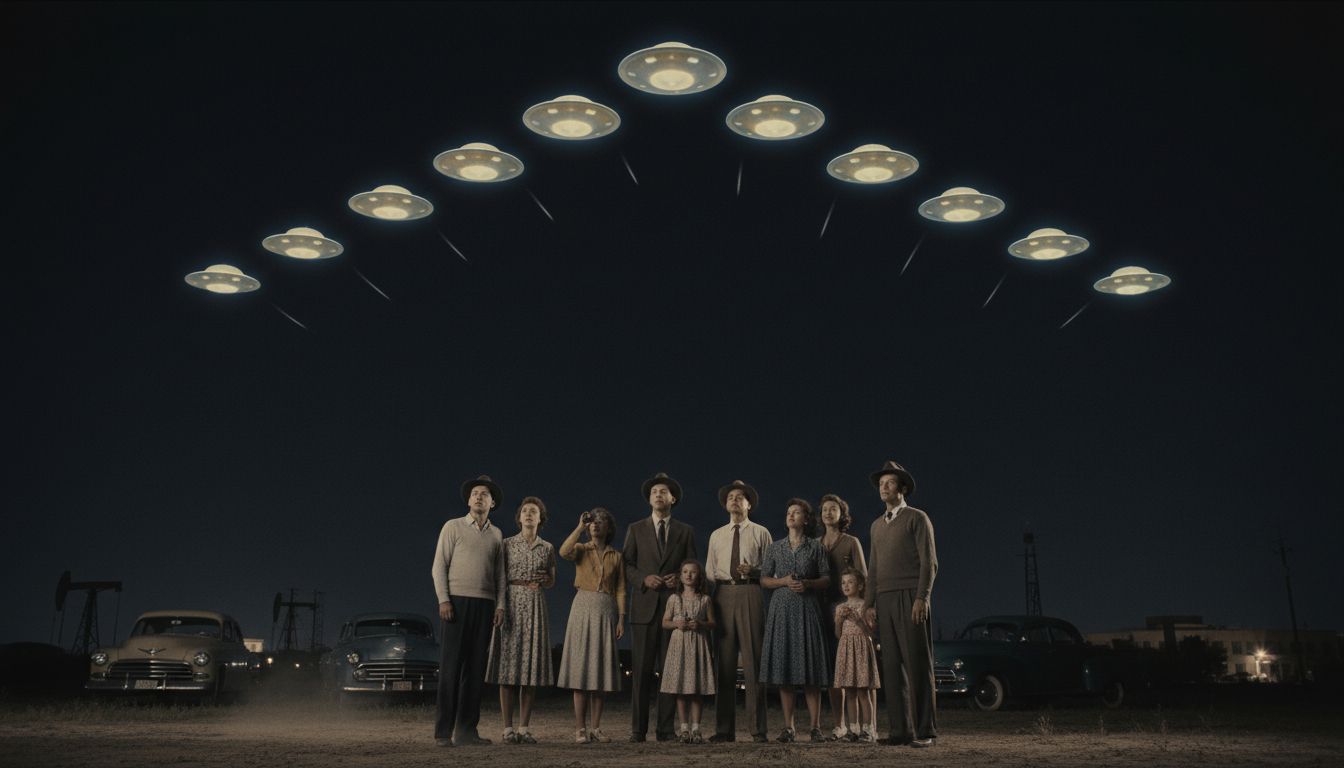
In late August 1951 a series of synchronized lights crossed the night sky over Lubbock, Texas, drawing the attention of both the local community and the United States Air Force. The first documented sighting occurred on the evening of August 25 when three Texas Technological College professors—Dr. W. I. Robinson, Dr. A. G. Oberg and Dr. W. L. Ducker—were discussing meteor activity in a backyard when they observed a semi‑circular formation of fifteen to thirty bluish‑green lights. “They were as bright as stars, yet noticeably larger,” Robinson later recalled in an interview with the Air Force investigators. The formation moved silently at an estimated speed of more than 600 mph (970 km/h) at an altitude of roughly 2,000 feet, according to the professors’ calculations, a performance that did not match any known aircraft or natural phenomenon at the time.
The incident quickly gained wider visibility when Carl Hart Jr., a freshman at Texas Tech, captured five photographs of the phenomenon on August 30 using a standard Kodak 35 mm camera. The images, which showed distinct rows of luminous dots arranged in a tight, orderly pattern, were reproduced in national outlets, including Life magazine, and became some of the most widely circulated UFO photographs of the 1950s. Even skeptics noted the unusual symmetry and clarity of the shots, prompting the Air Force’s Project Blue Book to dispatch a team led by Captain Edward J. Ruppelt to Lubbard for a formal investigation.
Project Blue Book’s field investigators interviewed dozens of witnesses, many of whom were students, teachers and local residents who reported seeing similar light formations on subsequent evenings. The professors’ scientific backgrounds gave the case a level of credibility that distinguished it from many other contemporary sightings. Ruppelt’s report concluded that the lights could not be readily identified; they were too fast for conventional aircraft and their color and shape did not correspond to known atmospheric events. The Air Force ultimately offered a tentative explanation that the lights were reflections from the undersides of night‑flying plover birds illuminated by newly installed streetlights. This hypothesis was met with strong resistance from the witnesses, who described the objects as “too bright, too synchronized, and moving too uniformly to be birds,” a sentiment echoed in a letter from Dr. Oberg to the Air Force in September 1951.
The Lubbock Lights have remained a focal point for a range of alternative theories. Some researchers have suggested that the lights were the result of secret military tests, pointing to the proximity of several Air Force bases and the heightened security environment of the early Cold War. Others have explored atmospheric explanations, such as ball lightning or ionized air columns, though these phenomena typically lack the sustained, orderly motion reported by witnesses. UFO investigators, meanwhile, have highlighted the precision of the formation as indicative of controlled flight, arguing that the case represents one of the earliest documented encounters with a potentially extraterrestrial craft. Despite decades of analysis, no definitive evidence has emerged to confirm any single theory.
The Lubbock Lights episode is frequently cited in ufology as a benchmark case because it combined credible, educated witnesses, contemporaneous photographic documentation, and a formal government investigation. It also illustrates the methodological challenges that persist when evaluating anomalous aerial phenomena: the need to balance eyewitness testimony, physical evidence and the limits of contemporary technology. As Project Blue Book’s archives continue to be examined by historians and scientists, the Lubbock incident serves as a reminder that even well‑documented sightings can resist easy classification, leaving the question of what illuminated the Lubbock sky in 1951 unresolved.