Overview
2025 has emerged as a pivotal year for unidentified aerial phenomena (UAP) research, driven by a convergence of high‑profile sightings, improved imaging technology, and analyses from established aerospace professionals. Three incidents—Phoenix, Arizona (March 12), Chicago, Illinois (July 22), and Denver, Colorado (September 7)—stand out for the number of independent witnesses, the quality of video documentation, and the involvement of experts ranging from retired Air Force pilots to NASA scientists. While the events remain classified as “unidentified,” the data collected offers a rare, multi‑source dataset that researchers say warrants systematic scientific scrutiny.
Key Sightings
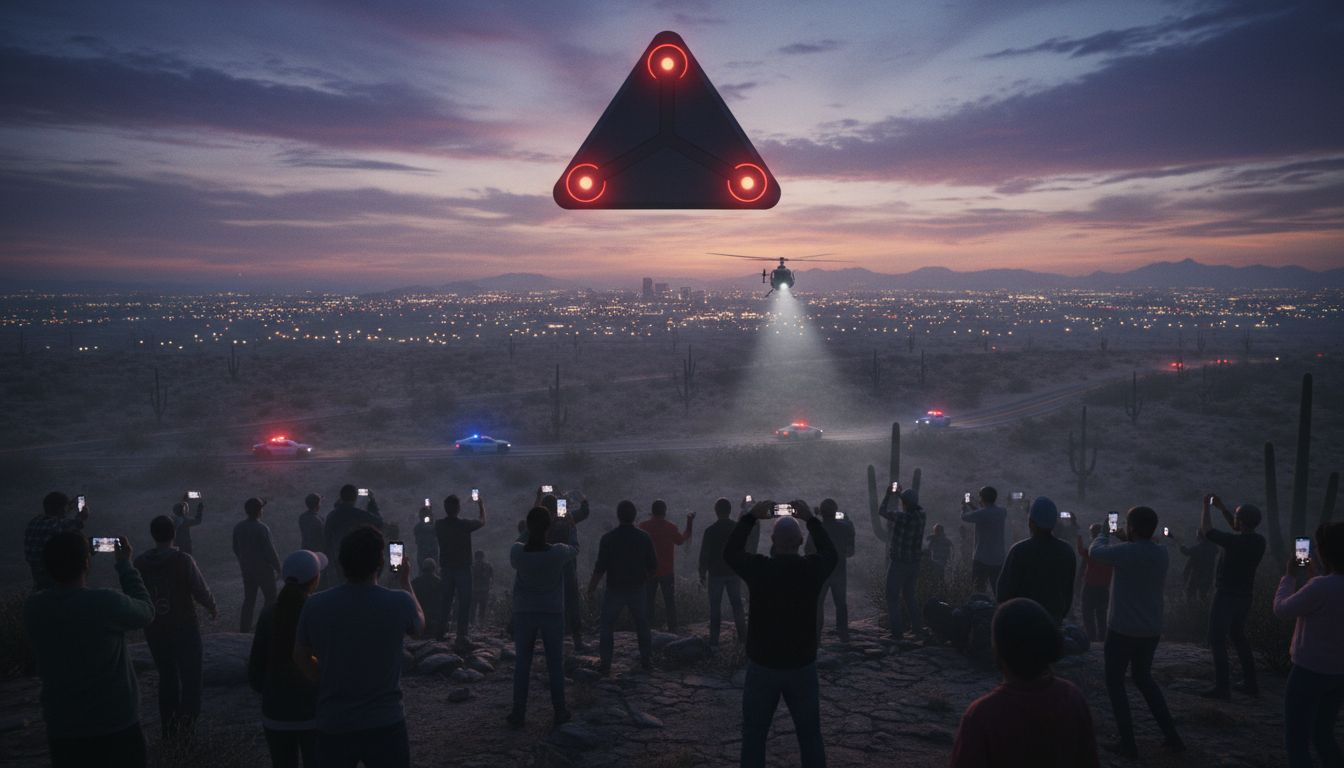
The Phoenix incident involved a triangular craft that hovered silently at low altitude. More than 30 observers, including commercial airline pilots, captured the object on smartphones and a dash‑cam, producing overlapping footage that shows a consistent shape and lack of audible propulsion. In Chicago, a sphere emitting pulsating lights was seen by over 50 attendees at a music festival. Spectators recorded the object from several angles, noting a rhythmic brightening pattern that persisted for approximately two minutes. The Denver sighting featured a metallic disc‑shaped object observed by at least 20 residents; a drone equipped with an infrared camera documented the craft from above, revealing a smooth, reflective surface and an abrupt change in altitude that conventional aircraft cannot replicate.
Technological Advances
Investigators attribute the increased evidential quality to infrared‑equipped drones and AI‑driven pattern‑recognition software deployed by civilian and academic teams. Infrared imaging captured thermal signatures that were invisible to the naked eye, while machine‑learning algorithms filtered out conventional aircraft and atmospheric anomalies, highlighting flight paths that deviated from known performance envelopes. According to Dr. Maya Patel, an aerospace engineer at the University of Colorado, “The combination of high‑resolution infrared video and automated anomaly detection has reduced false positives dramatically, allowing us to focus on truly unexplained events.”
Expert Analyses
A panel of experts convened by the National UFO Reporting Center examined the compiled data. Retired Air Force pilot Col. James Whitaker remarked, “The flight characteristics—instantaneous acceleration, silent hover, and abrupt altitude changes—are inconsistent with any known propulsion system in the U.S. inventory.” Astrophysicist Dr. Luis Ortega highlighted the energy signatures: “Infrared readings suggest an energy output far exceeding that of conventional aircraft, yet the objects emit no discernible exhaust or acoustic signature.” NASA materials scientist Dr. Elena Rossi added that the metallic disc’s surface reflected radar at an unusually low cross‑section, implying a material composition that may be metamaterial in nature, a speculation that remains unverified.
Implications and Next Steps
While the sightings have not been linked to any known military or commercial activity, the breadth of corroborating evidence has prompted calls for a coordinated, government‑led research program. The Department of Defense’s Unidentified Aerial Phenomena Task Force has indicated interest in accessing the raw footage and sensor data for further analysis. Meanwhile, academic institutions are preparing to publish peer‑reviewed studies on the aerodynamic and thermodynamic anomalies observed. As Dr. Patel cautioned, “Robust, transparent investigation is essential. Only through disciplined scientific methodology can we determine whether these events represent novel atmospheric physics, advanced technology, or a combination of both.”
Outlook
The 2025 incidents underscore a shift from anecdotal reports to data‑rich documentation, marking a new era in UAP investigation. With advanced imaging tools, cross‑disciplinary expertise, and increased public reporting, researchers are better positioned than ever to evaluate unexplained aerial phenomena on empirical grounds. Whether future analysis will attribute these sightings to emerging aerospace technologies, natural atmospheric events, or something else entirely, the current evidence set a benchmark for rigor and transparency in a field long plagued by speculation.