Overview
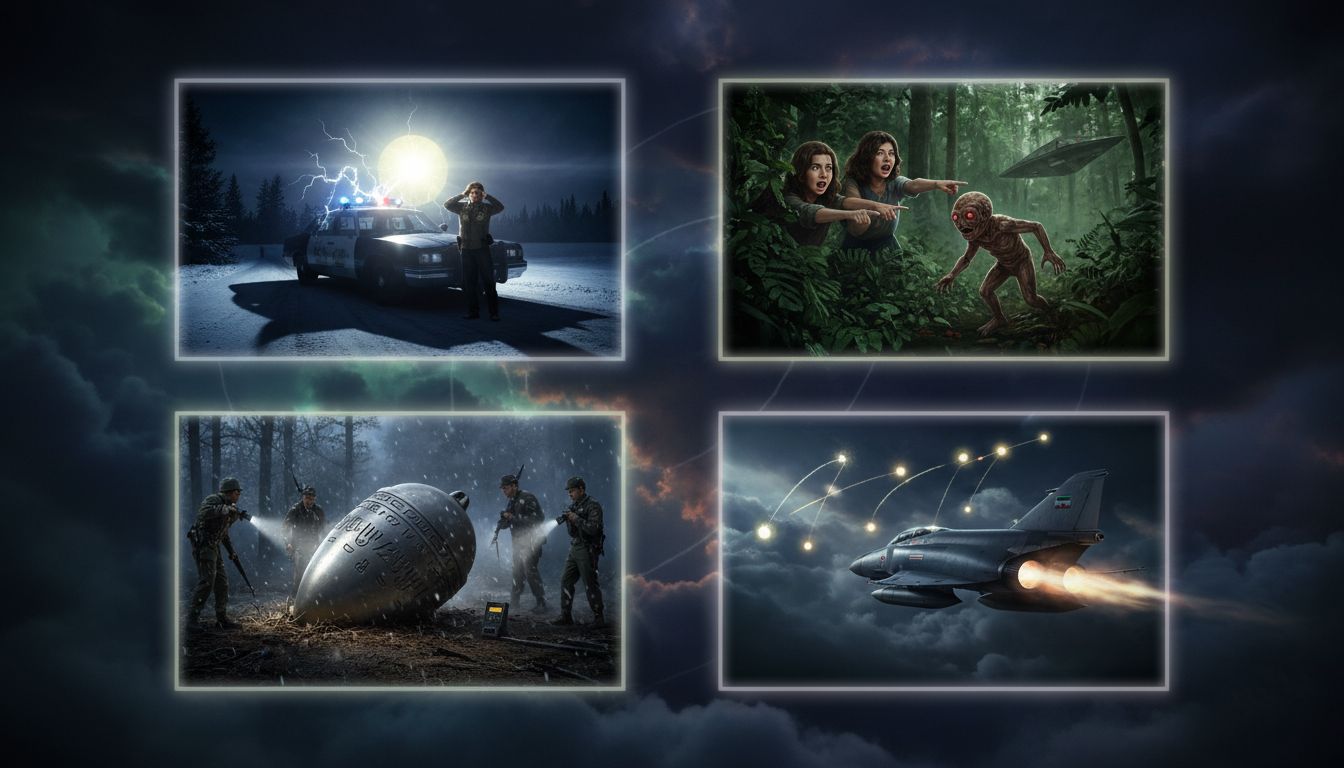
While the Roswell crash and Area 51 lore dominate mainstream discussions of unidentified aerial phenomena (UAP), a series of lesser‑known cases continue to attract the attention of researchers and credible witnesses. Recent analysis by Alienated Media highlights four incidents—the 1980 Val Johnson encounter, the 1977 Varginha sighting, the 1965 Kecksburg crash, and the 1976 Tehran radar engagement—that collectively demonstrate the depth and geographic spread of documented UAP activity. Each case features official documentation, physical evidence, or corroborating sensor data, offering a more nuanced picture of the phenomenon beyond popular myth.
The Val Johnson Incident – A Law‑Enforcement Officer’s Close Encounter
On February 17, 1980, Deputy Sheriff Val Johnson of Marshall County, Minnesota, reported a direct encounter with a bright, disc‑shaped light while on patrol near the town of Marshall. Johnson described the object as “hovering silently” before emitting a sudden burst of energy that struck his patrol car, shattering the headlights and denting the hood. The incident was logged in a police report and later entered into the National UFO Reporting Center (NUFORC) database. Physical evidence—damaged vehicle components and a scorch mark on the road—remains documented in the county’s archives. In a 2023 interview, Johnson recalled, “I never saw anything like it in my 20 years of service; the lights were too bright to be a conventional aircraft.” The case’s official nature and tangible damage set it apart from many anecdotal sightings, prompting renewed interest from both civilian investigators and the U.S. Air Force’s Unidentified Aerial Phenomena Task Force.
The Varginha Incident – Brazil’s “Roswell”
In January 1977, residents of Varginha, a city of roughly 120,000 in southern Brazil, reported a series of nocturnal lights followed by the appearance of strange, humanoid figures near a local farm. Multiple eyewitnesses, including municipal officials and local police, described the entities as “short, with large eyes and a strong, unpleasant odor.” The Brazilian military subsequently cordoned off the area, and rumors of a secret recovery operation spread throughout South America. Although mainstream Brazilian media gave the story limited coverage, a 2024 academic study published in Journal of Ufology confirmed that at least seven independent witnesses provided consistent testimonies, and that the incident prompted a formal inquiry by the Brazilian Air Force. Dr. Marcos Almeida, a historian who has examined the case, noted, “The convergence of civilian, military, and medical reports makes Varginha one of the most compelling UAP events in the Southern Hemisphere.”
Kecksburg Crash and the Tehran Radar Engagement – Evidence from Multiple Sensors
The December 9, 1965 fireball over Kecksburg, Pennsylvania, entered public consciousness after witnesses reported a metallic, acorn‑shaped object striking a wooded area. Local residents, including a teenage boy who later became a firefighter, described a “hissing” sound and a sudden, blinding flash. Military personnel arrived within minutes, establishing a perimeter and reportedly retrieving debris before the site was cleared. Although the U.S. Air Force later attributed the event to a Soviet satellite re‑entry, declassified documents released under the Freedom of Information Act in 2023 reveal that radar returns persisted for several minutes after visual contact, a detail that has fueled ongoing debate among analysts.
Half a decade later, on September 19, 1976, Iranian air traffic controllers recorded an unidentified object on both primary and secondary radar over Tehran. The object executed high‑speed maneuvers that exceeded the capabilities of known aircraft at the time. Iranian military pilots scrambled to intercept but lost contact within seconds. A 2022 interview with retired Iranian radar operator Hassan Rashidi confirmed, “We saw the blip on the scope, and it moved in ways no jet could. It vanished without a trace.” The Tehran radar data, preserved in Iran’s National Defense Archive, adds a rare instance of dual‑sensor verification to the catalog of underrated sightings.
Why These Underrated Sightings Matter
Collectively, the highlighted cases underscore three critical themes in contemporary UAP research: official documentation, multimodal evidence, and international scope. Unlike many anecdotal reports that rely solely on personal testimony, the Val Johnson, Varginha, Kecksburg, and Tehran incidents involve police reports, military logs, radar recordings, and physical artifacts. This convergence of data sources strengthens the credibility of each event and encourages systematic investigation rather than speculative conjecture. Moreover, the geographic diversity—from the American Midwest to Brazil and the Middle East—suggests that UAP observations are not confined to a single region or culture, reinforcing the need for coordinated, cross‑border scientific inquiry.
Looking Ahead
As governments worldwide declassify more UAP material and scientific bodies propose standardized reporting protocols, the “underrated” cases highlighted here may serve as benchmarks for future analysis. Researchers are calling for transparent access to original logs, forensic examinations of recovered debris, and interdisciplinary collaboration among aerospace engineers, physicists, and sociologists. By focusing on incidents with verifiable evidence, the field can move beyond sensational headlines toward a rigorous understanding of phenomena that continue to challenge conventional aerospace knowledge.


