Overview
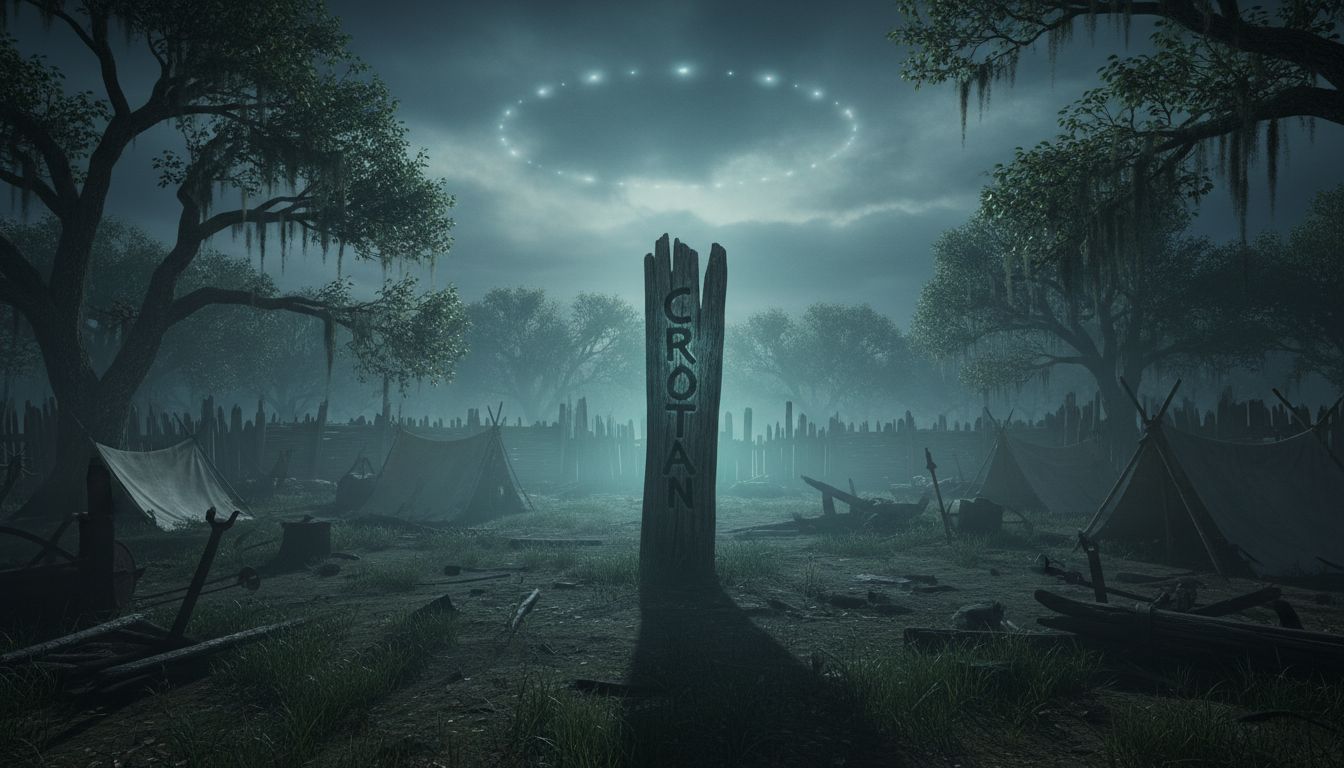
On August 18 1590, Governor John White returned to Roanoke Island after a three‑year absence to find the settlement of roughly 112‑121 British colonists completely empty. The only trace left behind was the word “CROATOAN” carved into a post and the fragment “CRO” etched into a nearby tree. The disappearance of the so‑called Lost Colony has resisted definitive explanation for more than four centuries, prompting endless archaeological digs, scholarly debates, and a lasting place in American folklore.
Historical Context
England’s push into the New World in the 1580s was driven by rivalry with Spain and the desire for a foothold in the lucrative Atlantic trade. Sir Walter Raleigh secured a royal charter in 1584, sending Philip Amadas and Arthur Barlowe to scout the coast. Their reports highlighted Roanoke Island’s strategic position and the apparent friendliness of local Algonquian peoples, prompting Raleigh to establish a military outpost under Ralph Lane in 1585. That first venture faltered due to supply shortages and deteriorating relations with the natives, leading the colonists to abandon the site in 1586 after Sir Francis Drake’s visit.
Learning from the failure, Raleigh organized a civilian settlement in 1587, this time bringing families. Approximately 115 settlers, including women and children, set sail under the command of John White, an artist‑navigator tasked with documenting the new world. The colony’s birth was marked by the arrival of Virginia Dare on August 18 1587, the first English child born in North America, a symbol of hope for a permanent English presence.
The 1590 Return and Immediate Findings
White’s request to return to England for provisions was granted, but the outbreak of the Spanish Armada in 1588 delayed his departure for two years and his return for another. When he finally reached Roanoke on the anniversary of Virginia Dare’s birth, he described the scene in his journal:
“There is not a soul here; the houses are taken down, and the only sign is the word ‘CROATOAN’ upon a post, and ‘CRO’ on a tree.”
The dismantled structures suggested an orderly relocation rather than a violent massacre, and White’s prior instructions to the colonists—carve the name of a destination if they moved, add a distress symbol if under duress—led him to interpret the carving as a possible destination marker. However, the absence of any distress sign and the lack of a follow‑up message left White without a clear answer.
Archaeological Investigations and Scholarly Debate
Since the 19th century, researchers have excavated Roanoke Island and nearby sites on the mainland, especially Croatoan Island (present‑day Hatteras Island). Findings include European‑style pottery fragments, a 16th‑century copper alloy buckle, and a possible 1590‑era hearth, yet none conclusively link to the missing colonists. Dr. Emily Kelley, a professor of early American archaeology at the University of North Carolina, notes:
“The material record is tantalizing but ambiguous; we have artifacts that could belong to the Roanoke group, but they do not tell us whether the settlers integrated with local tribes, perished, or moved elsewhere.”
Other scholars propose that the colonists may have sought refuge with the Croatoan (later known as the Hatteras) tribe, whose leader, Chief Manteo, had previously allied with the English. Historical accounts from English explorer Thomas Harriot describe a relatively peaceful relationship with the Croatoan people, lending credence to the integration hypothesis. Conversely, some historians argue that disease, starvation, or conflict with hostile tribes could have caused a rapid evacuation, leaving only the cryptic carving behind.
Current Understanding and Ongoing Research
While the mystery remains unsolved, the consensus among historians is that the colonists most likely relocated, possibly to Croatoan Island or another coastal settlement, rather than disappearing without a trace. Recent advances in DNA analysis of skeletal remains recovered from 17th‑century burial sites on Hatteras Island are being pursued to detect any genetic links to the original English settlers. As Dr. Kelley emphasizes, “Science may eventually provide the missing piece, but until then the Lost Colony endures as a cautionary tale of early colonial vulnerability and the complexities of cross‑cultural contact.”
The story of Roanoke continues to capture the public imagination, not only because of its unresolved nature but also because it underscores the challenges faced by the first English attempts to establish a foothold in the New World—a venture marked by ambition, hardship, and an enduring question that still haunts historians today.