The interstellar visitor designated 3I/ATLAS, first detected in early October 2025 as it raced toward the Sun, has sparked a fresh debate over whether the object is a natural comet or a piece of engineered technology. Observations from the Hubble Space Telescope and ground‑based facilities show that the object’s dust tail underwent an unusual reversal: a faint “anti‑tail” pointing sunward before perihelion gave way to a conventional tail streaming away from the Sun as the object passed its closest approach. The change, recorded over a span of just a few days, is the primary data point fueling a provocative new hypothesis.
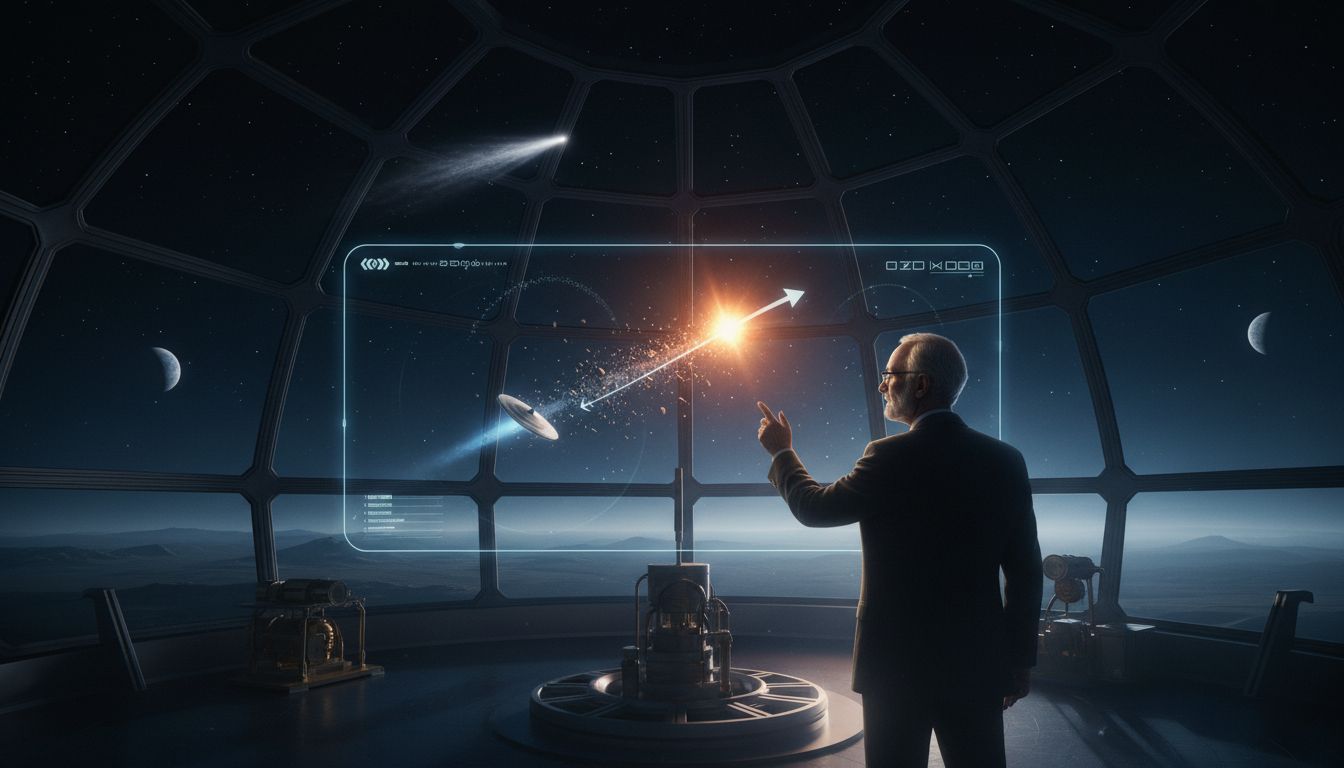
Astronomers noted the anti‑tail on October 15, a phenomenon that can arise when large dust particles, released earlier, are pushed by solar radiation pressure into a configuration that appears to point toward the Sun. By October 23, however, the same instruments detected a bright, classic tail extending in the opposite direction, suggesting a sudden shift in the forces acting on the debris cloud. “The morphology of the dust envelope changed in a way that is not typical for known comets,” said Dr. Maya Patel, a cometary physicist at the University of Arizona, who led part of the Hubble imaging campaign. “It could be a sign of a rapid change in outgassing or a non‑gravitational thrust, but the timing is puzzling.”
Harvard astrophysicist Avi Loeb, who has previously argued that the 2017 interstellar object ‘Oumuamua exhibited signs of alien technology, seized on the tail reversal as possible evidence of intentional braking. In a pre‑print posted to arXiv on October 24, Loeb wrote, “If the debris tail is being redirected by a thrusting mechanism, the most parsimonious explanation is that the object is attempting to shed kinetic energy and settle into a bound orbit between Mars and Jupiter.” He further suggested that such a maneuver would constitute a technosignature—a detectable artifact of an extraterrestrial probe deliberately slowing its passage through the solar system. Loeb’s team points to the abrupt transition from anti‑tail to tail as consistent with a controlled, retro‑propulsive burn rather than a stochastic outgassing event.
The majority of planetary scientists remain skeptical, emphasizing that natural processes can produce similar observational signatures. Dr. Elena García of the European Space Agency noted, “Cometary activity can be highly variable, especially for bodies that have spent most of their lives in interstellar space and are now encountering intense solar heating for the first time. Changes in sublimation rates, fragmentation of volatile‑rich layers, or even solar wind interactions can mimic a thrust‑like effect.” A recent study by the International Cometary Working Group, submitted to Astronomy & Astrophysics, models the tail reversal using conventional dust dynamics and finds that a modest increase in outgassing near perihelion could reproduce the observed morphology without invoking engineered forces.
Loeb’s proposal arrives in a lineage of interstellar object investigations that have repeatedly tested the boundaries between astrophysics and the search for extraterrestrial intelligence. ‘Oumuamua’s elongated shape and non‑gravitational acceleration in 2017, followed by the more conventional cometary behavior of 2I/Borisov in 2019, have kept the scientific community alert to anomalies. Loeb’s earlier book, Extraterrestrial: The First Sign of Intelligent Life Beyond Earth, argued that the scientific establishment often dismisses unconventional data too quickly. Critics, however, argue that his pattern of emphasizing alien explanations risks conflating genuine curiosity with sensationalism.
Regardless of the ultimate verdict, 3I/ATLAS offers a rare opportunity to study an object that has traversed interstellar space and now interacts directly with the Sun’s environment. NASA’s upcoming Near‑Earth Object Surveyor mission, slated for launch in 2028, could provide higher‑resolution imaging and spectroscopy of any future interstellar arrivals, helping to discriminate between natural and artificial phenomena. As Dr. Patel cautioned, “We need more data, not just more speculation. Whether ATLAS is a comet, a fragment of a distant planetary system, or something else entirely, it will teach us about the diversity of bodies that wander through our neighborhood.” The debate underscores the delicate balance between open‑minded inquiry and rigorous scientific scrutiny as humanity continues to look outward for signs of other intelligences.