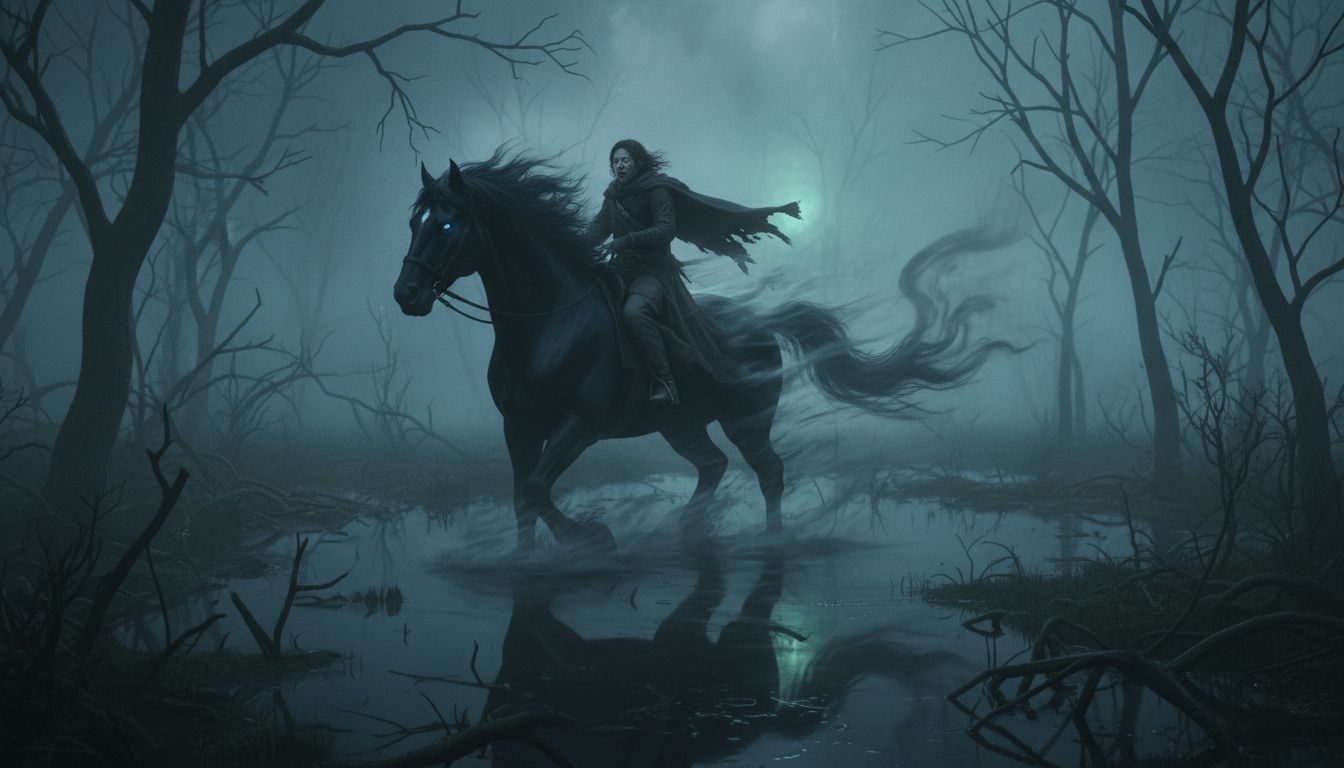
The legend of the Night Horse Zawudschawu has resurfaced in recent weeks across the Gruyère region, prompting both curiosity and concern among residents, scholars, and tourism officials. The tale, which describes a dark, spectral horse that appears on fog‑laden evenings along the marshy banks of the Saane River, dates back at least a century in oral tradition. According to the Moon Mausoleum website, which catalogues Swiss paranormal folklore, the creature is said to lure exhausted travelers onto its back, only to vanish or plunge them into the river’s icy waters. The story’s most vivid episode involves a drunken wanderer who, after mounting the horse, is abruptly thrown into the river as the animal’s demeanor shifts from benevolent to malevolent, accompanied by an “inhuman, mocking laughter” that fades into the mist.
Local historians trace the Zawudschawu narrative to the broader corpus of Alpine and pre‑Alpine mythmaking, where nocturnal equine figures often symbolize the perils of the wilderness. Dr. Elisa Keller, a folklorist at the University of Fribourg, explains that “the night horse motif appears throughout Europe, from the Irish ‘Púca’ to the German ‘Nachtross.’ In the Swiss context, the Gruyère moors’ treacherous terrain and frequent fog create a natural backdrop for such cautionary tales.” Keller adds that the dual description of the horse—alternately black as midnight or “iridescent milk‑white”—reflects the region’s linguistic diversity, with German‑speaking and French‑speaking communities adapting the legend to their own symbolic palettes.
The story has taken on a contemporary dimension as the Gruyère tourism board grapples with its impact on visitor perception. “We recognize that folklore is part of the cultural fabric here,” says Marie‑Claude Besson, head of the regional tourism office. “While the Zawudschawu legend adds a mysterious allure that some tourists find appealing, we must balance that with accurate information about safety on the moors, especially after dark.” Besson notes that local authorities have increased signage warning hikers about the Saane River’s swift currents and the rapid weather changes that can turn a simple night walk into a hazardous endeavor. The board has also partnered with the Gruyère Heritage Museum to host a series of talks on regional myths, emphasizing historical context over sensationalism.
For residents who live near the moors, the legend remains a practical reminder of the area’s natural dangers. Jean‑Pierre Roussel, an 82‑year‑old farmer who has traversed the Saane’s banks his entire life, recounts hearing the story from his grandfather. “When the fog rolls in, we tell the younger ones not to stray far from the path,” he says. “Whether you believe in a phantom horse or not, the marshes can swallow a person in minutes.” Roussel’s sentiment echoes a broader community consensus that the tale functions as an oral safety net, reinforcing caution during the long, cold nights that dominate the Alpine winter.
Scientists have offered alternative explanations for the phenomenon that fuel the legend’s persistence. Meteorologists point out that temperature inversions over the moors can create “mirage‑like” visual distortions, making distant lights or shadows appear as moving forms. Similarly, acoustic researchers have documented how wind passing through the reeds can produce low, resonant sounds that some interpret as a horse’s whinny or an eerie laugh. “Human perception is highly suggestible in low‑light, low‑visibility conditions,” notes Dr. Marco Giannini of the Swiss Federal Institute of Technology. “When the mind is already primed by a story, it can fill sensory gaps with imagined details.”
As the Zawudschawu legend continues to circulate through social media, local festivals, and guided night hikes, it illustrates how folklore can evolve while retaining its core function: to warn, to entertain, and to bind a community to its landscape. Whether the night horse is a supernatural entity, a product of atmospheric optics, or simply a cautionary allegory, its presence in modern Swiss discourse underscores the enduring power of myth to shape how people navigate both the physical and cultural terrain of the Gruyère moors.