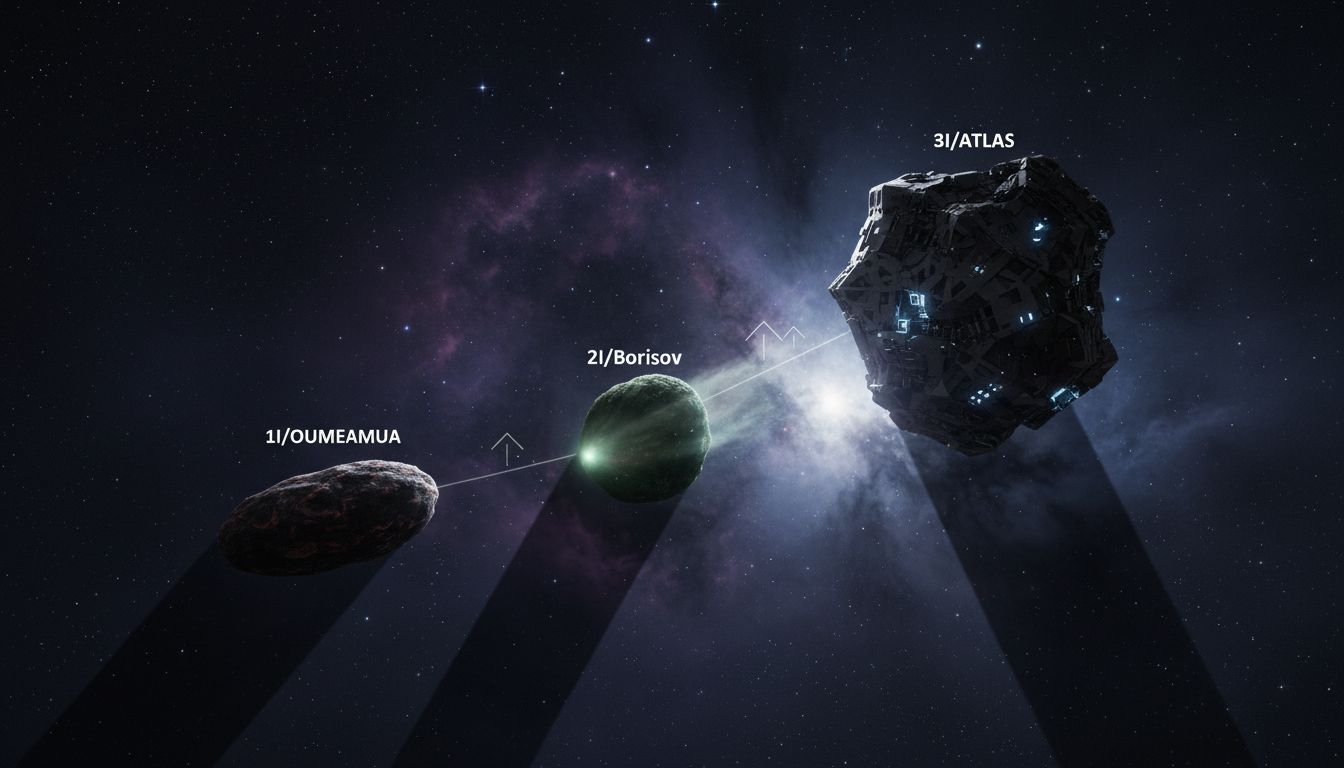
The discovery of three interstellar objects—1I/’Oumuamua in 2017, 2I/Borisov in 2019, and the newly identified 3I/ATLAS—has turned a decade‑old curiosity into a rapidly expanding field of study. In a recent Medium article, Harvard astronomer Avi Loeb and collaborators outline how each successive visitor has presented increasingly puzzling characteristics that strain conventional models of Solar‑System debris. ’Oumuamua, the first known interloper, exhibited a measurable non‑gravitational acceleration that could not be explained by outgassing alone, prompting debates over its composition and shape. Borisov, a comet‑like body, surprised observers with a series of post‑perihelion outbursts and fragmentation events that suggested a fragile, volatile‑rich interior. Now, ATLAS—estimated to be about five kilometres across, roughly ten times larger than ’Oumuamua—offers a scale on which any anomalous behavior would be amplified, raising the stakes for both observation and theory.
The authors argue that the Vera C. Rubin Observatory’s Legacy Survey of Space and Time (LSST), which began full operations this year, will transform the cadence of detections. “Where we once expected one interstellar object per decade, LSST is projected to deliver one every few months,” Loeb writes, citing recent simulations from the Astro2020 and Dorsey et al. studies. The telescope’s 8.4‑metre aperture and 3.2‑gigapixel camera will scan the entire visible sky nightly, dramatically expanding the searchable volume for fast‑moving objects. This shift from serendipitous to systematic discovery, the authors contend, will enable astronomers to treat interstellar objects as a “laboratory science” rather than a set of isolated curiosities.
Beyond sheer numbers, the article proposes a six‑pronged research framework to capitalize on the anticipated influx. First, a comprehensive population census could reveal the distribution of sizes, compositions, and trajectories, shedding light on the formation environments of other planetary systems. Second, laboratory analyses of returned samples—if rapid‑response interception missions can be fielded—would provide astrobiological data at a fraction of the cost of exoplanet spectroscopy. Third, the “Loeb Scale” classification would help identify objects that might be technological relics, while the fourth and fifth points stress the need for northern‑hemisphere observatories and even gravitational‑wave detectors to catch dark or high‑velocity interlopers. Finally, the authors link planetary‑defense considerations to the same infrastructure, noting that the same rapid‑response capabilities required for scientific study would also mitigate potential threats, natural or artificial.
The call for rapid‑response interception is not merely speculative. Loeb and his co‑authors point to the 2023 “Comet Interceptor” concept, which demonstrated that a spacecraft could be placed on standby and redirected within weeks to a newly discovered object. “If we can launch a probe to ATLAS within months, we could retrieve material from a body ten times larger than any we have ever sampled,” Loeb says, emphasizing the potential for direct measurement of isotopic ratios, mineralogy, and perhaps even biosignatures. Such data would bypass the uncertainties inherent in remote spectroscopy, offering a tangible benchmark for models of planetary formation beyond the Sun’s neighborhood.
The article concludes that international coordination will be essential. Funding mechanisms must be agile enough to support “fast‑track” missions, and institutional frameworks need to accommodate discoveries that could challenge humanity’s cosmic perspective. As the Rubin Observatory begins to fill the sky with a steady stream of interstellar visitors, the scientific community stands at a crossroads: to treat these objects as fleeting oddities or to integrate them into a systematic, interdisciplinary program that could reshape our understanding of the galaxy and our place within it.