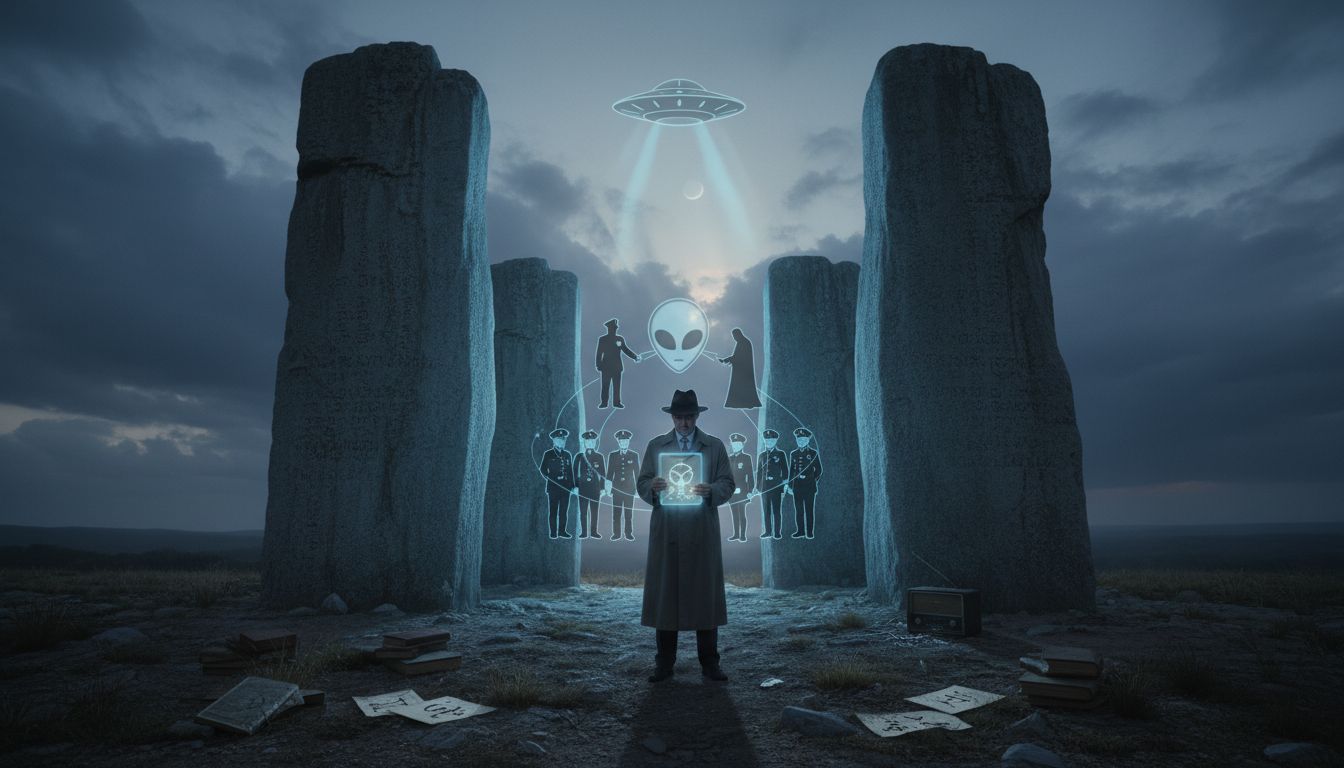
The granite slabs that rose in Elbert County, Georgia, on March 22, 1980 have long been a magnet for speculation. Known as the Georgia Guidestones, the 19‑foot‑tall monument bears ten statements in multiple languages that advise, among other things, “maintain humanity under 500 million in perpetual balance” and “guide reproduction wisely.” Its creator, a man who identified himself only as “Robert C. Christian,” claimed to act on behalf of “a small group of loyal Americans.” While the stones’ origin and purpose have been debated for decades, a new line of inquiry is emerging from the pages of Paul Blake Smith’s book President Eisenhower’s Close Encounters, which argues that the Guidestones may be a terrestrial echo of extraterrestrial contact that took place in the mid‑1950s.
Smith’s thesis centers on a series of alleged meetings between President Dwight D. Eisenhower and unidentified flying objects between 1954 and 1955. According to the author, Eisenhower was briefed by a covert cadre of six senior law‑enforcement officials—dubbed the “Secret Six”—who allegedly facilitated the president’s clandestine dialogues with an “advanced civilization” that sought to influence humanity’s future trajectory. Smith contends that the ten tenets etched into the Guidestones reflect a distilled version of the “wisdom” imparted during those meetings, especially the emphasis on population control, environmental stewardship and global unity. “If the Guidestones are a public‑facing artifact, they could be the only sanctioned transmission of extraterrestrial counsel to the world,” Smith writes.
The alleged connection between the “Secret Six” and the Guidestones is not the only thread linking the monument to UFO lore. Smith points to the proximity of Holloman Air Force Base in New Mexico, a site of documented UFO sightings and alleged reverse‑engineering projects dating back to the late 1940s. Holloman’s “Project Blue Book” investigations, declassified in the 1970s, recorded multiple sightings of luminous objects performing maneuvers beyond known aeronautical capabilities. Some researchers have suggested that data gleaned from those encounters filtered into civilian technological advances, ranging from early computer systems to satellite communications. If Eisenhower’s purported briefings did occur, Smith argues, they may have set a precedent for integrating alien-derived concepts into policy frameworks—a precedent that could have culminated in the Guidestones’ public message.
Skeptics, however, caution against conflating correlation with causation. Dr. Maria Hernandez, a historian of Cold‑War era science policy at the University of Georgia, notes that “the 1950s were rife with public anxiety about overpopulation and nuclear fallout, themes that appear in many contemporary civic projects.” She adds that the Guidestones’ language mirrors the United Nations’ 1972 “Conference on the Human Environment” and the 1974 “World Population Plan of Action,” both of which were widely disseminated in the United States. “There is no documentary evidence linking the Eisenhower administration to the Guidestones’ commissioning,” Hernandez says, “and the ‘Secret Six’ remains an unverified construct within UFO folklore.”
The debate has taken on renewed urgency after the Guidestones were demolished by an explosive device in July 2022, an act that sparked a wave of conspiracy theories about hidden agendas and cover‑ups. While law‑enforcement agencies have attributed the destruction to a lone individual motivated by personal opposition to the monument’s messages, the incident has also reignited interest in the broader narrative of secretive government‑UFO interactions. Whether the Guidestones were a benign public art installation, a covert transmission of extraterrestrial counsel, or simply a product of Cold‑War era anxieties, the story underscores the persistent allure of mystery at the intersection of policy, technology and the unknown.


