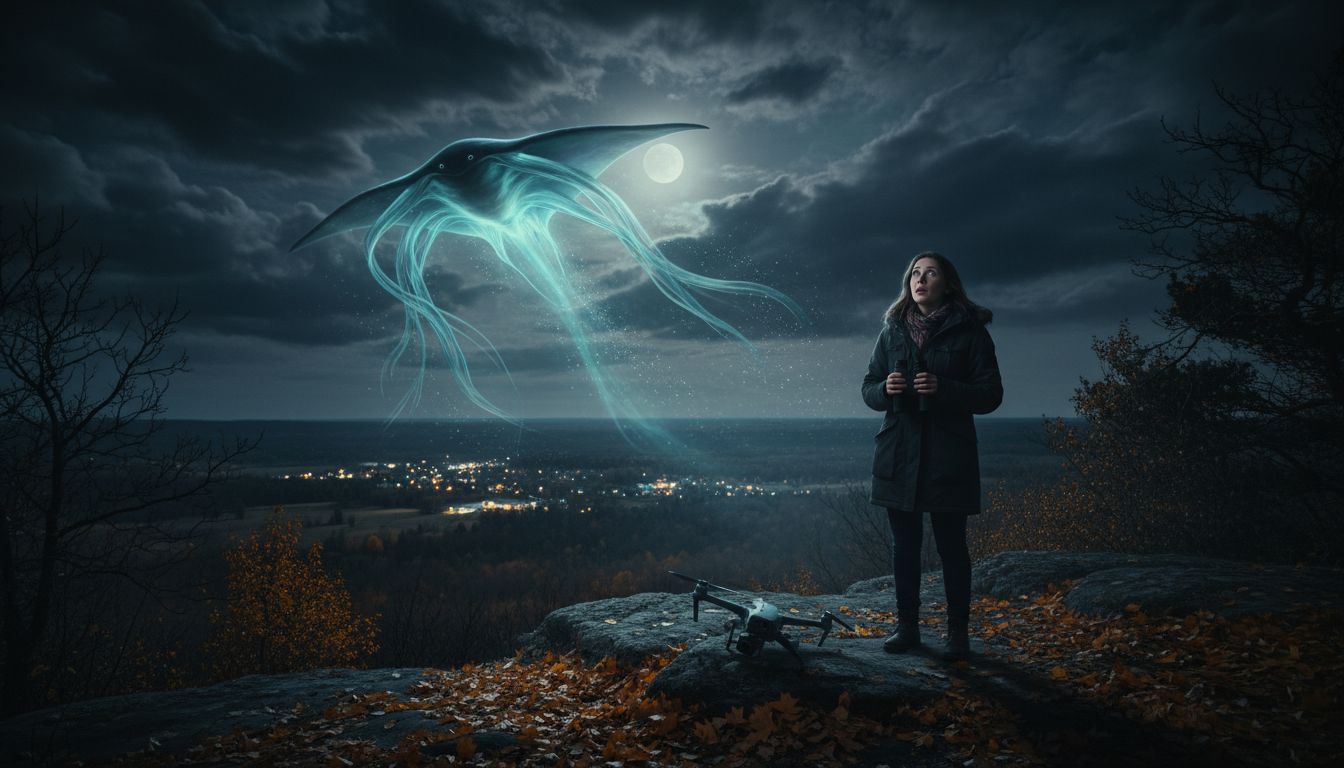
In late October 2024 a resident of the Appalachian foothills reported a brief, luminous encounter that has been described as a “Sky Ray,” a manta‑ray‑shaped form that emerged from a cumulus cloud and glided across the night sky. The witness, who asked to remain anonymous because of the stigma surrounding unexplained sightings, recounted stepping outside at about 10:45 p.m. on a cool, humid night when the temperature hovered in the mid‑40s. “I was trying to see if I could catch a glimpse of the ‘drones’ people were spotting all over the United States at that time,” the source said, adding that they had spoken aloud a request for any presence to reveal itself. Within a minute, a faintly glowing, reddish silhouette rose from the northwest cloud bank, moving with a fluidity the witness likened to a deep‑sea bioluminescent organism rather than a conventional aircraft or drone. The entity, described as lacking a hard outline and emitting a soft, steady glow, traversed the sky at high speed before disappearing back into the clouds.
The account arrives amid a growing body of civilian reports of unidentified aerial phenomena (UAP) that have prompted renewed interest from both the public and certain government sectors. The Advanced Aerospace Weapons Systems Application Program (AAWSAP), a Defense Intelligence Agency‑funded initiative that operated under the pretense of national‑defense research, has historically examined “transmedium craft” and “unexplained biological encounters” that echo folklore from regions such as Appalachia. Dr. James Lacatski, former director of AAWSAP and co‑author of Skinwalkers at the Pentagon, has noted that the program’s archives contain numerous references to sightings that parallel traditional cryptid narratives, suggesting a convergence of military‑level UAP inquiry and cultural mythos. While the Pentagon’s recent UAP task force has released limited data on aerial anomalies, it has not publicly addressed biologically based phenomena like the Sky Ray, leaving a gap that civilian researchers and cryptozoologists are eager to fill.
Academic circles remain cautious. The primary obstacle to scientific validation is reproducibility; a single, brief visual observation cannot be subjected to controlled testing, and the lack of physical evidence—such as radar signatures, thermal imaging, or recovered material—precludes peer‑reviewed analysis. Dr. Emily Hart, a professor of atmospheric physics at the University of Colorado, explains that “high‑altitude cloud formations can occasionally produce optical effects, especially under low‑light conditions, that might be interpreted as structured movement. However, the description of a coherent, manta‑ray silhouette with bioluminescent qualities is atypical for known atmospheric optics.” Hart adds that, without corroborating data from multiple sensors, the encounter remains anecdotal, though it does merit documentation for future pattern‑recognition efforts.
The Sky Ray narrative also resonates with a longstanding Appalachian tradition of “cloudland” cryptids, ranging from the Mothman to the Flatwoods Monster. Local folklore scholars point out that such stories often serve as cultural touchstones, reflecting communal anxieties about the unknown and the environment. Anthropologist Dr. Maya Singh of Appalachian State University observes that “when a community experiences a striking, inexplicable event, it is natural for the story to be woven into existing mythic frameworks. The Sky Ray could become another emblem of regional identity, regardless of its ontological status.” This perspective underscores the dual role of such sightings: they are both potential data points for UAP research and narrative elements that reinforce regional folklore.
As the U.S. government continues to grapple with how to classify and communicate about anomalous aerial observations, cases like the Sky Ray highlight the tension between scientific rigor and public curiosity. Officials have repeatedly warned that premature disclosure of unverified phenomena could provoke “societal disruption” or “psychological instability,” a sentiment echoed in the source material’s cautionary remarks about the broader implications of acknowledging non‑human intelligences in the atmosphere. For now, the Sky Ray remains a solitary testimony, cataloged by independent researchers and awaiting any future corroboration that might shift it from cryptid legend to a subject of empirical inquiry.