Overview
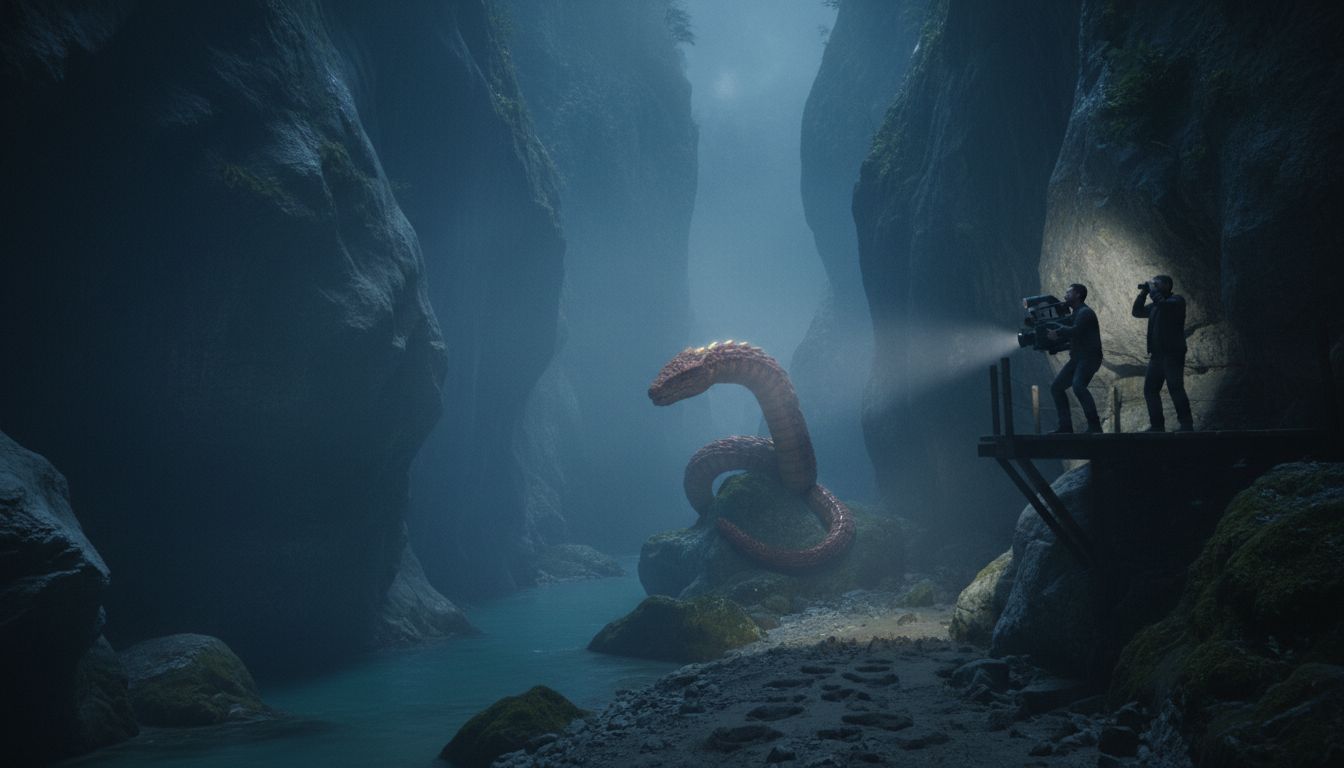
The Aare Gorge in the Bernese Oberland has long attracted hikers for its dramatic limestone walls and the roar of the Aare River, but it also shelters a quieter, more unsettling legend: the Tatzelwurm. Known locally as the “Stollenwurm,” this serpent‑like creature is said to slither through the gorge’s hidden tunnels, combining a scaled body with short, clawed limbs. While the tale originates in Alpine folklore dating back to the early 19th century, a handful of modern eyewitness reports keep the mystery alive, prompting both curiosity and cautious skepticism among scholars and tourists alike.
Historical Account
The most frequently cited encounter dates to 1935, when Russian‑born photographer Balkin stopped for a drink at the Hotel Bär in Meiringen after a hike through the gorge. Over schnapps, he described spotting an animal about 80 cm long and 25 cm wide, resembling a “big, scaly snake with legs.” The innkeeper, familiar with local lore, identified the creature as a Tatzelwurm, noting its “row of sharp teeth” and a “sharp whistling sound” that accompanied it. Balkin allegedly captured a photograph, which the German newspaper Berlin Illustrierte Zeitung published in April 1935, accompanied by a cash prize for anyone who could produce a physical specimen.
Modern Perspectives
In recent years, hikers and wildlife enthusiasts have reported fleeting glances of a low‑lying, stubby animal moving near the gorge’s mist‑filled passages. One account from July 2024, submitted to the Swiss Alpine Club, described a “grayish, reptilian shape with two front limbs that darted into a crevice after emitting a high‑pitched hiss.” While no new photographs have surfaced, the consistency of size estimates—between 60 cm and 2 m—and the characteristic hiss echo Balkin’s original description, lending a degree of continuity to the legend. Nevertheless, skeptics point out that the region’s known fauna, such as the alpine salamander and the occasional escaped domestic cat, could be misidentified under low‑light, misty conditions.
Scientific Viewpoint
Researchers at the University of Bern’s Department of Zoology have examined the Tatzelwurm claim through a biological lens. Dr. Lena Krämer, a herpetologist, notes that “the reported morphology—scaled body, short limbs, and a feline‑like head—does not correspond to any known vertebrate species native to the Alps.” She adds that the alleged ability to turn sand into glass, a recurring motif in older tales, is likely a mythic embellishment rather than a physiological trait. Without verifiable physical evidence, the creature remains classified as cryptid folklore, a cultural artifact rather than a documented species.
Cultural Impact
Regardless of scientific verdicts, the Tatzelwurm continues to shape the cultural narrative of the Aare Gorge. Local businesses, such as the Hotel Bär, display reproductions of Balkin’s 1935 photograph, and guided tours now include a “Tatzelwurm legend stop,” where storytellers recount the creature’s supposed poisonous breath and aggressive behavior. The legend also ties into broader Alpine myths that liken the gorge to the Greek Acheron, the river of the dead, reinforcing the region’s aura of mystery. As tourism blends with tradition, the Tatzelwurm endures as both a marketing motif and a reminder of the Alps’ deep‑rooted storytelling heritage.