Overview
In a recent episode of Emergent, host Reed Summ Summers interviewed John and Jerry Tedesco, the brothers behind the “Nightcrawler – Eye on the Sky” project. Operating a mobile, multi‑sensor laboratory from a retro‑fitted RV off Long Island, the brothers have transitioned from investigating local electromagnetic interference and health concerns to systematically recording Unidentified Anomalous Phenomena (UAVP) after the 2022 Office of the Director of National Intelligence (ODNI) report on UAP. Their combined 65 years of experience in electrical engineering and avionics, and their affiliation with Harvard’s Galileo Project, position them as one of the most technically sophisticated civilian groups currently engaged in this field.
Methodology
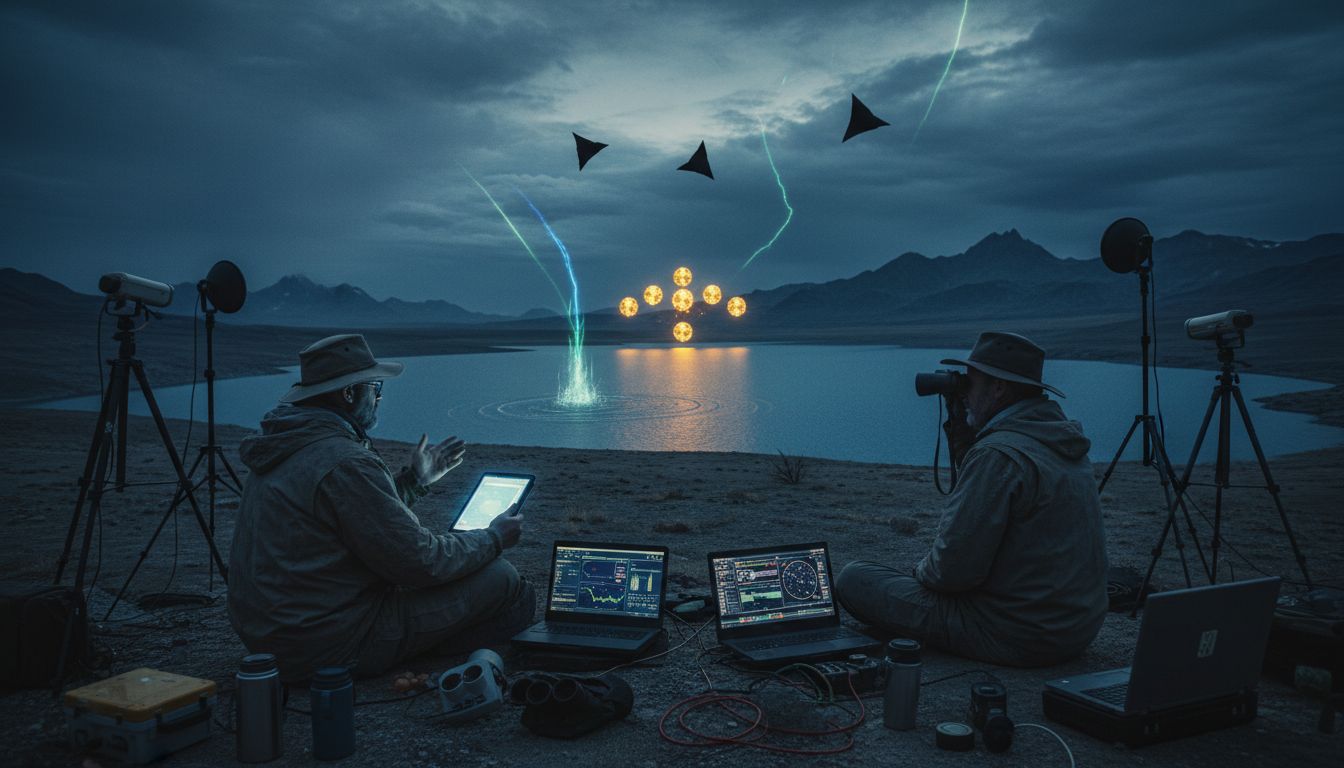
The Tedesco brothers emphasize “multi‑sensor fusion” as the foundation of their approach, deliberately avoiding reliance on eyewitness testimony alone. Their platform integrates dual X‑band radar, night‑vision, ultraviolet and infrared cameras covering a broad spectral range, and radio‑frequency spectrum analyzers for acoustic and electromagnetic interrogation. All instruments are calibrated nightly against known reference sources, and data are logged in a centralized repository for open‑access release. This systematic collection allows them to apply objective filters that rule out conventional aircraft, atmospheric phenomena, and known satellite passes before labeling an event as anomalous.
Notable Incidents
Two incidents discussed in the interview illustrate the breadth of their observations. On August 27 2022, while tracking a triangular formation of luminous spheroids near Robert Moses State Park, John Tedes c triggered an infrared rangefinder. Within three seconds the formation accelerated from 1,450 feet to within the immediate vicinity of the RV. Both brothers experienced a transient loss of motor control in their lower limbs lasting about 45 seconds, a phenomenon they described as “temporary flaccid paralysis.” Simultaneously, the infrared footage suffered “color‑confetti” artifacts and the radar displayed rapid loss of lock, suggesting a strong electromagnetic interaction.
A later event on August 29 2025 captured a large, black, bell‑shaped triangular object moving at approximately 220 mph. Radar traces indicated the object may have “spawned” into multiple distinct contacts mid‑flight, a behavior the Tedesco’s refer to as “trans‑medium behavior.” Both incidents were recorded in full and have been subjected to peer‑review in the Open Journal of Applied Sciences, where the authors detail the instrument‑level evidence and the observed physiological effects.
Institutional Engagement
The brothers’ publicly released data attracted attention from the FBI and the Pentagon’s All‑Domain Anomaly Resolution Office (AARO. In a de‑classified briefing, former Deputy Director Tim Phillips acknowledged that the military had replicated the Night Nightc “mobile detection system” and found it more effective than some existing military platforms. The Tedesco’s also introduced the “Sentinel Experiment,” a proposed civilian‑sourced mesh network leveraging smartphone magnetometers and accelerometers to capture environmental anomalies at a broader scale. The project aims to systematically document the “Hitchhiker Effect,” a term the brothers use for unexplained technical or biological changes reported by individuals after a close encounter.
Future Outlook
The interview concluded with a forward‑looking perspective: “rigorous, data‑centric research will drive disclosure more than any single policy decision,” John Tedes c asserted. The brothers are slated to present their full dataset at the 2026 UAP Detection and Tracking Summit (February 7‑8), where they will release additional raw footage and analysis scripts for independent verification. As civilian groups like Nightcrawler demonstrate the capability to collect high‑


