Overview
On a frigid February day in 1793, the small New England village of Manchester, Vermont, gathered in its town square to confront a feared “vampire” among the dead. The body of Rachel Burton (née Harris), who had died the previous year of consumption (tuberculosis), was unearthed, mutilated, and burned before a crowd estimated in the hundreds. Villagers believed that by destroying the corpse’s vital organs and interring the ashes they could halt the mysterious illness that had already claimed her husband’s new wife, Hul‑da Powell. The dramatic episode, recorded decades later by Judge John S. Pettibone, offers a stark glimpse into how early Americans merged folk superstition with the desperate search for medical explanations.
Historical Context
In the late 18th century, New England’s rural communities were still reeling from the legacy of witch trials and Puritanical fears. Epidemics of consumption—a slow‑wasting disease later identified as tuberculosis—swept through families, leaving few clues about transmission. Lacking germ theory, residents turned to folklore that held the dead could “feed” on the living. Local belief, documented in Pettibone’s History of Manchester (c. 1860), described a “demon vampire” who drained life from relatives. Such narratives were not unique; similar “vampire cures” appeared in New England towns from Connecticut to Massachusetts, where exhumations were performed to protect surviving kin.
The Exhumation Event
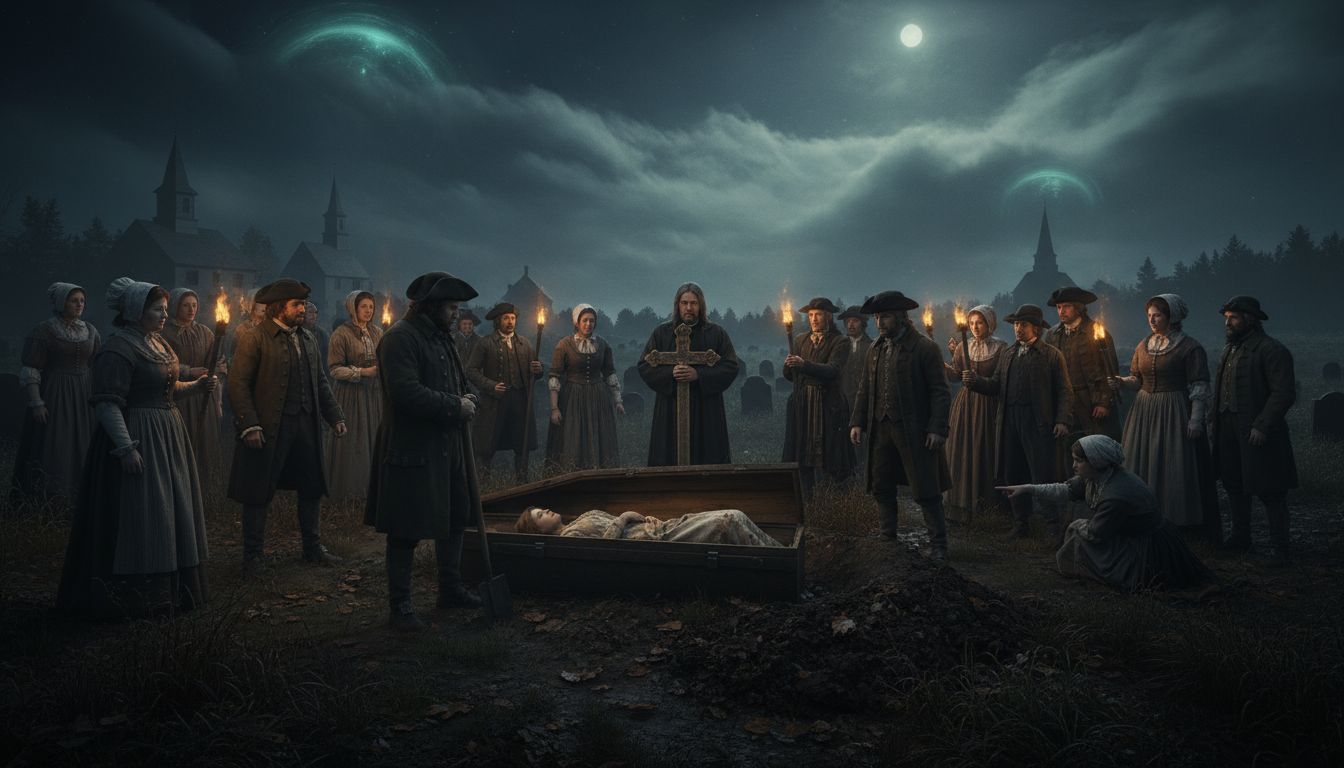
According to Pettibone’s manuscript, Rachel was described as “a fine, healthy, beautiful girl” who died at about twenty after a brief bout of consumption. Within a year, Captain Isaac Burton—a respected deacon—remarried Hul‑da Powell. When Hul‑da began exhibiting the same cough, night sweats, and wasting that had taken Rachel, suspicion fell on the deceased first wife. On the appointed day, townspeople, led by the local clergy, dug up Rachel’s grave, removed her heart and liver, and publicly displayed the organs. The remains were then burned, and the ashes scattered over the grave of Hul‑da, a ritual intended to sever any supernatural link. Contemporary accounts note that the entire village—men, women, and children—watched in solemn silence as the ceremony concluded.
Medicine Meets Myth
Modern historians view the Manchester incident as an early, albeit misguided, attempt to combat an infectious disease. Tuberculosis spreads through airborne droplets, a fact not discovered until the late 19th century. At the time, the visible similarity of symptoms in successive family members reinforced the notion of a cursed corpse. “People did what they could with the knowledge they had,” says Dr. Eleanor Whitaker, a historian of early American medicine at the University of Vermont. “The exhumation was a tangible action that gave the community a sense of control, even if it had no effect on the bacterium that caused the illness.” The ritual also reflected a broader New England practice of “vampire cures,” where the heart or liver of a suspected vampire was burned to protect the living.
Legacy and Reflection
The story of Rachel Burton resurfaced in the 20th century through local folklore collections and, most recently, in a 2025 feature by Moon Mausoleum. While sensational headlines often label the episode a “vampire haunting,” scholars stress its importance as a cultural artifact illustrating how fear, religion, and limited scientific understanding intersected in early America. The event underscores the human tendency to seek visible solutions to invisible threats—a pattern that repeats in modern public health crises. As historian Margaret L. Harris notes, “The Manchester exhumation reminds us that before vaccines and antibiotics, communities relied on ritual and myth to confront mortality.”
Bottom line: The 1793 Manchester exhumation was less a tale of the supernatural than a desperate, community‑wide response to a deadly epidemic. By examining the episode through both historical records and medical hindsight, we gain insight into how early Americans navigated the unknown, turning folklore into a coping mechanism when science offered no answers.