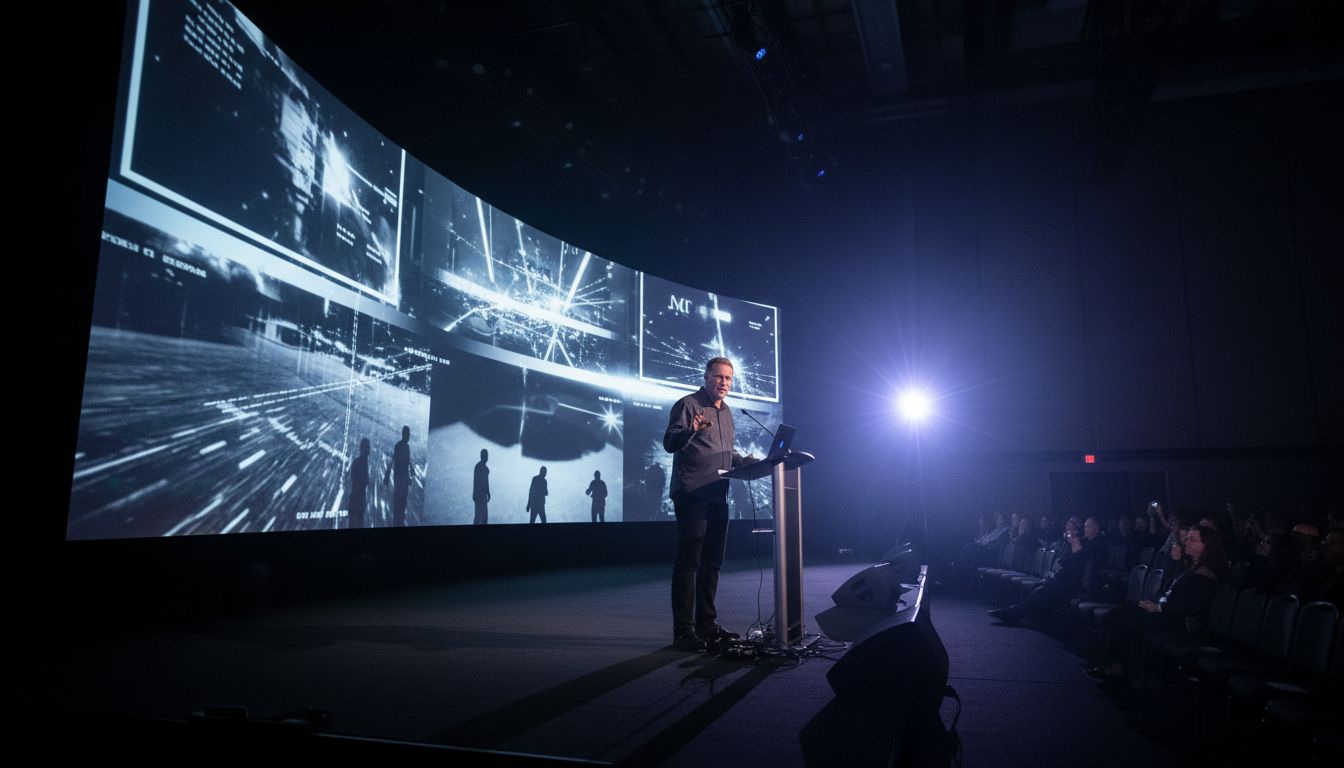
At a recent conference, renowned UFO researcher Richard Dolan presented a compelling overview of the current state of UFO, or Unidentified Aerial Phenomena (UAP), investigations, focusing on recent declassified footage and firsthand eyewitness accounts. Dolan, who has spent over two decades analyzing government documentation and interviewing key figures in the field, emphasized the profound implications these encounters have for both scientific understanding and public policy. Drawing on his extensive research, Dolan challenged the prevailing narrative that UFOs are a fringe topic, instead asserting that their reality is supported by credible evidence and official acknowledgment.
During his talk, Dolan referenced materials and technologies reportedly recovered from alleged UFO crash sites, highlighting how certain alloys and manufacturing processes remain beyond the known capabilities of human science. "We don't know how to get the bond between the bismuth and magnesium at this level. This is way beyond anything that we know how to do," Dolan quoted a source as saying, underscoring the advanced nature of the materials associated with some UAP incidents. He further pointed out that these revelations are not widely discussed in mainstream media or even some specialized television programs, despite the Pentagon’s own admission that the Advanced Aerospace Threat Identification Program (AATIP) was actively investigating UFOs.
Dolan recounted his personal journey into the field, which began as a brief academic curiosity but soon became a lifelong pursuit. He recalled being motivated by a desire to understand why credible reports and official interest in UFOs were largely absent from academic histories and public discourse. “Why would it not be [in the history books]? How is that not an interesting thing?” he asked, reflecting the central mystery that continues to drive his research. Dolan likened the process of investigating UFOs to an endless series of revelations, comparing it to the "red pill" metaphor from The Matrix: each discovery peels back another layer of secrecy, revealing more questions than answers.
A significant portion of Dolan’s presentation addressed the persistent issue of government secrecy and the paradox of UFO disclosure. He argued that while there is mounting evidence for the reality of advanced, possibly non-human technology interacting with humanity, the power structures in possession of this knowledge have little incentive to release it. “Disclosure is a paradox. It’s impossible and it’s also inevitable,” Dolan stated, referencing his earlier work co-authored with Bryce Zabel. He posited that the transformative and potentially revolutionary implications of open disclosure—social, economic, and technological—are precisely why the information remains tightly controlled by a select group, which he referred to as a “breakaway civilization.”
Despite public pressure and occasional official admissions, Dolan remains skeptical that full disclosure will be voluntarily initiated by those in power. He responded to recent commentary suggesting he believes otherwise, clarifying, “I have never said the government’s going to do this. And also, by the way, it’s going to be great. I’ve never ever said that.” Instead, Dolan urged continued public scrutiny and engagement, suggesting that awareness and incremental transparency may be the most realistic path forward.
As the field of UFO research continues to evolve, Dolan’s message resonated with an audience eager for answers but wary of easy solutions. He called for a more open and honest conversation about the evidence at hand, emphasizing the need for both scientific rigor and public vigilance in the ongoing search for the truth behind UAP encounters.