Overview
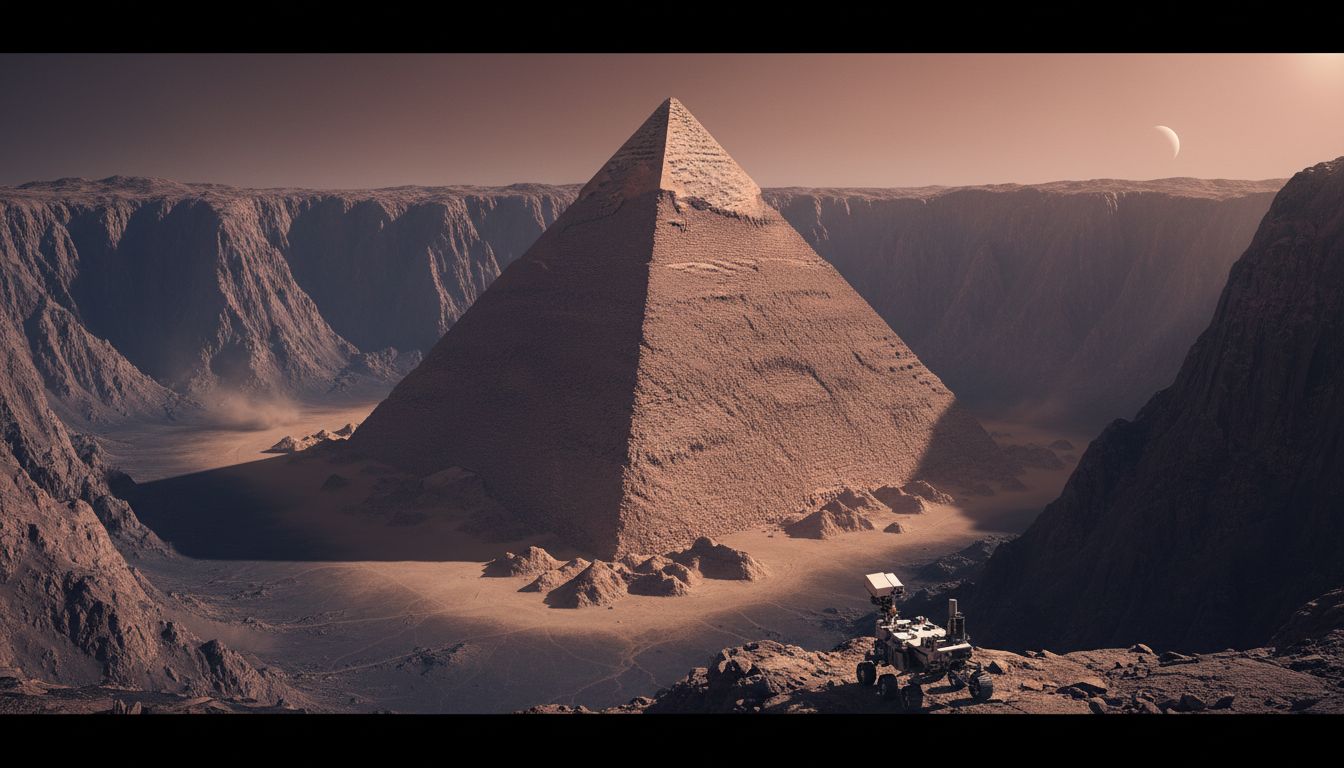
A high‑resolution image taken by NASA’s Mars Reconnaissance Orbiter (MRO) over the Valles Marineris canyon system has drawn renewed attention after independent researcher Keith Laney identified a formation that he describes as a “three‑sided pyramid.” The structure, located in the narrow gorge known as Candor Chasma, appears in several consecutive frames and exhibits a striking triangular symmetry that Laney says is reminiscent of the geometry of Egypt’s Great Pyramid. The claim has sparked discussion among both professional planetary scientists and a subset of fringe commentators who see the shape as possible evidence of an ancient Martian civilization.
The Image and Its Features
The footage in question was released publicly by NASA as part of its routine “Mars Daily” archive on March 12, 2026. It shows a steep cliff face punctuated by a series of light‑and‑shadow patterns. Laney, who runs a private “UFO‑UAP” analysis website, used image‑enhancement software to isolate a region where three planar facets converge at a point, forming a shape he likens to a triangular pyramid. He notes that the geometry persists across at least five overlapping frames, reducing the likelihood of a single‑frame artifact. “The angles line up with a near‑perfect 60‑degree offset, which is not typical of natural erosion patterns in Valles Marineris,” Laney wrote in a public post dated March 20.
Scientific Context
Planetary geologists caution that many apparent “artificial” structures on Mars are the result of optical illusion, lighting, and the planet’s complex stratigraphy. Dr. Maya Patel, a senior researcher at the Jet Propulsion Laboratory, explains that “candor chasma is cut by layered sedimentary rocks and basaltic flows that can fracture along predictable planes. When the sun is low on the horizon, those planes cast shadows that can mimic geometric shapes.” Patel adds that similar “pyramid‑like” silhouettes have been documented in previous MRO images of the region, later identified as erosional mesas and fault blocks.
Fringe Interpretations
Despite the scientific explanations, a small community of “ancient astronaut” enthusiasts has seized on Laney’s findings. Online forums are citing declassified CIA documents released in 2024 that allegedly reference “astral projection” projects detecting “pyramidal formations” on Mars, interpreting them as a hint of past intelligent life. One commentator, known only as “StellarSeeker,” wrote, “When multiple agencies—NASA, CIA, and private researchers—report similar geometric anomalies, the simplest answer is that we’re looking at the remnants of a civilization that predates Earth.” Such claims, however, have not been corroborated by peer‑reviewed research.
Official Response
NASA’s Mars Exploration Program office issued a brief statement on March 25, emphasizing that the agency’s image processing pipeline is designed to avoid over‑interpretation and that “no evidence currently supports the existence of artificial structures on the Martian surface.” The statement also noted that the agency welcomes independent analysis, provided that conclusions are drawn from rigorous, reproducible methodology. The CIA, for its part, declined comment on the specific documents referenced by fringe groups, citing standard classification protocols.
Looking Ahead
The episode underscores the ongoing tension between public fascination with extraterrestrial possibilities and the methodical, evidence‑based approach of planetary science. Researchers plan to schedule a targeted observation of Candor Chasma during the next Mars opposition, using the MRO’s HiRISE camera at a higher resolution to determine whether the “pyramid” persists under different lighting conditions. Until then, the consensus among the scientific community remains that the formation is a natural geological feature, while the broader conversation continues to highlight how quickly speculative narratives can spread when striking visual anomalies appear in space imagery.