Overview
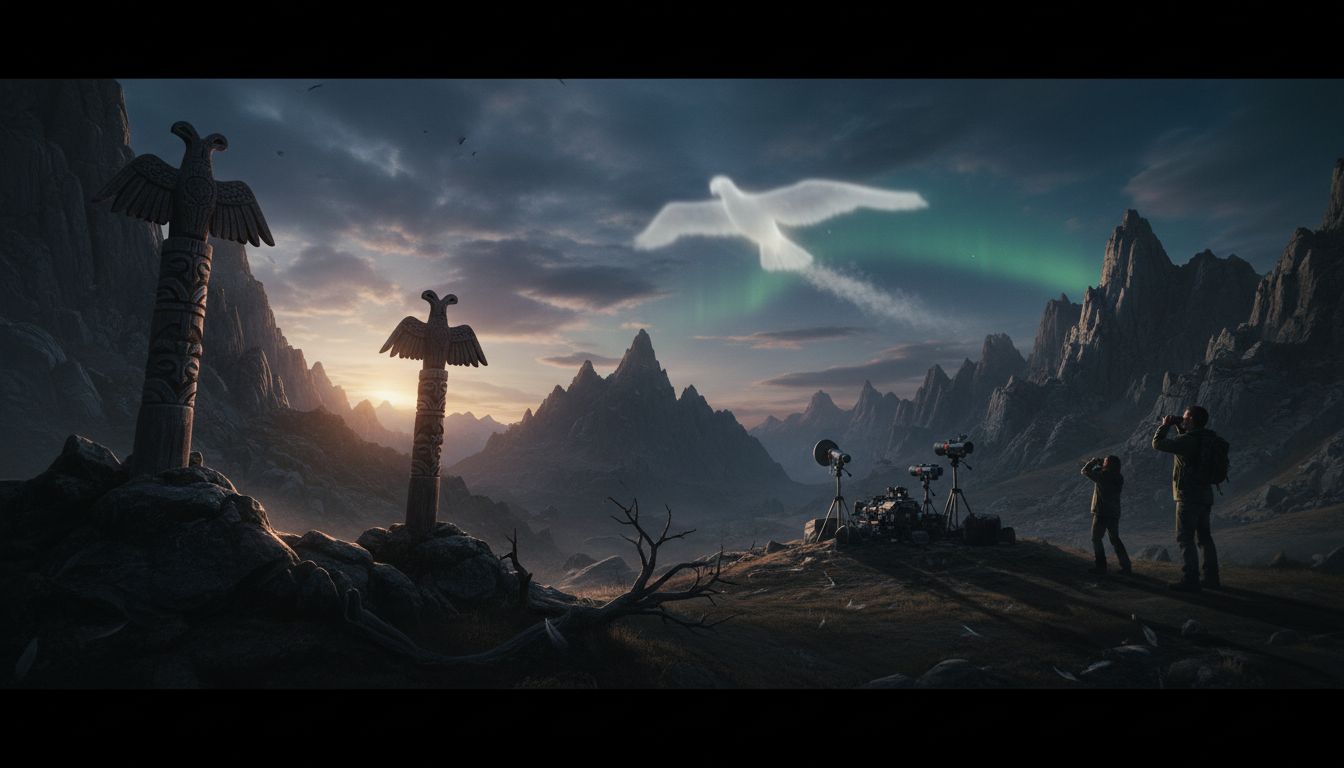
The “Thunderbird” remains one of the most persistent figures in North‑American folklore, appearing in oral histories from the Ojibwe, Lakota, Kwakwaka’wakw and dozens of other tribes. Traditionally described as a colossal bird‑spirit capable of generating thunder with a single wingbeat and hurling lightning from its eyes, the creature is celebrated in totem poles, petroglyphs and ceremonial narratives as both protector and omen of storms. In recent decades, the legend has migrated into the realm of cryptozoology, where researchers debate whether the myth could conceal sightings of an undiscovered large bird or a surviving relic of a prehistoric species.
Historical Roots and Indigenous Accounts
Anthropologists note that Thunderbird motifs recur across a wide geographic belt, from the Pacific Northwest coast to the Great Plains. “The consistency of the description—massive wings, a booming call, and a direct link to weather—suggests a shared cultural memory,” says Dr. Daniel Authur Biddle, author of Thunderbirds and Flying Dragons (2025). Archaeological evidence, such as carved wooden poles and stone panels, often depicts a bird with outstretched wings spanning the full height of the panel, reinforcing the notion that early peoples envisioned a creature far larger than any known raptor. While some scholars interpret these images symbolically, others argue they may reflect encounters with unusually large birds that once inhabited the continent, such as the extinct teratorns whose wingspans approached 20 feet.
Modern Sightings and Eyewitness Testimony
Contemporary reports of “giant birds” have surfaced repeatedly since the early 1900s, clustering in states like Illinois, Pennsylvania, Arizona, Iowa and Missouri. The most publicized case occurred in 1977 in Lawndale, Illinois, when a 10‑year‑old boy, Marlon Lowe, claimed two enormous birds seized him by the shoulders, lifted him 35 feet, and released him with deep claw marks on his arms. “I still have the scars,” Lowe told a 2024 interview, “and I’ve never seen anything else like it.” Similar accounts describe dark, leathery‑winged silhouettes gliding silently, sometimes generating gusts strong enough to rattle vehicles. Although skeptics attribute these sightings to misidentified golden eagles, large vultures, or even unmanned aerial vehicles, proponents point to recurring details—such as the birds’ size (20‑70 feet wingspan) and the audible “crack” of thunder‑like wingbeats—that appear across unrelated testimonies.
Scientific Evaluation and Cryptozoological Theories
Researchers like Loren Coleman have organized field expeditions to remote forests and high‑altitude ridges in search of physical evidence, yet no verifiable remains, feathers or clear photographs have emerged. Some cryptozoologists propose that the Thunderbird could be a surviving Washington’s Eagle, a 19th‑century specimen recorded by James Audubon with a wingspan exceeding 10 feet, or a relict population of teratorns, which vanished at the end of the Pleistocene. A more speculative hypothesis suggests that pterosaurian lineages—such as Pteranodon—might have persisted in isolated ecosystems, though the lack of any fossil or genetic data makes this claim tenuous. “Extraordinary claims require extraordinary evidence,” notes Dr. Emily Hart, a zoologist at the University of Colorado, “and to date the empirical record for a bird of the reported dimensions simply does not exist.”
Cultural Persistence and Ongoing Interest
Even without concrete proof, the Thunderbird continues to inspire literature, artwork and a niche tourism industry centered on “sky‑monster” lore. Recent publications, including Biddle’s 2025 volume and T. Peter Park’s A Guide to Sky Monsters (2021), compile both indigenous narratives and modern eyewitness reports, underscoring how folklore and contemporary curiosity intersect. The phenomenon also prompts broader questions about the limits of scientific knowledge in vast, under‑explored North‑American wildernesses. As Dr. Biddle observes, “The Thunderbird reminds us that indigenous knowledge and modern inquiry can coexist, urging us to keep an open yet rigorous eye on the skies.”


