Overview
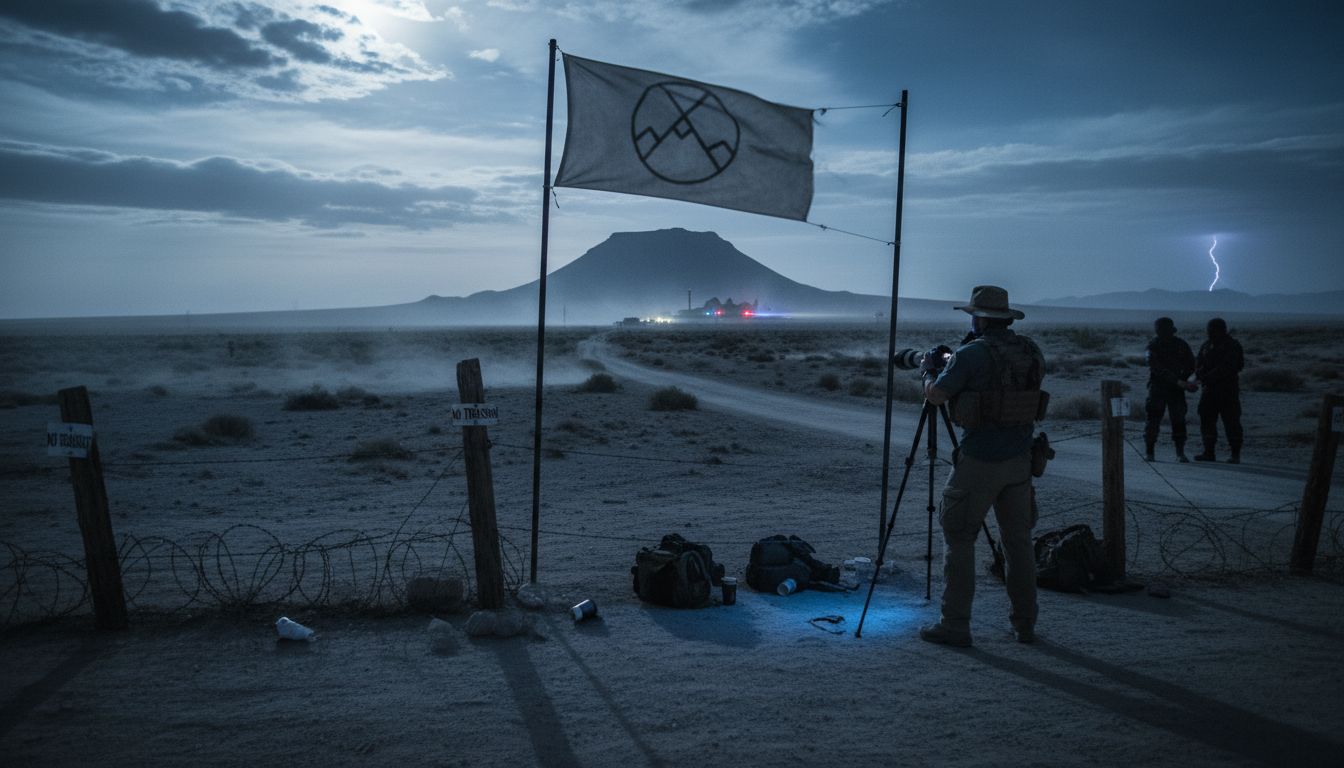
The U.S. Bureau of Land Management (BLM) announced a temporary closure of 22,987 acres surrounding Tikaboo Peak, the most accessible public overlook of the secretive Groom Lake installation commonly known as Area 51. The restriction, effective immediately, follows a series of recent arrests of civilian photographers accused of capturing images of “restricted military sites.” While the BLM describes the measure as a “protective action” to safeguard national security, legal experts note that the closed land is not contiguous with the Air Force’s test range, raising questions about the authority behind the shutdown.
Background
Tikaboo Peak, located in the Nevada desert about 30 miles north of the Groom Lake complex, has long been a magnet for aviation enthusiasts, UFO investigators, and tourists seeking a glimpse of the highly classified base. Since the Air Force’s 1995 “no‑fly zone” that barred public access to the original viewpoint at the “Groom Lake Road,” Tikaboo has served as the de‑facto “window” for civilian observation. Over the past decade, the site has seen a steady increase in visitors, spurred by online forums and social‑media groups that share coordinates, timing tips, and equipment recommendations.
In early April 2026, federal authorities arrested three individuals near the peak after they were found operating high‑resolution cameras and drone equipment aimed at the base. The arrests were made under the National Defense Authorization Act’s provisions against “unauthorized acquisition of restricted military imagery.” The BLM’s subsequent closure notice cites the need to “prevent further unauthorized surveillance” and to “ensure the safety of both the public and ongoing operations at Groom Lake.”
Legal and Policy Considerations
The closure raises complex legal issues. Under the Federal Land Policy and Management Act (FLPMA), the BLM can restrict access to public lands for national security reasons, but such actions typically require a demonstrable link to the protected facility. Critics point out that the 22,987‑acre block is separated from the Air Force’s 2,400‑square‑mile test range by more than 15 miles of open desert, making the direct security justification less clear.
Civil‑rights attorney Maya Patel of the ACLU’s Nevada chapter commented, “While the government has a legitimate interest in protecting sensitive operations, the blanket closure of a vast public‑land area that does not abut the base could set a concerning precedent for overreach.” Legal scholars at the University of Nevada, Reno, have indicated that a challenge could be filed under the Administrative Procedure Act, arguing that the BLM failed to provide a reasoned explanation for the non‑contiguous restriction.
Reactions from Stakeholders
Local businesses that depend on tourism have expressed alarm. John Ramirez, owner of the nearby “Desert Sky Outfitters,” said, “Tikaboo Peak brings hundreds of visitors each year; the closure hits our economy hard and leaves many wondering why a scenic viewpoint is now off‑limits.” Meanwhile, the Nevada Department of Wildlife reiterated that the area remains open for wildlife observation, but that any approach within the newly designated perimeter is prohibited.
Federal officials remain tight‑lipped about the specifics of the security concerns. A BLM spokesperson, Karen Liu, stated, “The decision was made after a thorough risk assessment. Our priority is to protect national security assets while balancing public access wherever possible.” The statement stopped short of confirming whether the closure will be lifted once the investigation concludes.
Outlook
The BLM has labeled the restriction “temporary”, but no timeline has been provided. If legal challenges proceed, a court could order a partial reopening or demand a more detailed justification from the agency. In the meantime, enthusiasts have turned to alternative, lower‑elevation sites farther from the peak, though none offer the same unobstructed view of Groom Lake.
The incident underscores a broader tension between public curiosity about classified military installations and the government’s mandate to shield sensitive operations. As the case unfolds, observers will watch closely to see whether the closure becomes a short‑term security measure or a precedent for broader limitations on access to public lands adjacent to restricted sites.


