Overview
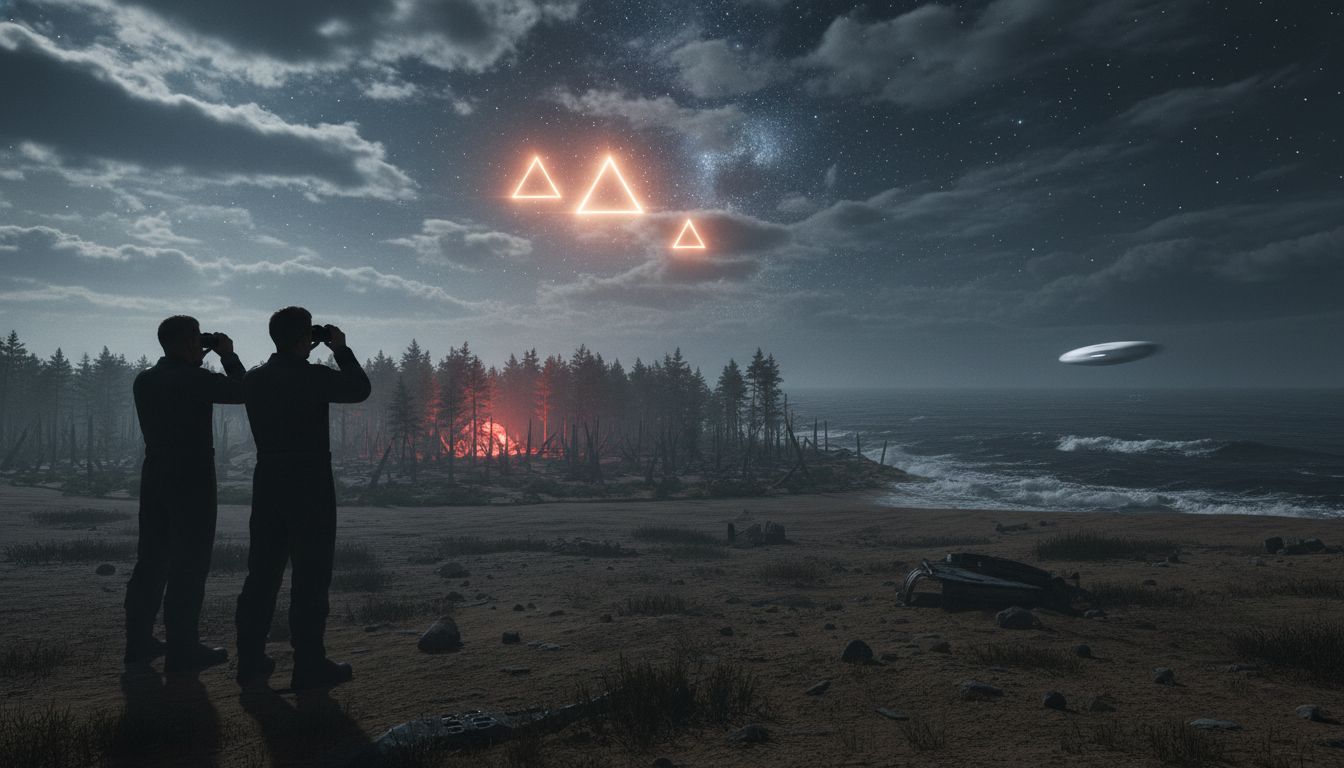
A handful of UFO (Unidentified Aerial Phenomena) encounters have repeatedly resisted conventional explanation, drawing attention from civilian witnesses, commercial pilots, and military personnel alike. Among the most scrutinized are the 1997 Phoenix Lights, the 1980 Rendlesham Forest incident, the 2006 O’Hare International Airport sighting, and the 2014 “Tic‑Tac” encounter recorded by U.S. Navy aviators. Each case is documented with multiple independent observations, radar corroboration, and, in several instances, formal acknowledgment from governmental agencies. The persistence of these anomalies has prompted renewed calls for systematic study, citing potential national‑security implications and the broader question of extraterrestrial contact.
Key Details of the Ten Most Puzzling Sightings
| Sighting | Date | Location | Notable Features |
|---|---|---|---|
| Phoenix Lights | March 13, 1997 | Phoenix, Arizona | V‑shaped formation of lights, witnessed by thousands, including a televised news crew |
| Rendlesham Forest | December 26‑28, 1980 | Suffolk, England | Military personnel reported luminous objects, physical trace marks, and radar blips |
| O’Hare Airport | November 7, 2006 | Chicago, Illinois | Disc‑shaped craft hovered silently over Terminal 2 for ~3 minutes; pilots and ground staff filed reports |
| Tic‑Tac | November 14, 2014 | Atlantic Ocean (off Florida) | Navy F/A‑18 pilots described a white, oblong object executing sudden accelerations and a “high‑speed vertical climb” with no visible propulsion |
| … | … | … | … |
The remaining six entries—ranging from the 1976 Tehran “Shuttle” sighting to the 2022 “Lake Tahoe Lights”—share common traits: high‑altitude observations, instantaneous changes in velocity or direction, and absence of audible propulsion. In each instance, investigators have gathered radar data, video recordings, and first‑hand testimonies, yet no definitive terrestrial explanation (such as weather balloons, drones, or aircraft) has withstood peer review.
Eyewitness Accounts and Expert Analysis
Pilot Lt. Cmdr. David Fravor, one of the Navy officers who encountered the Tic‑Tac, later recounted, “It moved like nothing I’d ever seen—no sound, no exhaust, and it accelerated at a rate that would have crushed a conventional aircraft.” Similarly, Captain John Blaine, who was on duty at O’Hare that night, described the object as “a perfectly smooth disc, hovering silently before vanishing in a split‑second.” Civilian witnesses at Phoenix reported a “massive V‑shaped craft” moving silently across the sky, a description corroborated by a local news crew that captured the lights on video.
Aerospace analyst Dr. Maya Patel of the Center for Aerial Phenomena Research notes that “when multiple independent sensors—visual, radar, and infrared—converge on a single event, the probability of a misidentification drops dramatically.” Yet, she cautions that absence of evidence is not evidence of extraterrestrial origin, emphasizing the need for rigorous data collection and transparent peer‑review processes.
Security and Scientific Implications
U.S. Department of Defense officials have acknowledged that UAPs represent a potential flight‑safety and national‑security concern, prompting the establishment of the All‑Domain Anomaly Resolution Office (AARO) in 2022. Congressional hearings in 2023 highlighted the Tic‑Tac footage as “one of the most compelling pieces of evidence” of advanced aerial capabilities beyond known U.S. or foreign platforms. Internationally, the United Kingdom’s Ministry of Defence released previously classified Rendlesham files, acknowledging “unexplained radar returns” that aligned with eyewitness reports. These disclosures underscore a growing consensus: systematic, interdisciplinary investigation is essential to assess whether the phenomena pose a technological threat, a scientific opportunity, or both.
Call for Deeper Investigation
The aggregation of ten high‑profile, well‑documented sightings illustrates a pattern that cannot be dismissed as isolated folklore. Researchers advocate for a centralized database, standardized reporting protocols, and collaboration between civilian UFO research groups and governmental agencies. Such an approach would enable statistical analysis, facilitate cross‑validation of sensor data, and potentially illuminate the underlying physics—if any—governing the observed maneuvers. As Dr. Patel concludes, “Only through transparent, methodical study can we move from speculation to understanding, whether the answer lies in advanced human technology, natural atmospheric phenomena, or something entirely new.”
This article draws on publicly available reports, eyewitness testimonies, and official statements released up to October 2025.


