Overview
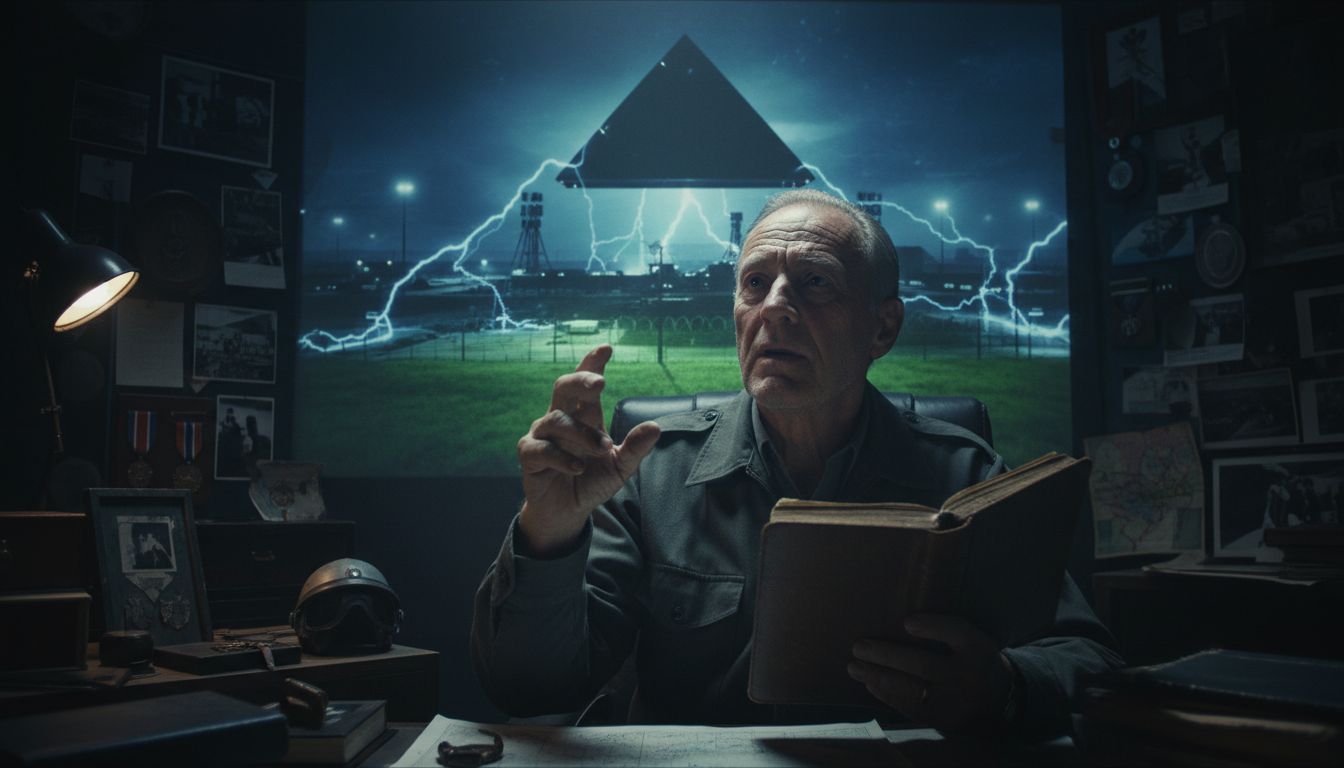
A former senior fighter pilot has spoken publicly for the first time about a 1980 encounter with an unidentified aerial phenomenon (UAP) at a U.S. nuclear weapons complex. The pilot, who requested anonymity for security reasons, described a “50‑foot triangular craft” that reportedly disabled the base’s security systems and hovered silently for several minutes before disappearing. The disclosure comes 45 years after the event and follows a wave of whistle‑blower testimonies released in November 2025 that suggest systematic non‑human surveillance of nuclear facilities.
The Pilot’s Account
The pilot, who flew F‑15s during the Cold War and later held a command position at the base, recounted the incident in a recorded interview released to the press. He said the aircraft was on a routine patrol over the Pantex nuclear weapons plant in Texas when radar operators flagged an anomalous contact. “It was a massive, perfectly shaped triangle, roughly 50 feet across, with no visible propulsion or exhaust,” he recalled. “Within seconds the base’s perimeter alarms and infrared sensors went dark, as if the craft emitted some kind of electromagnetic pulse.”
According to the pilot, the craft remained stationary for about three minutes, during which time ground crews reported a sudden loss of communications and a brief, low‑frequency hum that could be heard inside nearby control rooms. When the craft finally ascended, it accelerated to a speed that outpaced the fastest fighter jets of the era, disappearing beyond the radar horizon. The pilot emphasized that he reported the sighting through official channels at the time, but “the record was sealed, and I was instructed not to discuss it further.”
Historical Context of UAPs at Nuclear Sites
The pilot’s testimony aligns with a pattern documented in multiple government and independent investigations. The 2020 Office of the Director of National Intelligence (ODNI) report on UAPs highlighted a “high frequency of encounters near nuclear weapons installations and missile test ranges.” Subsequent congressional hearings in 2022 and 2023 cited similar accounts from pilots, radar operators, and ground personnel.
Researchers such as Dr. Jacques Vallée and the National Aviation Reporting Center on Anomalous Phenomena (NARCAP) have noted that the triangular shape is a recurring descriptor in UAP reports, dating back to the 1940s “Foo Fighters” and the 2004 “Nimitz” incident. While many sightings can be linked to experimental aircraft or atmospheric phenomena, the combination of electromagnetic interference and proximity to strategic assets remains unexplained.
Recent Disclosures and Validation
In November 2025, a classified whistle‑blower dossier was declassified by the Department of Defense, revealing internal memos that corroborated multiple civilian and military reports of non‑human surveillance over nuclear facilities. The documents referenced “unidentified objects exhibiting capabilities beyond known technology” and recommended heightened monitoring protocols.
Analysts from the Congressional UAP Research Panel have cited the pilot’s 1980 account as a “representative case” illustrating the long‑standing challenges of gathering verifiable data. “When credible witnesses from the highest echelons of the Air Force come forward, it forces a reassessment of our intelligence collection and threat‑assessment frameworks,” said Representative Mike Turner, a member of the panel.
Implications and Next Steps
The pilot’s revelation, while dramatic, underscores the need for systematic, transparent investigation rather than sensational speculation. Defense officials have pledged to expand the All‑Domain Anomaly Resolution Office (AARO) and to integrate UAP reporting mechanisms across all branches of the armed services.
Civil‑rights groups and scientific bodies are urging the government to release more data to enable independent analysis. “Public confidence hinges on openness,” noted Dr. Sara Klein, a senior researcher at the Center for Aerospace Studies. “If these phenomena pose a national‑security risk, we must understand their capabilities and intent, however elusive they may be.”
As the Pentagon moves toward a more structured approach, the pilot’s long‑held story adds a critical piece to the evolving mosaic of UAP research—one that bridges Cold‑War era encounters with contemporary disclosures, and challenges policymakers to confront a phenomenon that remains, for now, beyond conventional explanation.