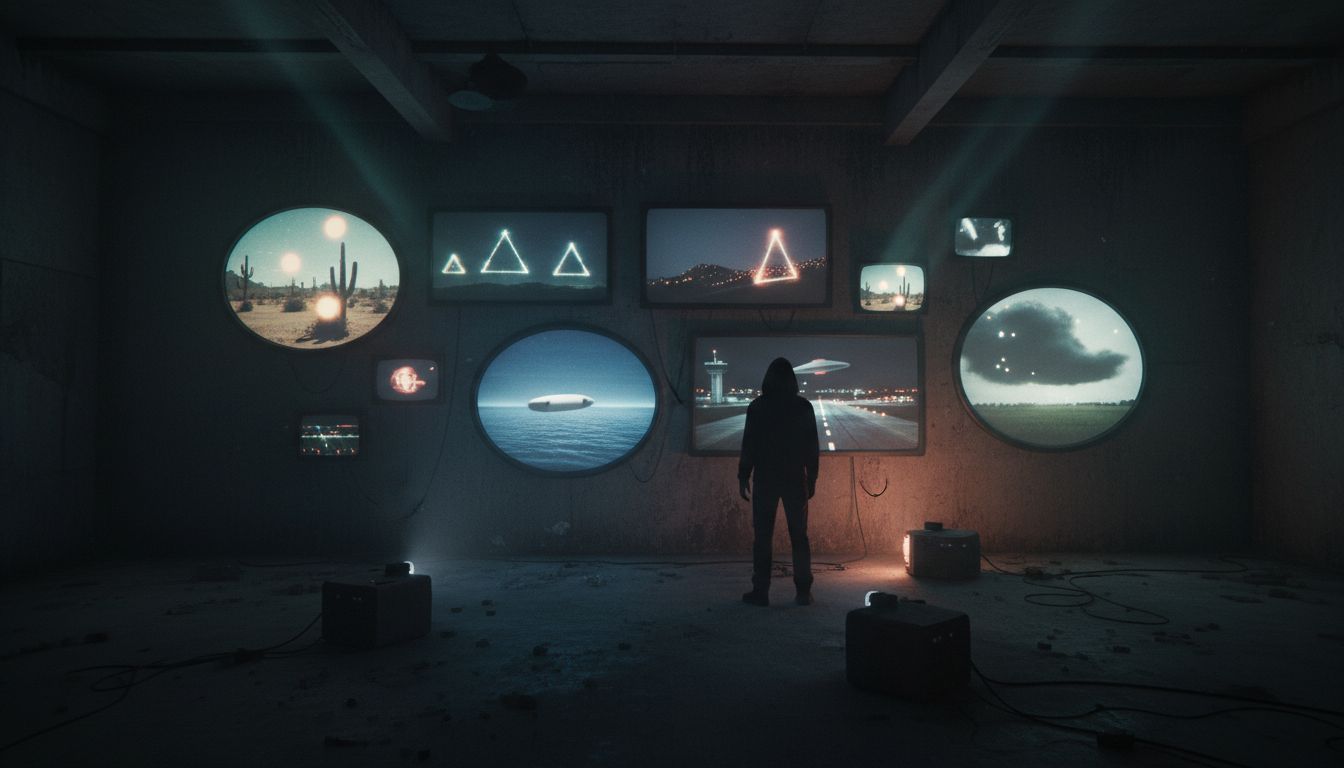
Overview
In recent years, de‑classified footage and civilian recordings have thrust the subject of unidentified aerial phenomena (UAP) into mainstream discourse. From the 1947 Roswell crash to the 2004 “Tic‑Tac” encounter captured by Navy pilots, the videos now circulating in public archives display flight characteristics—rapid acceleration, abrupt changes of direction, and silent hovering—that challenge conventional aeronautical explanations. While skeptics point to misidentified aircraft, atmospheric effects, or camera artifacts, the consistency of witness testimony and the involvement of U.S. defense agencies have prompted a more rigorous scientific inquiry.
Key Historical Clips
The earliest widely discussed visual evidence stems from the Roswell incident on July 2, 1947, when a rancher reported debris that some later described as a “flying saucer.” Although the original footage consists of newspaper reels and later reenactments rather than real‑time video, the episode set a cultural precedent for government secrecy claims. Decades later, the Phoenix Lights of March 13, 1997 provided a stark contrast: thousands of residents across Arizona captured a series of massive V‑shaped lights moving silently across the night sky. Analysis of the video frames shows a uniform formation that does not match known military flares or conventional aircraft, a point highlighted by Dr. Jacques Vallee, a senior researcher at the UFO Research Center, who noted, “The geometry and lack of propulsion signatures remain unexplained.”
Modern Military Recordings
The most compelling recent material originates from the U.S. Navy’s Advanced Aerospace Threat Identification Program (AATIP) and its successor, the All‑Domain Anomaly Resolution Office (AARO). On November 14, 2004, pilots from the USS Nimitz carrier strike group recorded a “Tic‑Tac” shaped object off the coast of San Diego. The infrared video, released by the Pentagon in 2020, shows an object accelerating to speeds exceeding Mach 5 while executing instantaneous stops and vertical climbs—maneuvers that exceed the performance envelope of known aircraft. Lieutenant Commander David Fravor, who led the intercept, later told reporters, “It moved like nothing I’ve ever seen; it vanished in a blink, leaving no sonic boom.”
A separate clip, often referred to as the “Nimitz UFO,” captured by the same task force’s radar and visual sensors, reinforces these observations. The footage reveals a low‑observable craft executing rapid lateral shifts without visible propulsion, prompting the Department of Defense to describe the phenomenon as “unexplained aerial objects that may pose a flight safety risk.”
Civilian Sightings and International Cases
Beyond U.S. military encounters, civilian videos continue to surface. The Chicago O’Hare incident of November 2006, recorded by airport staff, shows a disc‑shaped object hovering above a terminal before disappearing. Although the FAA classified the event as a “weather balloon” after investigation, the original video retains a steady, luminescent outline that some analysts argue is inconsistent with balloon dynamics.
In Australia, the Westall School sighting of April 1966—documented by multiple student‑taken films—features a cluster of bright lights descending rapidly and vanishing within seconds. While Australian defense officials have not released an official assessment, the incident is frequently cited in comparative studies of UAP reports across the Southern Hemisphere.
Emerging Context and Skeptical Review
The Pentagon’s 2022 UAP report acknowledged 144 sightings by military personnel, with approximately 25 % remaining “unexplained” after preliminary analysis. This admission has spurred congressional hearings and calls for a standardized data‑collection framework. Yet, scientific skeptics caution against overinterpretation. Dr. Michael Shermer of the Skeptics Society remarks, “Video artifacts, lens flares, and misidentified drones can produce spectacular effects; rigorous peer‑review is essential before attributing these to advanced technology.”
Nevertheless, the convergence of high‑resolution military footage, credible eyewitness accounts, and governmental transparency marks a shift from fringe speculation to a subject of legitimate national‑security interest. As agencies like AARO expand their investigative capacity, the next wave of released videos may either demystify these phenomena or deepen the mystery—underscoring the need for objective, data‑driven analysis in the years ahead.


