Overview
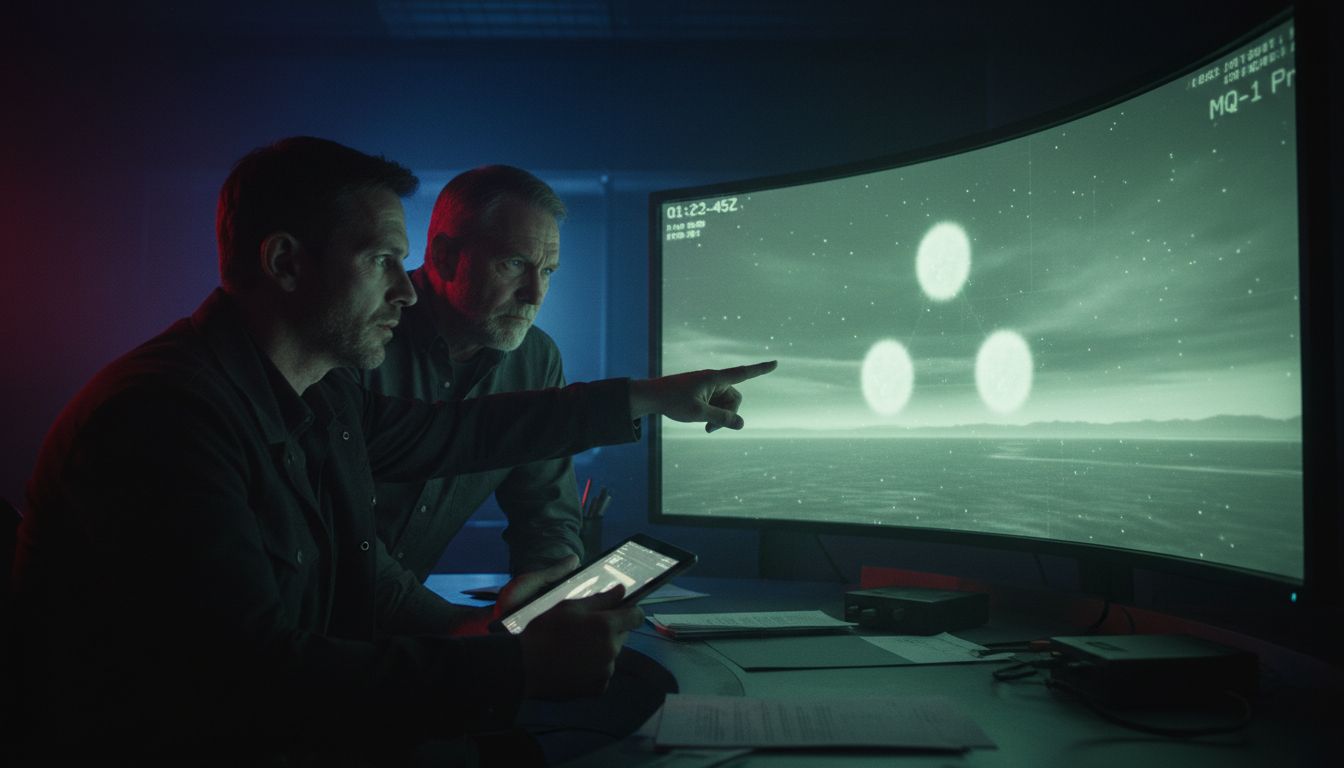
Investigative journalists Jeremy Corbell and George Knapp have released, for the first time, a classified video captured by a U.S. Air Force‑directed MQ‑1 Predator drone on 23 August 2012 over the Persian Gulf. The thermographic (FLIR) footage shows three luminous “orbs” moving in a tight triangular formation at 18:21 UTC, performing abrupt directional changes without any discernible propulsion plume or heat signature. The material, now catalogued by the United States intelligence community as “UAP orbs,” adds to a growing body of evidence that the Department of Defense is formally acknowledging the presence of Unidentified Anomalous Phenomena in operational airspace.
Key Details
The video, recorded at coordinates 28°27′17.0″ N, 50°33′37.0″ E, was obtained from a high‑confidence source within the Predator’s data archive. Analysts note that the objects were actively tracked by the drone’s sensors, indicating that the platform’s operators recognized them as distinct contacts rather than sensor artifacts. Throughout the 30‑second clip, the orbs execute rapid, angular turns and maintain formation despite the absence of conventional aerodynamic surfaces or exhaust plumes. The FLIR imagery registers no thermal contrast against the surrounding sea and sky, a factor that has puzzled both military and civilian experts tasked with evaluating the phenomenon.
Context within UAP Investigations
Since the 2020 release of the UAP Task Force report, the intelligence community has steadily de‑classified sightings that meet stringent criteria for “unidentified.” The Pentagon’s All‑Domain Anomaly Resolution Office (AARO) now maintains a database that includes over a thousand such events, many of which involve radar‑visible objects that evade visual identification. The 2012 Persian Gulf incident aligns with prior reports of triangular formations—notably the 2004 “Nimitz” encounter—yet distinguishes itself by the exclusive reliance on infrared imaging, eliminating visual‑light bias. Researchers such as Dr. Jacques Vallée have long argued that formation flight suggests a level of coordinated control, a point reinforced by the Predator’s on‑board tracking logs indicating intelligent maneuvering rather than random drift.
Expert Commentary
Corbell, whose documentary work has previously highlighted Navy pilot testimonies, emphasized the strategic implications:
“No matter where UFOs are from – it is now openly admitted by our Department of War that they are appearing with an increased frequency worldwide. It’s time to acknowledge the UFO problem – as this case reveals that incursions by UAP pose a significant challenge for our collective defense apparatus.”
George Knapp, a veteran investigative reporter on aerospace anomalies, added that the footage “provides a rare, high‑resolution glimpse of an event that was previously known only through anecdotal accounts.” Both journalists stress that the release aims to foster transparency and reduce the stigma that has historically hampered scientific inquiry into UAPs.
Implications for Defense and Policy
The emergence of a high‑confidence, sensor‑verified record of coordinated, propulsion‑less flight raises several questions for national security planners. If the objects possess capabilities beyond current aerospace technology, they could represent a potentially adversarial system or an unknown natural phenomenon with strategic relevance. Congressional oversight committees, which have recently pushed for more rigorous reporting requirements, may now have concrete data to justify increased funding for AARO’s analytical tools. Moreover, the incident underscores the need for inter‑agency data sharing, as the original flight logs were reportedly generated under Air Force command but are now being examined by intelligence analysts, civilian scientists, and the broader public.
The Persian Gulf triangle formation footage marks a significant milestone in the ongoing effort to document and understand UAP activity. By making the video publicly accessible, Corbell and Knapp hope to encourage a rational, evidence‑based dialogue that bridges the gap between classified military observations and open‑source scientific research. As the Department of Defense continues to refine its approach to unidentified aerial phenomena, incidents like this will likely shape both policy and public perception for years to come.