Overview
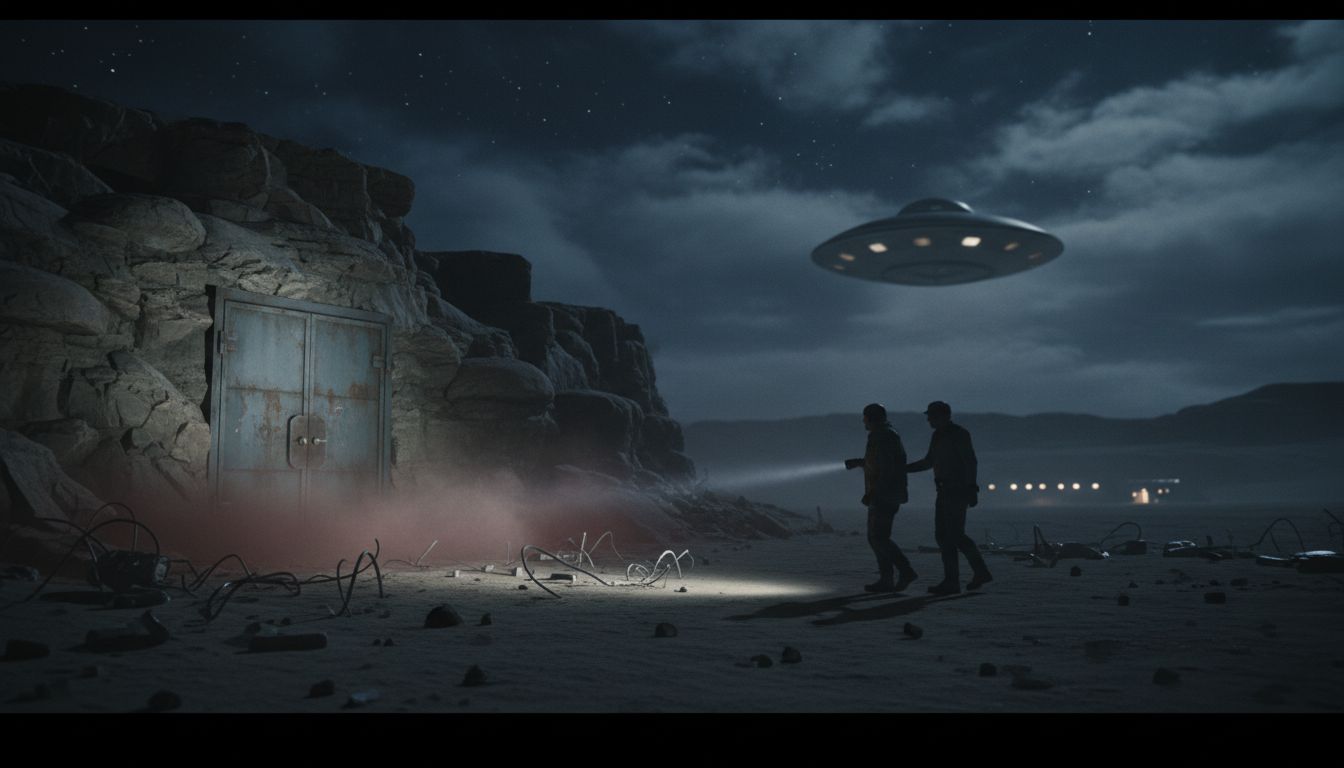
The documentary “Trip to Nowhere: A Bob Lazar Story” (Eyes On Cinema, 2026) revisits the claims that have kept Bob Lazar at the center of UFO discourse for nearly four decades. Lazar, a self‑described physicist, alleges that in late 1988 he was recruited to work on reverse‑engineering alien propulsion systems at a secretive Nevada installation known as S‑4, adjacent to the famed Area 51. The film assembles archival footage, interview excerpts, and documentary‑style analysis to invite researchers to examine the narrative with a critical eye, emphasizing that the story’s persistence stems as much from its gaps as from its intrigue.
Claims and Evidence
Lazar’s account rests on several specific assertions. He says he was hired through the recommendation of Dr. Edward Teller, the “father of the hydrogen bomb,” and assigned to EG&G Special Projects to work at S‑4. According to Lazar, the mountain‑side facility housed nine “flying saucers” and employed a gravity‑propulsion system powered by element 115 (Moscovium)—a then‑undiscovered isotope. He described one craft, dubbed the “Sport Model,” as approximately 16 feet tall and 52 feet in diameter, with an interior designed for occupants “smaller than humans.” In a 1989 hypnosis session, Lazar recounted seeing a “small, grey” entity through a window, later qualifying the memory by saying, “I’m not sure if it was a doll or a living being.” The documentary also highlights a purported W‑2 form issued by the “United States Department of Naval Intelligence,” which Lazar claims was part of a broader pattern of intimidation and alleged memory tampering by government agents.
Key Figures
The film situates Lazar’s story within a network of journalists, scientists, and UFO investigators. George Knapp, a KLAS‑TV reporter, first aired Lazar’s allegations in May 1989 under the pseudonym “Dennis,” later revealing Lazar’s identity in November 1989 to “save his life.” John Lear, a former CIA pilot, introduced Lazar to the UFO community and accompanied him on desert trips that were reportedly halted by security personnel. Gene Huff, a real‑estate appraiser, corroborated Lazar’s presence at test‑flight sites. The documentary also references Jacques Vallee, an astrophysicist who has examined Lazar’s demeanor for signs of memory alteration, and Stanton Friedman, a nuclear physicist who questioned Lazar’s academic credentials at MIT and Caltech, noting the absence of official transcripts.
Timeline and Locations
Key dates anchor the narrative. In June 1982, a Los Alamos newspaper featured Lazar’s jet‑powered car, an episode he claims led to his meeting with Teller. By late 1988, Lazar says he began employment at S‑4. On March 22 and 29, 1989, Lazar, Lear, and Huff allegedly filmed test flights of the saucers before being intercepted by security. The first public interview with Knapp occurred in May 1989, and Lazar’s full‑name disclosure followed in November 1989. The alleged site, S‑4, is described as a concealed complex near Papoose Lake, south of Groom Lake (Area 51), built into the side of a mountain and inaccessible to outsiders.
Assessment and Takeaway
While the documentary refrains from sensationalizing Lazar’s story, it underscores the persistent absence of verifiable academic records and the lack of independently


