Overview
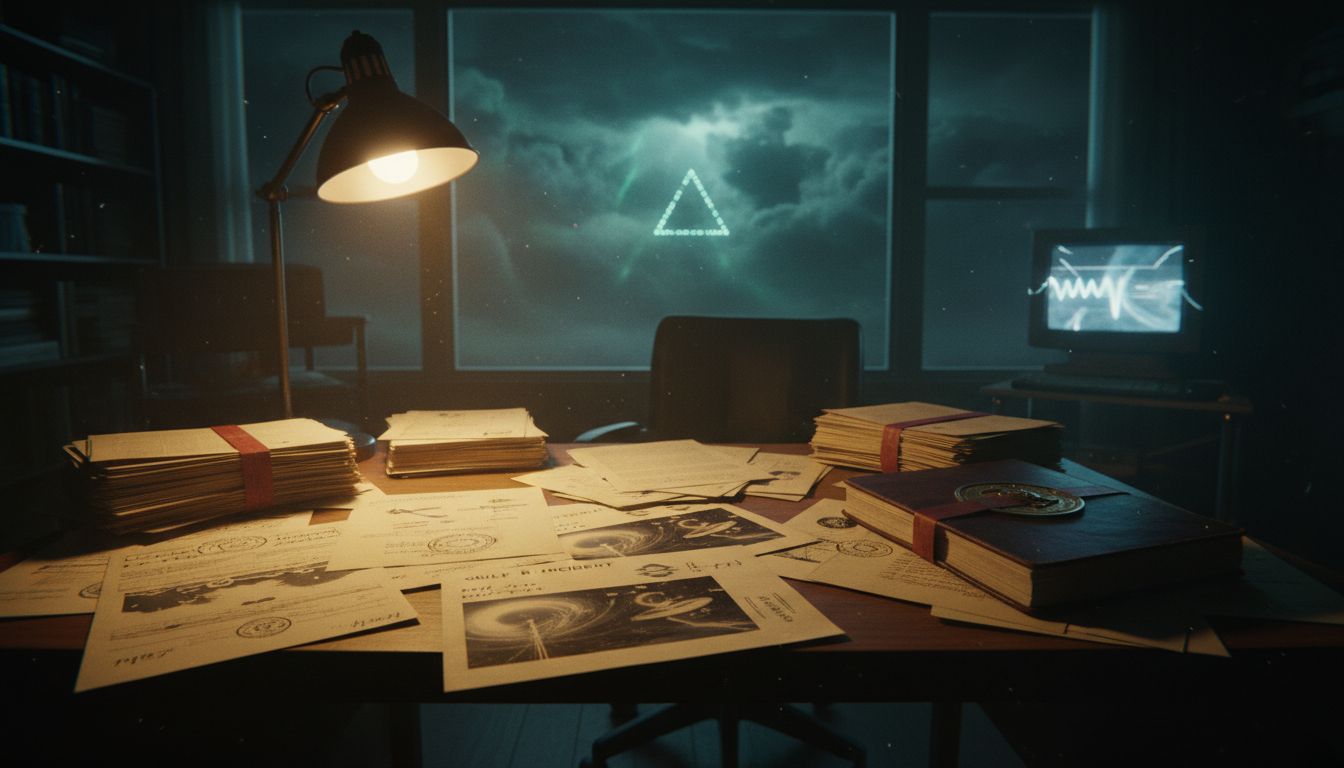
A cache of internal documents from Los Alamos National Laboratory (LANL) has been released to filmmaker Jeremy Corbell, who says the material proves the lab was running a covert program to study unidentified aerial phenomena (UAP). The documents, allegedly belonging to the late cybersecurity chief of LANL, were obtained by Corbell’s team after the chief’s death in early 2026. According to the filmmaker, the files include classified memos, technical drawings and Polaroid photographs that detail “atmospheric anomalies” and reference historic incidents such as the 1987 Gulf Breeze sightings in Florida. The release coincides with the disappearance in 2025 of two LANL researchers, Anthony Chavez and Melissa Casias, who were reportedly working on the same UAP project.
Document Findings
The leaked papers consist of roughly 120 pages of internal correspondence spanning 2022‑2025. Several memos, marked “TOP‑SECRET – UAP RESEARCH,” describe experimental sensor arrays installed on the laboratory’s high‑altitude test platform. One diagram shows a “tri‑spectral lidar” aimed at capturing “non‑conventional electromagnetic signatures” that, according to the note, “exhibit flight characteristics inconsistent with known aircraft.” A series of Polaroid images, dated March 2024, depict faint, disc‑shaped objects hovering above the New Mexico desert, captured during routine calibration flights. In a February 2025 briefing, senior physicist Dr. Elena Mendoza (identified in the files) wrote, “Preliminary analysis suggests these phenomena may involve localized atmospheric refractive effects, but the data warrants further investigation.”
Link to the Missing Scientists
Anthony Chavez, a senior aerospace engineer, and Melissa Casias, a data‑analysis specialist, were listed as the lead analysts on the “UAP Atmospheric Interaction” task force. Their last known assignment, according to the documents, was a field test in late 2024 intended to validate the lidar system’s ability to track high‑velocity objects. Both scientists vanished from the Los Alamos campus in June 2025 under circumstances that remain unclear. LANL spokesperson Karen Liu declined to comment on the missing personnel, citing an ongoing internal investigation, while the Department of Energy’s Office of Science confirmed that the two were “active on a classified project” but offered no further details.
Documentary and Reactions
Corbell’s forthcoming documentary, “Sleeping Dog,” will feature the leaked memos, technical schematics and the Polaroid photographs as central evidence. In a recent interview, Corbell said, “These are not speculative sightings; they are hard‑copy records from a federal laboratory that explicitly acknowledge a hidden research effort.” The filmmaker has scheduled a private screening for members of the UAP Task Force and invited former Pentagon officials who participated in the 2022 Office of the Director of National Intelligence (ODNI) UAP report. Critics, however, caution against drawing definitive conclusions from the material. Dr. Michael Hernandez, a senior analyst at the Center for Aerospace Studies, noted, “While the documents are intriguing, they do not constitute proof of extraterrestrial technology. They could reflect experimental physics projects that remain classified for national‑security reasons.”
Broader Context
The release arrives amid heightened public and congressional interest in UAPs following the 2022 ODNI assessment, which acknowledged “unidentified aerial objects that may pose a flight‑safety or national‑security risk.” Los Alamos, historically known for nuclear research, has previously been linked to classified aerospace programs, but official statements have never confirmed a dedicated UFO research division. If the documents are authentic, they would add a new layer to the ongoing debate about the extent of government involvement in UAP investigations. As the documentary prepares for release later this year, policymakers and intelligence officials are expected to request a formal review of the materials, while families of Chavez and Casias hope the revelations may finally shed light on their loved ones’ disappearance.


