Overview
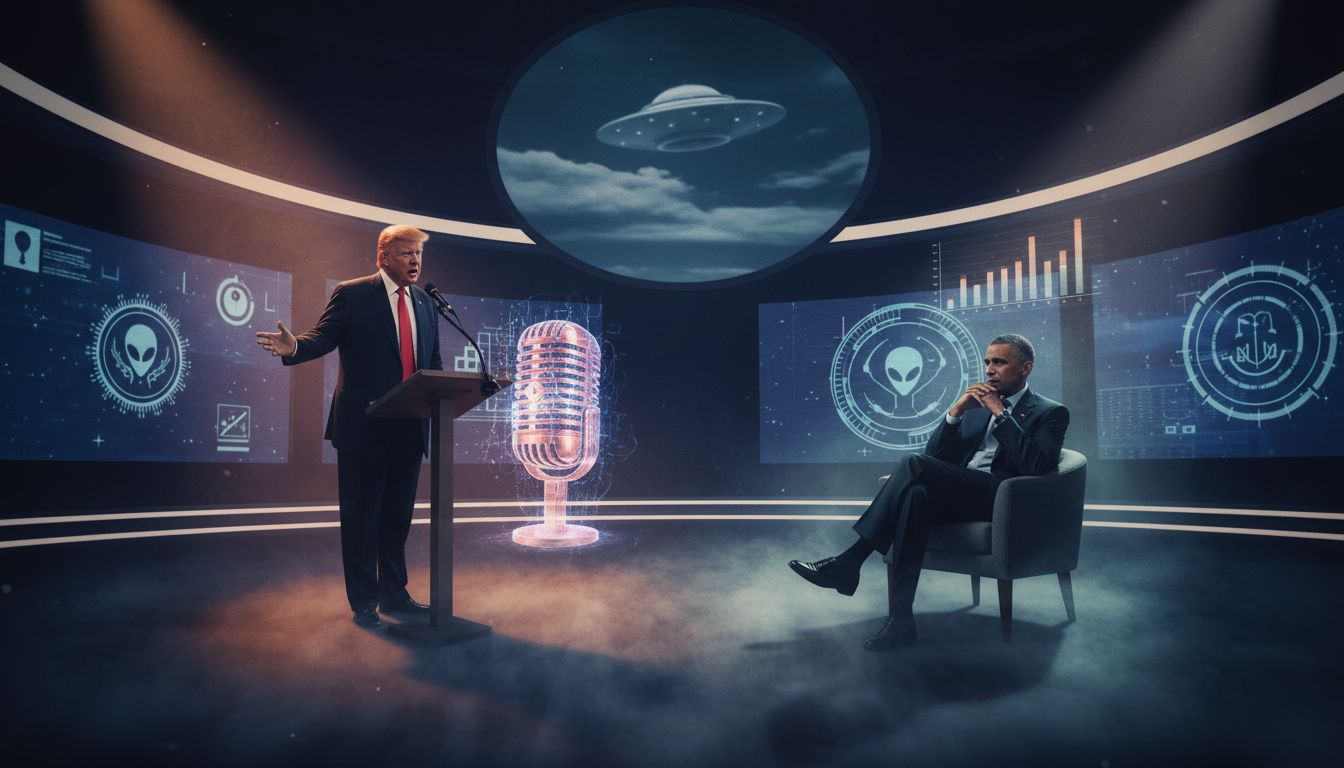
Former President Donald Trump publicly condemned former President Barack Obama for what he described as a “big mistake” in revealing classified information about extraterrestrial life during a recent podcast interview. Trump asserted that Obama’s statement—suggesting that “aliens are real” and that the government possesses evidence—constituted an unauthorized disclosure of sensitive material. The remarks come amid a surge of congressional and public interest in Unidentified Aerial Phenomena (UAP), following the Pentagon’s 2024 release of a de‑classified report and the establishment of a dedicated inter‑agency task force.
Background
In a March 2025 episode of the “Future Frontiers” podcast, Obama addressed a question on the likelihood of extraterrestrial intelligence, noting that statistical models indicate a high probability of life elsewhere in the universe but emphasizing that no concrete evidence had been uncovered during his administration. The comment was framed as a scientific perspective rather than an admission of classified findings. Since then, the UAP community has been closely monitoring any public statements that could hint at hidden data, especially after the 2024 U.S. intelligence assessment acknowledged “multiple credible sightings” of unexplained aerial objects.
Trump’s Accusation
During a press briefing on February 19, 2026, Trump claimed that Obama’s podcast remark “crossed the line” by implicitly revealing classified information. He alleged that the former president’s phrasing suggested the existence of a secret repository of alien‑related evidence, which Trump said should have remained confined to secure channels. “If you’re going to talk about classified material, you do it behind closed doors, not on a public platform,” Trump told reporters, adding that the disclosure could jeopardize national security and diplomatic relations with potential extraterrestrial interlocutors. He also announced that his administration would direct the release of all government alien and UFO files to multiple federal agencies nationwide for review, citing the need for “full transparency and proper oversight.”
Obama’s Response
When asked to comment on Trump’s allegations, Obama reiterated that his podcast remarks were purely speculative and grounded in publicly available scientific discourse. “I was discussing the statistical probability of life elsewhere in the cosmos, not confirming any classified program,” Obama said in a brief statement released by his office. He noted that while the U.S. government continues to investigate UAP incidents, no definitive proof of extraterrestrial technology has been found to date. Obama also warned against politicizing the issue, urging both parties to focus on rigorous investigation rather than sensational claims.
Implications and Next Steps
The exchange underscores the heightened political sensitivity surrounding UAP disclosures. Congressional committees, including the House Committee on Oversight, have already scheduled hearings to examine the scope of the Pentagon’s UAP task force and the criteria for de‑classifying related documents. Trump’s pledge to disseminate alien‑related files to a broader network of agencies could lead to expanded inter‑agency collaboration, but it also raises questions about data security and the potential for premature public release. Analysts caution that while public interest is legitimate, any release must balance transparency with the protection of intelligence methods and diplomatic considerations. As the debate continues, both the Trump and Obama camps appear poised to let the forthcoming agency reviews determine whether any classified UAP information was indeed mishandled.