Overview
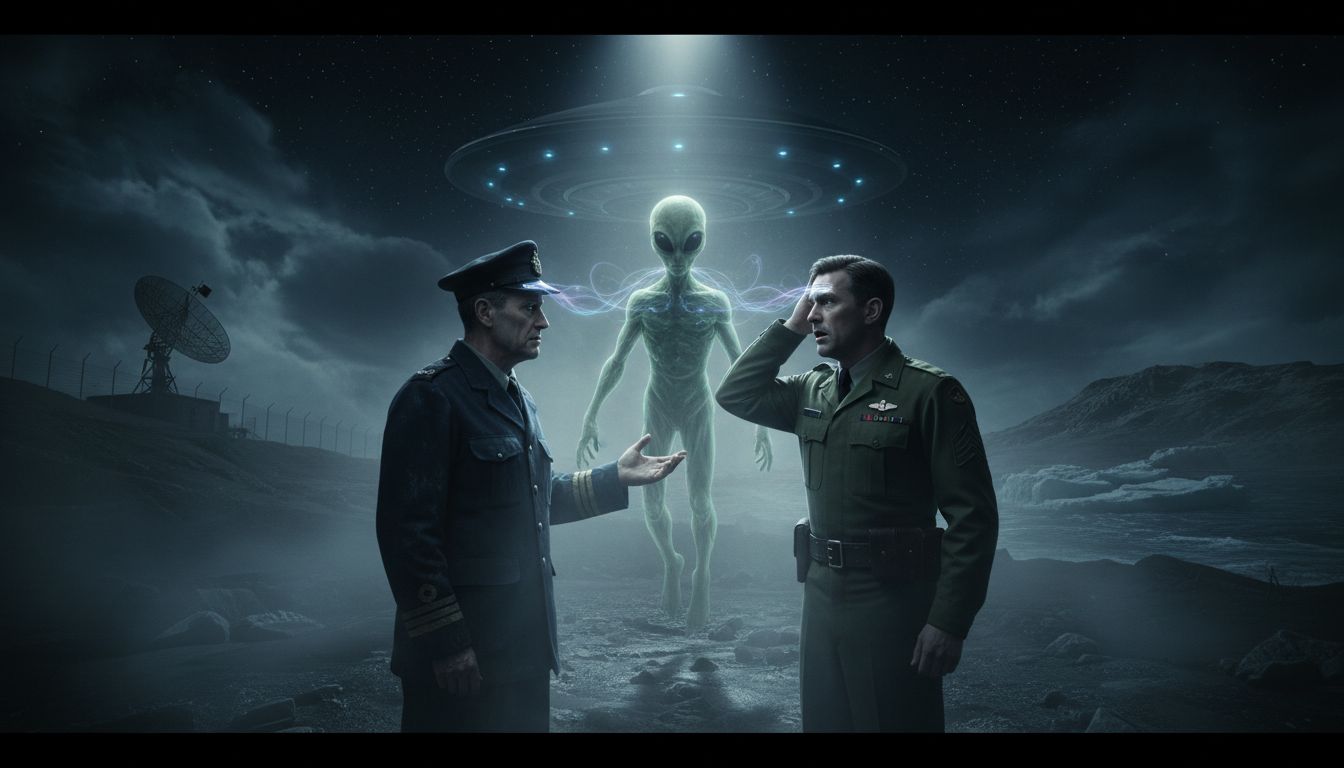
On February 10, 2026, two retired service members broke decades‑long silence about encounters they say involved unidentified aerial phenomena (UAP) and non‑human entities. Former Royal Navy sailor John Seer, who served aboard a North Atlantic patrol vessel in 1980, and former United States Air Force security guard Richard Barth, who was stationed at Vandenberg Air Force Base in 1964, described remarkably similar experiences that included paralysis, vivid visual impressions, and what they interpreted as telepathic communication from “gray‑skinned beings.” Both men assert that the entities warned them about humanity’s future relationship with nuclear technology and urged a path toward peaceful development.
Witness Accounts
Seer recounted a night watch in the North Atlantic when a luminous object hovered above the ship, emitting a low hum. “The next thing I knew, I was unable to move,” he said in a recorded interview. “It felt like an invisible force pressed down on my chest. Then a presence entered my mind, not with words but with images and feelings.” He described the beings as approximately four feet tall, with large heads and dark, almond‑shaped eyes. According to Seer, the communication centered on humanity’s trajectory: “They showed us a timeline where nuclear weapons are used, and then a stark image of a world devastated by that choice. They urged us to choose cooperation over conflict.”
Barth’s account, set at Vandenberg AFB, mirrors Seer’s in several details. While on guard duty in 1964, he witnessed a disc‑shaped craft descend near the runway. “I was frozen, my limbs wouldn’t respond, and a bright, featureless figure hovered inches from my face,” Barth recalled. “It didn’t speak, but thoughts flooded my mind—images of nuclear missiles, a warning to stop the arms race, and a plea to protect the planet.” Both men reported a delayed recollection: the vivid details resurfaced only after years of suppressed memory, prompting them to come forward now.
Scientific and Military Context
These testimonies arrive amid a growing body of declassified UAP reports from the United States Department of Defense and allied nations. Since the 2020 establishment of the All‑Domain Anomaly Resolution Office (AARO), the Pentagon has released over 500 documented sightings, many involving sensor‑based data that corroborate visual accounts. However, direct interactions with alleged non‑human intelligences remain rare and largely anecdotal.
Academic researchers in astrobiology and psychology note that the “gray” archetype has appeared repeatedly in civilian and military reports, raising questions about cultural imprint versus genuine phenomenology. Dr. Elena Ramirez, a cognitive scientist at the University of Cambridge, cautions, “Memory distortion, especially under high‑stress conditions, can produce vivid but inaccurate reconstructions. Yet the convergence of details across independent witnesses warrants systematic investigation.”
Reactions and Implications
The disclosures have elicited a measured response from both governments and the scientific community. The U.S. Air Force’s public affairs office issued a statement acknowledging the reports as “personal recollections that fall outside the scope of current investigative protocols.” In the United Kingdom, the Ministry of Defence reiterated its policy of reviewing historical UAP material but declined to comment on specific cases.
Advocacy groups, such as the Mutual UFO Network (MUFON), have welcomed the testimonies, emphasizing the need for “transparent, interdisciplinary research into potential non‑human contact.” Conversely, skeptics argue that the lack of corroborating radar data or physical evidence limits the credibility of the claims. Nonetheless, the focus on nuclear prevention resonates with ongoing diplomatic efforts to curb proliferation, suggesting that the narratives may influence public discourse on arms control.
Next Steps
Seer and Barth have agreed to cooperate with AARO investigators, offering access to any personal logs, photographs, or medical records from the periods in question. Their participation could help determine whether physiological markers—such as transient electromagnetic disturbances or neurochemical changes—align with their described paralysis and telepathic experiences.
Meanwhile, policymakers are urged to consider the broader implications of these accounts. If, as the witnesses suggest, the entities possess awareness of humanity’s nuclear trajectory, the reports could inform future dialogues on existential risk. As Dr. Ramirez notes, “Even if the phenomena are ultimately explained by natural or psychological mechanisms, the underlying messages about global responsibility merit serious attention.”
The coming months will likely see further data collection, expert panels, and possibly congressional hearings. Whether these decades‑old encounters will reshape the scientific understanding of UAP or remain footnotes in the annals of military folklore remains to be seen, but the willingness of two seasoned veterans to speak openly marks a notable moment in the ongoing quest for clarity.


