Overview
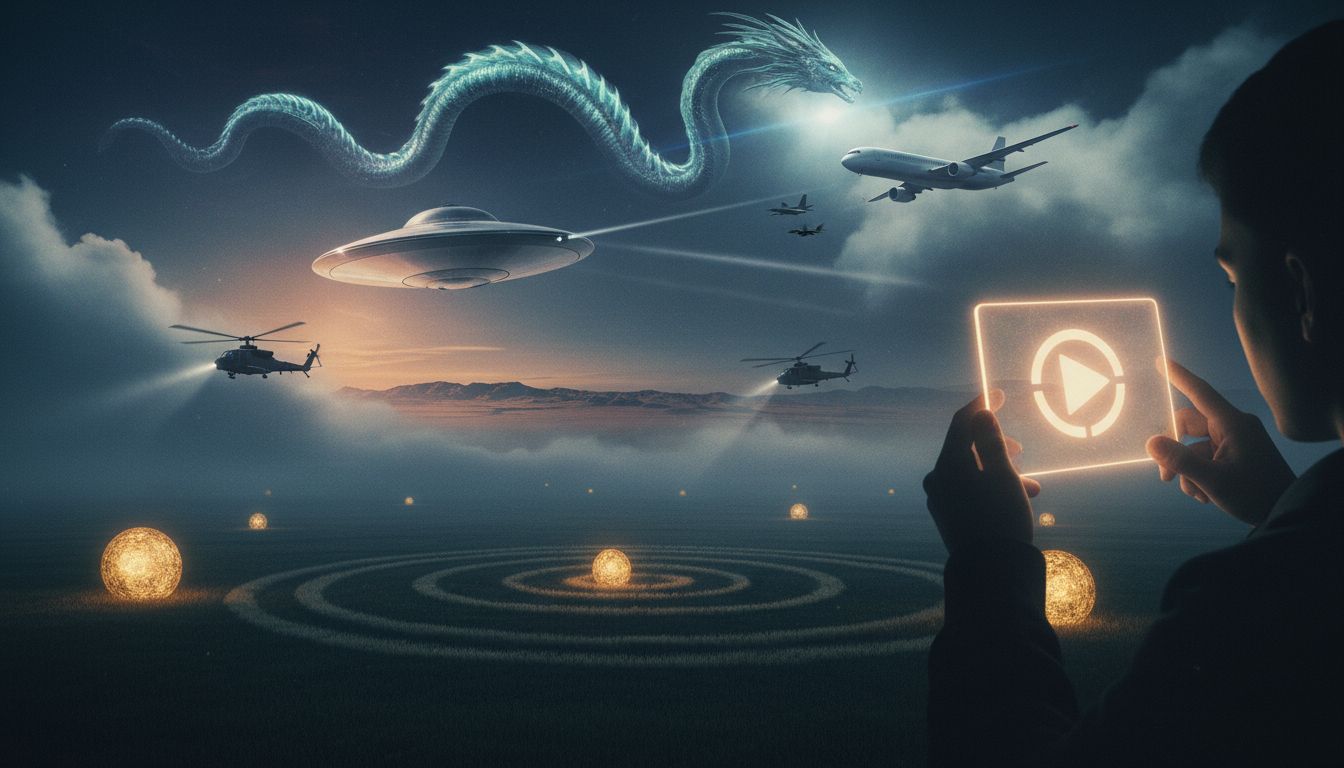
A recent video posted by the YouTube channel UndercoverET compiles and analyses four distinct Unidentified Aerial Phenomena (UAP) sightings recorded in the United Kingdom, United States, and Australia. The presenter frames the material as a call for stricter documentation standards and independent verification of anomalous aerial events. By juxtaposing amateur footage with flight‑tracking data and artificial‑intelligence (AI) image analysis, the segment seeks to demonstrate that the clips are not products of computer‑generated imagery (CGI) and that the observed objects—often described as “orbs,” “rods,” or “dragon UAPs”—exhibit consistent flight characteristics across disparate locations.
Key Sightings
The video highlights four incidents that together illustrate a pattern of high‑speed, low‑altitude objects interacting with conventional aircraft.
Wiltshire, United Kingdom (July 2000) – A VHS‑style recording shows a British military helicopter appearing to pursue small white orbs over a field known for crop‑circle activity. The host notes that AI analysis (using the tool “Grok”) found no evidence of digital manipulation, though the clip was trimmed for brevity.
Logan, Queensland, Australia (November 2023) – Videographer Chris Carncross captured a thin, rod‑like object darting across his backyard at velocities that exceed typical civilian drones. The presenter likens this “Gordon” type to similar rod sightings he recorded near Chippenham, Wiltshire.
Oklahoma, United States (date unspecified) – A researcher identified as Ben (operating the @custodianfile channel) recorded a swarm of more than a dozen tiny objects maintaining a steady altitude while orbiting a commercial airliner. Flight‑tracking data from Flightradar24 corroborates the aircraft’s route and timing.
Marina Del Rey, California (March 2024/2026) – Dr. Robert Schipe documented an LAPD helicopter (registration N224LA) being overtaken by several “dragon UAPs” moving at estimated speeds of roughly 2,500 mph. The footage is accompanied by synchronized radio‑interference “hits,” which the host cites as additional, non‑visual evidence of the objects’ presence.
Verification Methods
UndercoverET emphasizes a multi‑layered approach to authenticity. The presenter employs AI‑driven image forensics to rule out CGI, checks metadata for editing timestamps, and cross‑references flight‑tracking logs to confirm aircraft positions at the moments of sighting. “Every piece of footage must survive its own debunking before we can treat it as evidence,” the host asserts. Moreover, the inclusion of radio‑frequency anomalies—recorded by Dr. Schipe’s equipment—provides an independent data stream that is not subject to visual manipulation. While these methods improve credibility, the analysis acknowledges the limitations of low‑resolution, amateur recordings and the difficulty of measuring exact speeds without calibrated instruments.
Observed Patterns and Implications
Across the four cases, a recurring motif emerges: the objects tend to appear in the minutes immediately before or after a conventional aircraft passes a specific waypoint. In the Oklahoma incident, the swarm lingered near the airliner for several minutes, suggesting a possible monitoring behavior. The California footage shows “dragon UAPs” overtaking a law‑enforcement helicopter at speeds far beyond known aircraft capabilities, raising questions about propulsion mechanisms and air‑space safety protocols. Researchers cited in the video argue that these repeatable temporal and spatial relationships merit systematic study, especially given the potential impact on civil aviation.
Community Response and Future Directions
The presentation concludes with a broader appeal to the UAP research community. “We must label our evidence clearly, attempt to debunk it ourselves, and share data openly,” the host urges, echoing calls from mainstream scientific bodies for transparent methodology. He also outlines a personal objective: to capture high‑definition footage of an orb actively forming a crop circle, an effort he plans to pursue within the next year. While the video refrains from speculative explanations, it underscores the need for coordinated observation networks, standardized reporting formats, and collaboration between amateur videographers and professional investigators to move the discourse beyond anecdote toward verifiable science


