Overview
A recently released report identifies a series of anomalous light bursts captured in declassified photographs taken during U.S. nuclear‑test operations in the 1950s and 1960s. The images, sourced from the Department of Energy’s historic archives, show brief, high‑intensity flashes that appear to originate from locations above ground‑zero at the Nevada Test Site and the Pacific Proving Grounds. Researchers from the University of Arizona’s Center for UFO Studies (CUFOS) and the National Archives’ Photographic Division argue that the phenomena merit further scientific scrutiny and could represent one of the earliest visual records of unidentified aerial phenomena (UAP) intersecting with military activities.
Methodology
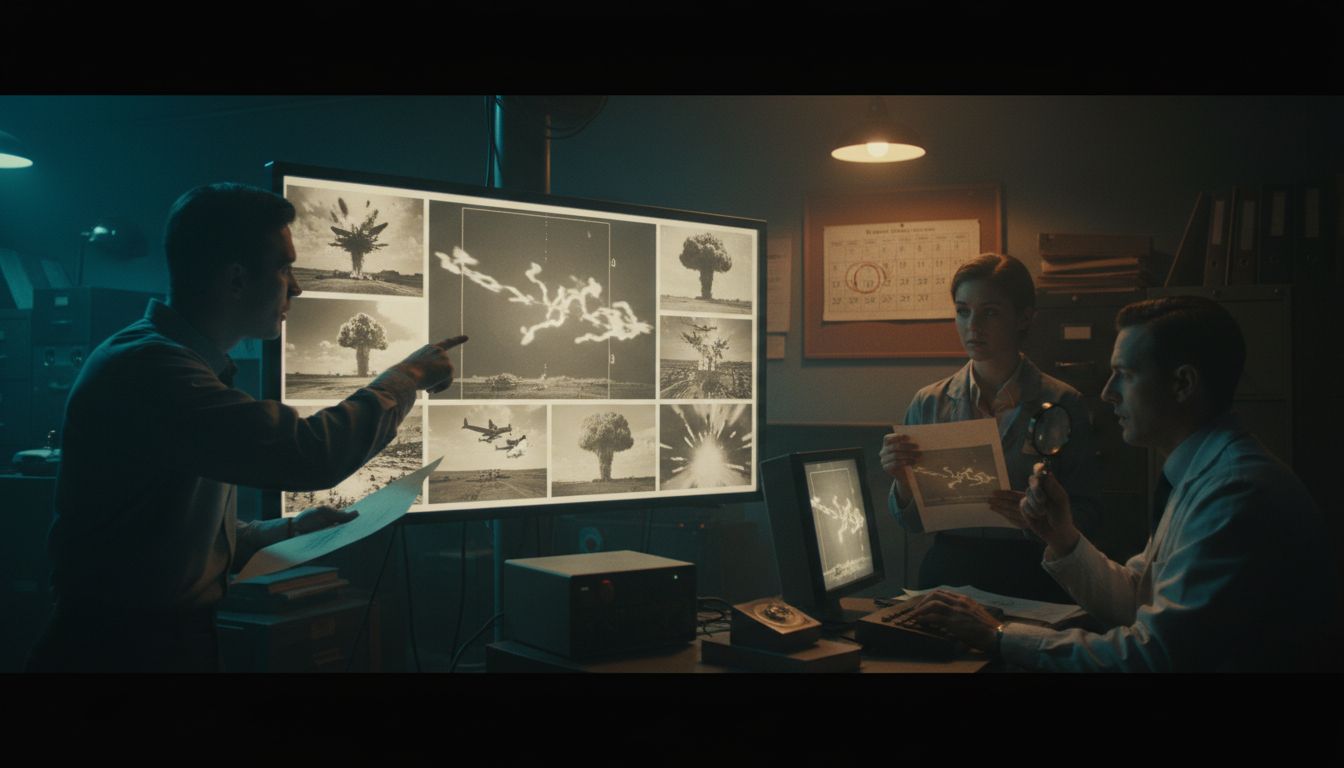
The investigative team, led by Dr. Elena Ramirez, a senior astrophysicist at CUFOS, examined over 3,000 digitized frames from the “Operation Hardtack” and “Operation Plumbbob” test series. Using image‑enhancement software and temporal analysis, the researchers isolated 27 instances where a luminous burst appeared in the sky moments before or after a nuclear detonation. “We cross‑referenced each frame with official test logs, timing data, and atmospheric conditions to eliminate conventional explanations such as sensor flare, camera artifact, or lightning,” Dr. Ramirez explained. The team also consulted with former test‑site personnel to verify that no known aircraft or instrumentation were present during the recorded moments.
Key Findings
The analysis revealed several consistent characteristics: the bursts were circular, lasted between 0.2 and 0.7 seconds, and displayed a spectral signature that differed from the characteristic fireball of a nuclear explosion. In three cases, the flashes were captured from multiple angles, allowing triangulation that placed the source at altitudes ranging from 12,000 to 18,000 feet—well above the typical mushroom cloud formation. “What is striking is the repeatability of the visual pattern across different test sites and years,” noted Dr. Ramirez. The report cautions that while the data are compelling, alternative hypotheses—including high‑altitude meteoric entry or classified experimental aircraft— have not been definitively ruled out.
Expert Reactions
The findings have prompted a measured response from government officials. A spokesperson for the Department of Energy’s Office of Science said, “We are aware of the newly released analysis and will review the evidence in coordination with the National Archives and the Office of the Director of National Intelligence. Our priority is to ensure that any conclusions are based on rigorous scientific evaluation.”
Conversely, aerospace analyst Mark Whitaker of the Center for Strategic and International Studies warned against premature speculation: “Historical test footage is notoriously difficult to interpret. While the anomalies are worth investigating, they do not automatically imply extraterrestrial technology.” The scientific community, represented by the American Astronomical Society, has called for an independent peer‑review process to assess the photographic evidence alongside contemporaneous sensor data.
Implications and Next Steps
If the anomalous bursts are confirmed as UAP, the discovery would extend the timeline of documented encounters by several decades, linking them directly to high‑security military environments. This could influence ongoing congressional hearings on UAP transparency and shape future protocols for imaging nuclear tests. The research team has submitted a formal request for access to original film reels, high‑resolution sensor logs, and any related classified documentation that may shed light on the source of the flashes. “Our goal is not to sensationalize but to apply the same scientific rigor that we use for any unexplained natural phenomenon,” Dr. Ramirez emphasized.
The report, slated for publication in the Journal of Unexplained Atmospheric Phenomena later this month, underscores a growing consensus that historical archives may hold untapped data relevant to today’s UAP investigations. As agencies continue to declassify Cold‑War‑era material, the intersection of legacy military operations and unexplained aerial events is likely to remain a focal point for both researchers and policymakers.