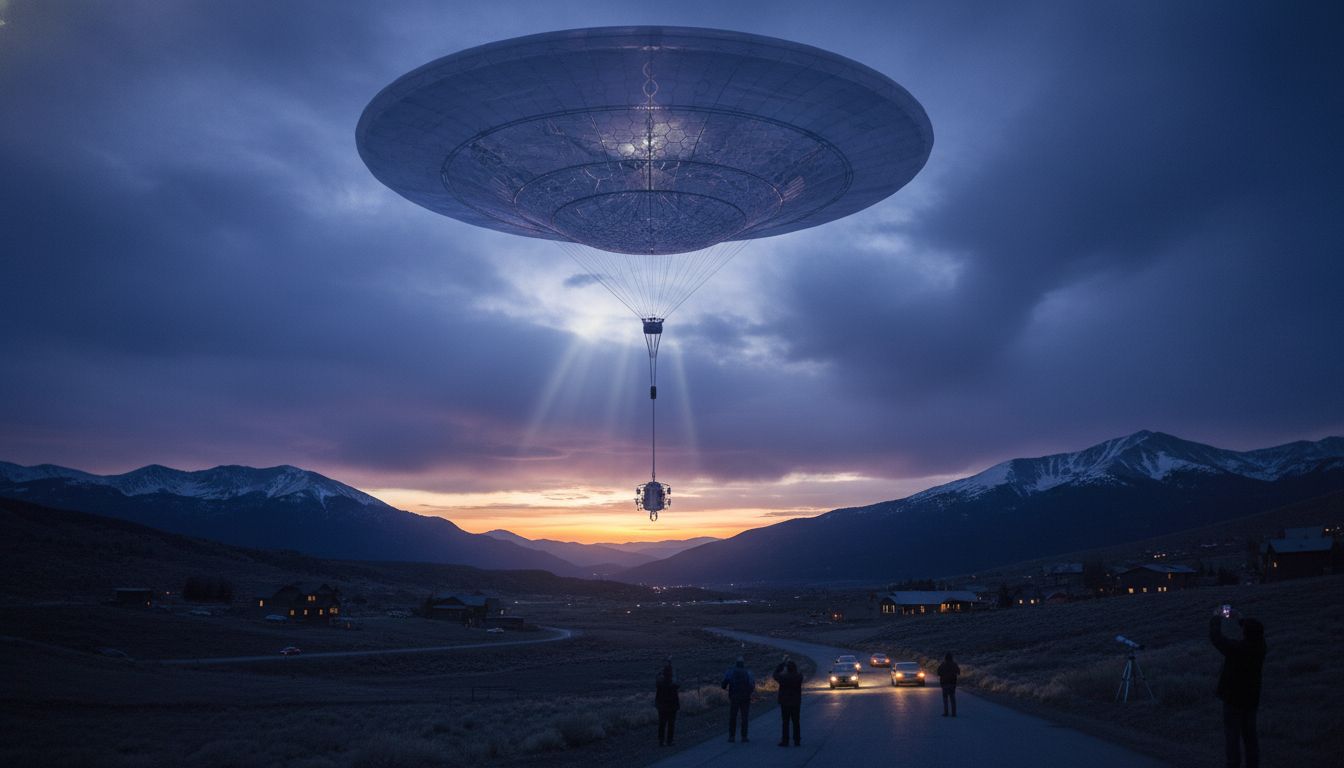
Residents of the western slope of Colorado reported an unusual, slow‑moving object drifting above the Rocky Mountains on the evening of October 12. The silhouette, described by several eyewitnesses as a “silvery disc” hovering at an altitude that made it appear stationary against the night sky, quickly sparked speculation on social‑media platforms that the sighting could be a UFO or a covert military operation. Local authorities received a handful of calls, and the Colorado Department of Public Safety issued a brief advisory asking the public to refrain from approaching the object while investigators determined its nature.
Within hours, the Federal Aviation Administration confirmed that the object was a high‑altitude research balloon operated by World View Enterprises, a commercial aerospace firm based in Tucson, Arizona. The balloon is a Stratollite—a solar‑powered, programmable platform that can ascend to the stratosphere, adjust its altitude, and ride prevailing winds for extended missions. According to World View’s director of flight operations, Dr. Maya Patel, the vehicle was launched on October 9 from the company’s Arizona test site to evaluate a new composite material designed to reduce payload weight and increase flight endurance. “The Stratollite’s ability to change altitude in real time lets us steer it around atmospheric disturbances, which is exactly what we needed to test with the lingering winds from Hurricane Priscilla,” Patel explained.
Hurricane Priscilla, which made landfall in the Gulf of California earlier in the month, left a complex pattern of upper‑level jet streams that extended far inland. Meteorologists at the National Weather Service noted that remnants of the storm generated unusually strong westerly winds at the 70,000‑foot level, a region the Stratollite was programmed to occupy. By descending to lower altitudes, the balloon could catch a different wind corridor and redirect its trajectory toward its intended recovery zone in New Mexico. The maneuver, while routine for the platform, produced a visible silhouette that, in the low‑light conditions of the Colorado mountains, appeared anomalous to observers unfamiliar with the technology.
The incident underscores a broader trend of increasing public encounters with civilian high‑altitude balloons. Since the declassification of several government‑run programs, commercial entities such as World View, Alphabet’s Loon (now defunct), and aerospace research groups have been deploying dozens of Stratollites and similar platforms each year for atmospheric science, communications testing, and materials research. Dr. Elena García, a professor of aerospace engineering at the University of Colorado Boulder, cautions that “the proliferation of these vehicles, combined with limited public awareness, creates fertile ground for misidentification. Most of the time, what looks like a UFO is simply a research asset operating above commercial air traffic.” She added that the FAA’s “UAS and high‑altitude balloon” tracking system logs thousands of such flights annually, many of which never become public knowledge.
In response to the Colorado sighting, the FAA reiterated that all high‑altitude balloon operations are required to file flight plans and coordinate with air‑traffic control to avoid conflicts with manned aircraft. No safety concerns were reported, and the balloon completed its mission on schedule, descending over the New Mexico desert where ground crews retrieved it on October 15. While the brief episode ignited curiosity and online conjecture, officials and experts agree that it serves as a reminder of the need for transparent communication about emerging aerospace technologies. As commercial stratospheric platforms become more commonplace, clear public outreach will be essential to distinguish routine scientific endeavors from the extraordinary phenomena that continue to capture the imagination.


