Overview
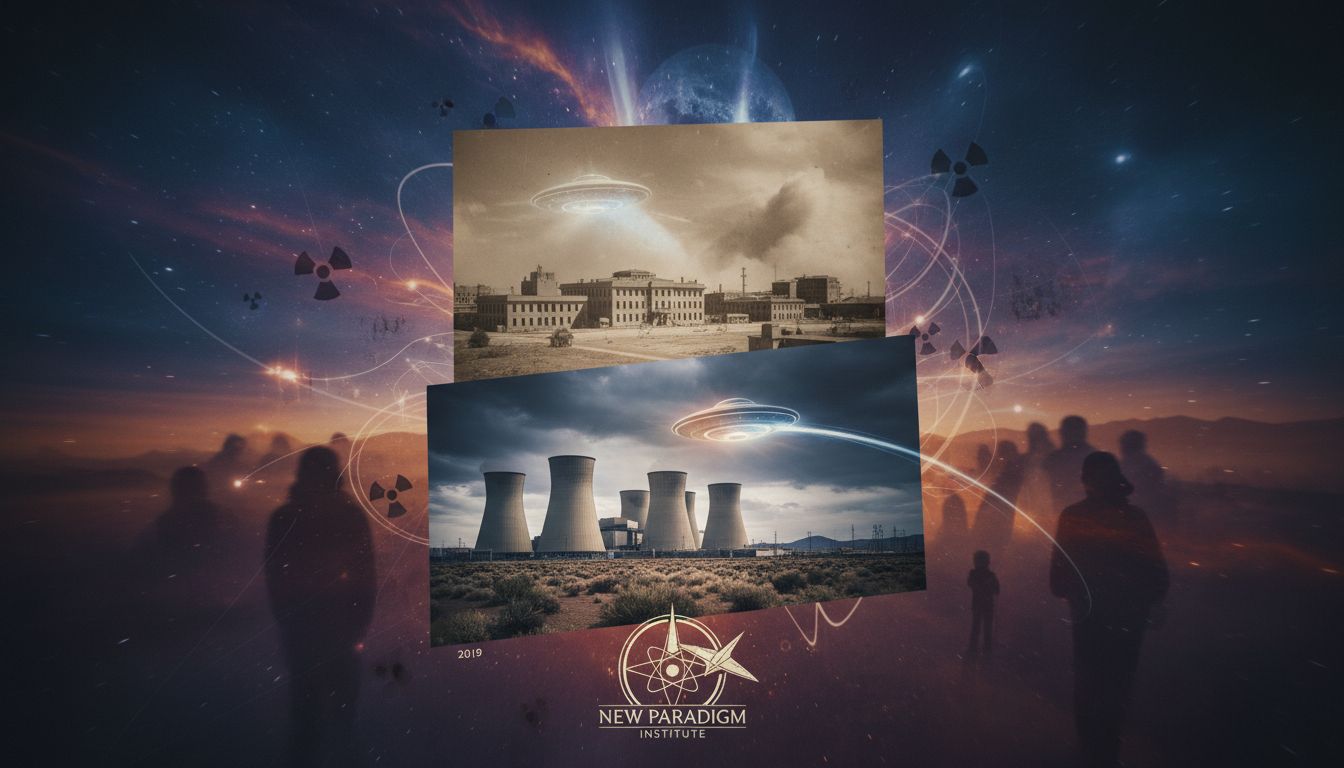
The New Paradigm Institute (NPI) has released a comprehensive update on a pattern that stretches back more than eight decades: unexplained aerial phenomena (UAP) appearing near nuclear facilities. From the first documented sighting over Los Alamos in the 1940s to the 2019 encounter at the Palo Verde Nuclear Generating Station in Arizona, the institute’s analysis suggests a consistent “watch‑and‑warn” behavior that may be intended to signal extraterrestrial concern over humanity’s nuclear ambitions. Recent declassifications of U.S. government reports, including the Office of the Director of National Intelligence’s 2021 UAP assessment, lend additional weight to NPI’s findings and rekindle calls for a transparent investigation.
Historical Cases
The earliest recorded incident occurred in 1947, when a bright, disc‑shaped object was observed hovering above the perimeter of the Los Alamos National Laboratory. Laboratory personnel reported the craft maintaining a stationary position for several minutes before accelerating upward at high speed. Similar reports emerged from the Hanford Site in the early 1950s, where multiple witnesses described a “silent, luminous sphere” that lingered near the reactor complex during routine inspections.
In the 1970s and 1980s, the pattern persisted at the Carteret Nuclear Power Plant in New Jersey and the Surry Power Station in Virginia. Both sites logged multiple radar contacts that did not correspond to known aircraft or weather phenomena, coinciding with brief spikes in radiation detector readings that later proved to be false alarms. The most recent high‑profile case, documented on June 13, 2019, involved a series of infrared camera captures of a triangular formation hovering over the Palo Verde plant’s cooling towers, followed by an abrupt loss of power to a secondary grid line for less than a second.
Recent Declassifications
The 2021 ODNI report, now fully declassified, identified 144 UAP incidents reported by military and civilian pilots, with nine occurring within a 10‑kilometer radius of nuclear installations. The report’s language, while cautious, noted that “the proximity of these phenomena to high‑value strategic sites warrants further scientific scrutiny.” In a follow‑up briefing released by the Department of Defense in March 2025, officials acknowledged that UAPs have repeatedly demonstrated the ability to enter and exit restricted airspace without detectable propulsion signatures.
NPI’s latest briefing, posted on the WOW! Signal news portal on November 24, 2025, references these declassifications and adds that “the cumulative data set now exceeds 200 documented events, forming a statistically significant correlation between UAP activity and nuclear facilities.” The institute’s director, Dr. Mara L. Jensen, emphasized that “the consistency of these encounters across different eras, technologies, and geopolitical contexts suggests an intent beyond random observation.”
Expert Commentary
Dr. John Ventre, a physicist who has consulted for the Pentagon’s UAP task force, cautioned against jumping to conclusions while acknowledging the pattern’s intrigue. “We are dealing with high‑altitude, low‑observable objects that appear to be aware of our most sensitive infrastructure,” he said in an interview with The WOW! Signal. “Whether this reflects a protective stance, a scientific curiosity, or something else entirely remains unknown, but the data compel us to treat the phenomenon seriously.”
Former Air Force pilot Lt. Col. (Ret.) Susan Miller, who witnessed a 2015 sighting near the Plattsburgh Air Force Base while on a routine patrol, echoed the sentiment: “The craft exhibited instantaneous acceleration and deceleration that defy our current propulsion models. Its decision to linger near a nuclear storage area was unmistakable.”
Implications and Next Steps
If the “watch‑and‑warn” hypothesis holds merit, it could signal an extraterrestrial warning against nuclear proliferation, a notion that has surfaced in speculative circles for decades. While the scientific community remains divided, the convergence of historical testimonies, modern sensor data, and newly released government documents creates a compelling case for a coordinated research effort.
Congressional leaders, including Rep. Eric Burison, who chairs the House Committee on Science, Space, and Technology, have called for a joint inter‑agency task force to systematically analyze UAP‑nuclear interactions. In the meantime, NPI urges civilian researchers to share any credible sightings near nuclear sites, emphasizing the need for rigorous documentation and transparent data sharing.
The emerging picture is one of persistent, unexplained activity that aligns with humanity’s most powerful and potentially destructive technologies. As the evidence base expands, the conversation is shifting from fringe speculation to a policy‑relevant security concern that may shape future approaches to both UAP disclosure and nuclear stewardship.


