Overview
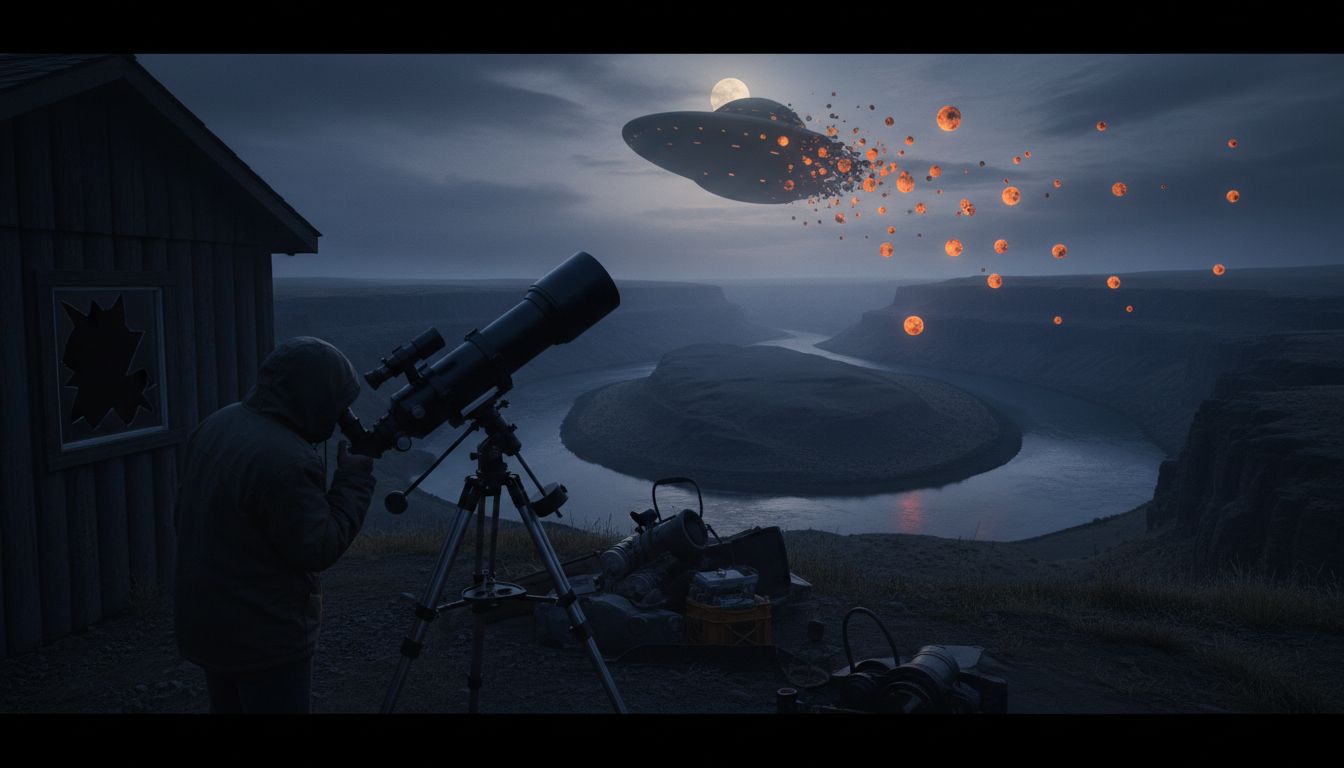
On the evening of January 5, 2026, a lone observer at Dedication Point along Idaho’s Snake River reported a striking aerial phenomenon that quickly entered the National UFO Reporting Center’s (NUFORC) database. While using a modest 8‑inch telescope to view the river’s twilight reflections, the witness saw a single luminous object separate into a cluster of orange‑colored orbs that hovered before dispersing downstream. The event, logged as “UFO Report Southern Idaho: Star People,” was submitted to NUFORC at 19:33 GMT on January 6, 2026 and has since been classified as a “breaking sighting” due to the clarity of the visual details and the lack of any audible or propulsion cues.
Witness Account
The observer, who chose to remain anonymous for personal safety, described the initial sighting as “a faint, silver disc gliding silently over the river, about the size of a small car.” At approximately 10 minutes after the first appearance, the disc appeared to split into three distinct orange orbs, each roughly the diameter of a basketball. The orbs rose a few meters, hovered in place for 15–20 seconds, and then descended in a gentle cascade, merging back into a single point before vanishing from view. The witness emphasized that no sound, vibration, or exhaust plume accompanied the maneuver, noting that “the night was otherwise still; I could hear the river, but nothing else.” Photographs or video were not captured, as the event occurred at the edge of the telescope’s field of view and the observer’s equipment was not equipped for video recording.
Technical Observations
NUFORC’s preliminary analysis recorded the following data points:
- Location: Dedication Point, Snake River, Southern Idaho (approx. 43.6° N, 112.1° W)
- Time: 19:33 GMT, 5 January 2026 (local time ≈ 11:33 PM MST)
- Altitude estimate: Based on the angular size of the orbs and known distance to the riverbank, the objects were likely between 200 and 400 feet above the water surface.
- Color and luminosity: The orange hue was described as “steady, non‑flashing,” with a brightness comparable to a full‑moon illumination.
- Motion: The separation and recombination were smooth and linear, lacking any observable acceleration or deceleration spikes.
The report notes no radar contacts from nearby FAA stations, and no commercial or private aircraft filed flight plans in the area at the time, reducing the likelihood of a conventional aerial vehicle.
Expert Commentary
Dr. Megan Alvarez, an atmospheric physicist at the University of Idaho, cautioned against premature conclusions:
“While the description aligns with several documented UAP cases—particularly the silent, low‑altitude, multiorb phenomena—we must first rule out atmospheric optics such as balloon reflections, temperature inversions, or auroral activity. Idaho’s winter sky can produce unusual light scattering, though the orange coloration and discrete separation are atypical for such effects.”
Local amateur astronomer Tom Whitaker, who frequently observes the Snake River corridor, added:
“The telescope’s field of view at Dedication Point is usually clear of light pollution, making it a good spot for deep‑sky work. I have never seen an object behave like this, especially with the smooth orbital split. It merits further observation, perhaps with a calibrated camera system.”
Both experts highlighted the importance of multiple sensor corroboration—radar, infrared, and visual—to build a more robust data set, echoing NUFORC’s ongoing collaboration with the All‑Domain Anomaly Resolution Office (AARO).
Broader Context
The Idaho sighting joins a growing catalog of UAP reports in the western United States that feature silent, low‑altitude objects with multiorb characteristics. Recent NUFORC entries include “Mysterious Lights in Northern Michigan” and a series of “orange‑orb” sightings over Nevada’s desert basins earlier this year. While the U.S. government’s recent UAP task force has emphasized the need for systematic data collection, many civilian reports remain under‑documented due to limited instrumentation.
NUFORC’s role remains pivotal: the organization continues to collect, archive, and disseminate such reports for scientific and investigative scrutiny. As Dr. James E. McDonald’s 1968 statement reminds us, “situations have arisen in which a problem of ultimately enormous importance went begging for adequate attention simply because it lay outside the current bounds of scientific knowledge.” The Southern Idaho event, with its clear visual description and lack of conventional explanations, underscores the ongoing need for transparent, multidisciplinary study of unidentified aerial phenomena.