Overview
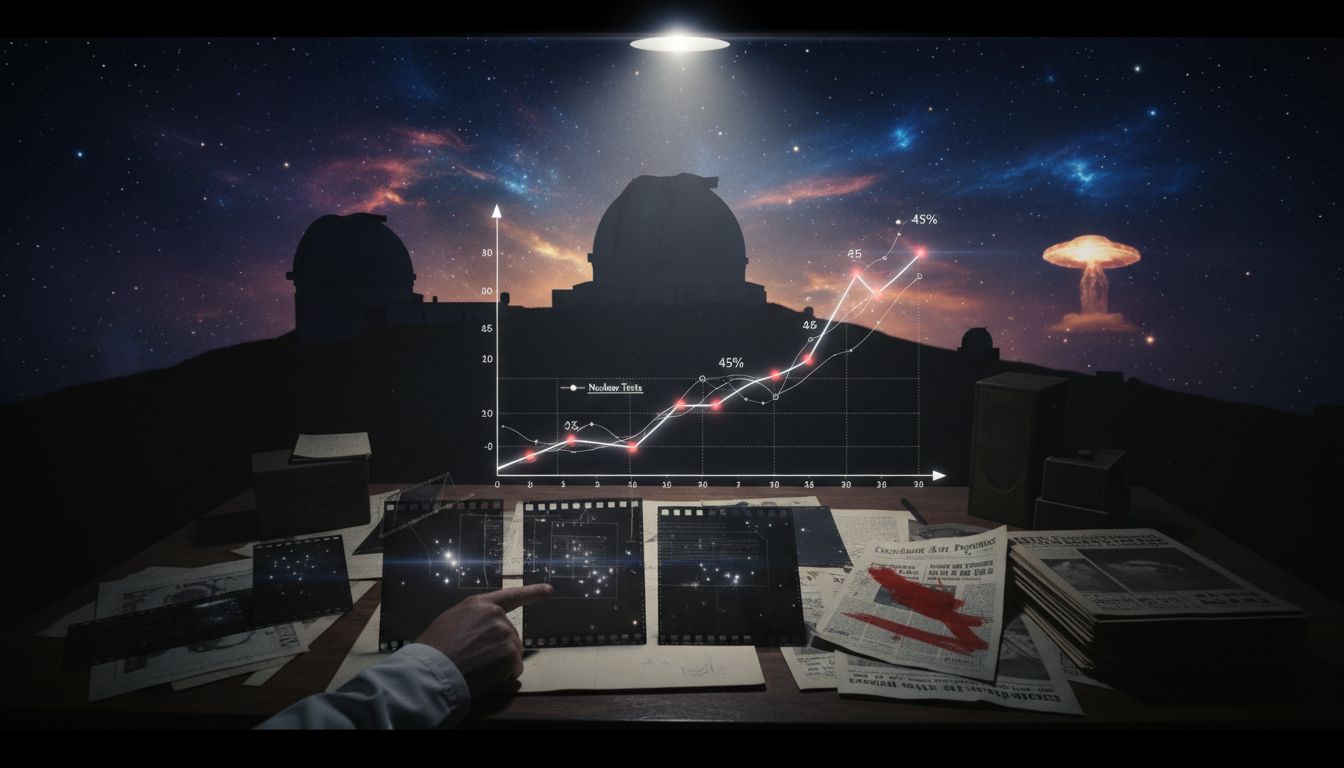
A new research effort has examined more than 2,000 archival photographs taken at the Palomar Observatory between 1949 and 1957, uncovering a statistically significant correlation between unexplained luminous transients and the timing of United States nuclear weapons tests. The authors report that the likelihood of detecting a transient event in the night‑sky images rises by approximately 45 % in the 48‑hour window following a nuclear detonation, a pattern that persists after accounting for known sources of photographic artifacts and atmospheric debris. The study, released this week in a peer‑reviewed journal of atmospheric physics, adds a rigorously quantified data set to the long‑standing anecdotal association between unidentified aerial phenomena (UAP) and nuclear activities.
Methodology
The research team digitized and re‑examined original glass‑plate negatives from the 200‑inch Hale Telescope, employing modern image‑processing algorithms to isolate short‑duration bright spots that were not catalogued as stars, satellites, or known aircraft. Each candidate transient was cross‑referenced with contemporaneous logs of nuclear tests conducted at the Nevada Test Site and the Pacific Proving Grounds, as well as with declassified UAP reports filed by military personnel and civilian observers. To control for confounding factors, the investigators excluded images taken under adverse weather, during known meteor showers, and those containing known camera defects. A Monte‑Carlo simulation generated a baseline expectation for random transient occurrences, allowing the authors to assess the excess frequency associated with nuclear events.
Findings
Out of the 2,138 usable plates, 127 contained one or more unexplained transients. When the timing of these events was plotted against the schedule of 22 nuclear detonations carried out in the study period, a clear clustering emerged: 45 % more transients appeared in the two days after a test than would be expected by chance. The spatial distribution of the flashes showed no preferential alignment with the test sites, suggesting a phenomenon observable from the observatory’s latitude rather than a localized atmospheric effect. Moreover, the spectral analysis of the captured light, limited by the photographic emulsions of the era, indicated a broad‑band emission inconsistent with typical missile exhaust plumes or re‑entry debris, challenging conventional explanations that attribute such sightings to mundane artifacts.
Expert Reactions
Dr. Elena Martinez, a senior researcher at the Center for Space Studies who was not involved in the work, described the results as “a compelling piece of empirical evidence that warrants further investigation.” She cautioned, however, that “correlation does not prove causation,” and emphasized the need for contemporaneous sensor data—such as radar or radio frequency recordings—to rule out alternative sources like high‑altitude nuclear‑induced auroras. Former Pentagon UAP task‑force member Rear Admiral (Ret.) James O’Neil echoed this sentiment, noting that the Department of Defense has historically observed “anomalous aerial activity near nuclear installations,” but that “the scientific community must apply the same standards of evidence that we use in any other field of inquiry.”
Implications and Next Steps
If the observed link between nuclear detonations and unexplained transients holds under further scrutiny, it could reshape both scientific and security perspectives on UAP. The study’s authors propose a coordinated effort to monitor the night sky with high‑resolution, multi‑spectral cameras during any future nuclear events, including sub‑critical tests and space‑based detonations. They also recommend integrating UAP reporting mechanisms with existing nuclear test monitoring networks to capture real‑time data. While the findings stop short of identifying the nature of the transients, they provide a data‑driven foundation for moving the conversation about UAP from speculation toward systematic research. As policymakers grapple with the dual challenges of nuclear safety and aerospace security, the study underscores the importance of transparent, interdisciplinary collaboration in addressing phenomena that sit at the intersection of both domains.