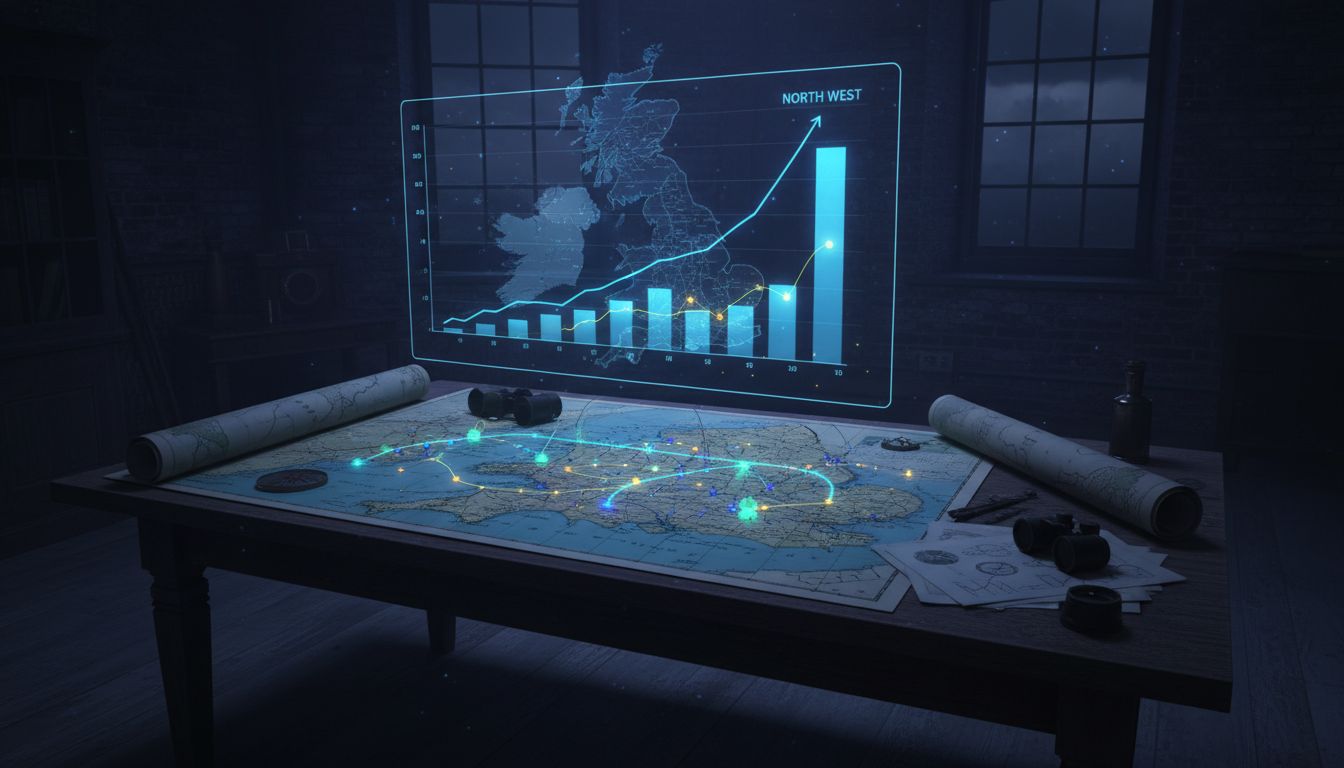
The latest analysis of civilian reports shows a distinct cluster of unidentified aerial phenomena over Kent, a pattern that has been visualised on an interactive map released by the UFO‑identification website UFO Identified. The map, compiled from more than 150 sightings logged between 2022 and 2024, highlights concentrations of “orbs” and “lights” both along the coastal strip from Dover to Whitstable and across inland towns such as Sevenoaks and Tonbridge. The timing of the release coincides with a high‑profile hearing in the United States Congress in which lawmakers acknowledged that “flying saucers are real,” a statement that has revived public interest in similar reports across the United Kingdom.
According to the data, Kent accounts for roughly 8 % of all U.K. sightings recorded by UFO Identified during the two‑year period, a modest share compared with the North West, which remains the region with the highest reporting rate. Nevertheless, the Kent data reveal two notable trends. First, coastal observations tend to involve single, slowly pulsing lights that hover for a few seconds before accelerating away at speeds described as “instantaneous.” Second, inland reports more often describe clusters of bright, spherical objects moving in tight formations, sometimes changing colour from white to amber before vanishing. The map’s heat‑map overlay shows the highest density of reports along the Thanet coastline, a stretch that has historically attracted attention from both amateur astronomers and naval observers.
Eyewitnesses interviewed by Kent Live described the phenomena as “silent” and “unusually fast.” One resident of Whitstable, who asked to remain anonymous, said, “I was walking my dog at about 10 p.m. when I saw three white balls hovering just above the sea. They didn’t make any sound, and within seconds they zipped off at a speed I could barely track.” A farmer near Maidstone added, “I was out checking the fences when I saw a single orange‑red light swoop low over the fields. It was there for a heartbeat, then it was gone—no engine noise, no lights on a plane.” Such accounts echo similar descriptions from previous UK reports, where the absence of audible propulsion and the sudden, high‑velocity movement challenge conventional explanations involving aircraft or drones.
UFO Identified’s coordinator, Dr. Helen Rowe, cautioned against jumping to extraterrestrial conclusions, noting that “the clustering of sightings in coastal zones could be linked to atmospheric conditions that affect light refraction, or even to increased maritime traffic that generates unusual visual signatures.” She also pointed out that the North West’s higher reporting rate may stem from a larger population of active sky‑watchers and a longer tradition of organized UFO‑investigation groups. Nevertheless, Rowe said the Kent data “provide a valuable baseline for cross‑regional comparison and underscore the need for systematic, scientifically‑rigorous documentation of these events.”
The UK Ministry of Defence, which formally ended its official UFO investigations in 2009, has not issued a new policy in response to the recent map. However, the Defence Science and Technology Laboratory (DSTL) continues to monitor anomalous aerial observations through its “Aerial Phenomena Reporting” portal, encouraging pilots and civilians to submit detailed reports. In a statement released to the press, DSTL spokesperson Lt‑Col. Mark Sinclair said, “While the majority of sightings can be attributed to known aerial platforms, any incident that remains unexplained after standard analysis is recorded for further study.” As public curiosity grows in the wake of the U.S. congressional remarks, officials say the focus remains on gathering reliable data, improving sensor coverage, and fostering collaboration between hobbyist groups and scientific institutions to better understand the phenomena that continue to light up Kent’s night skies.