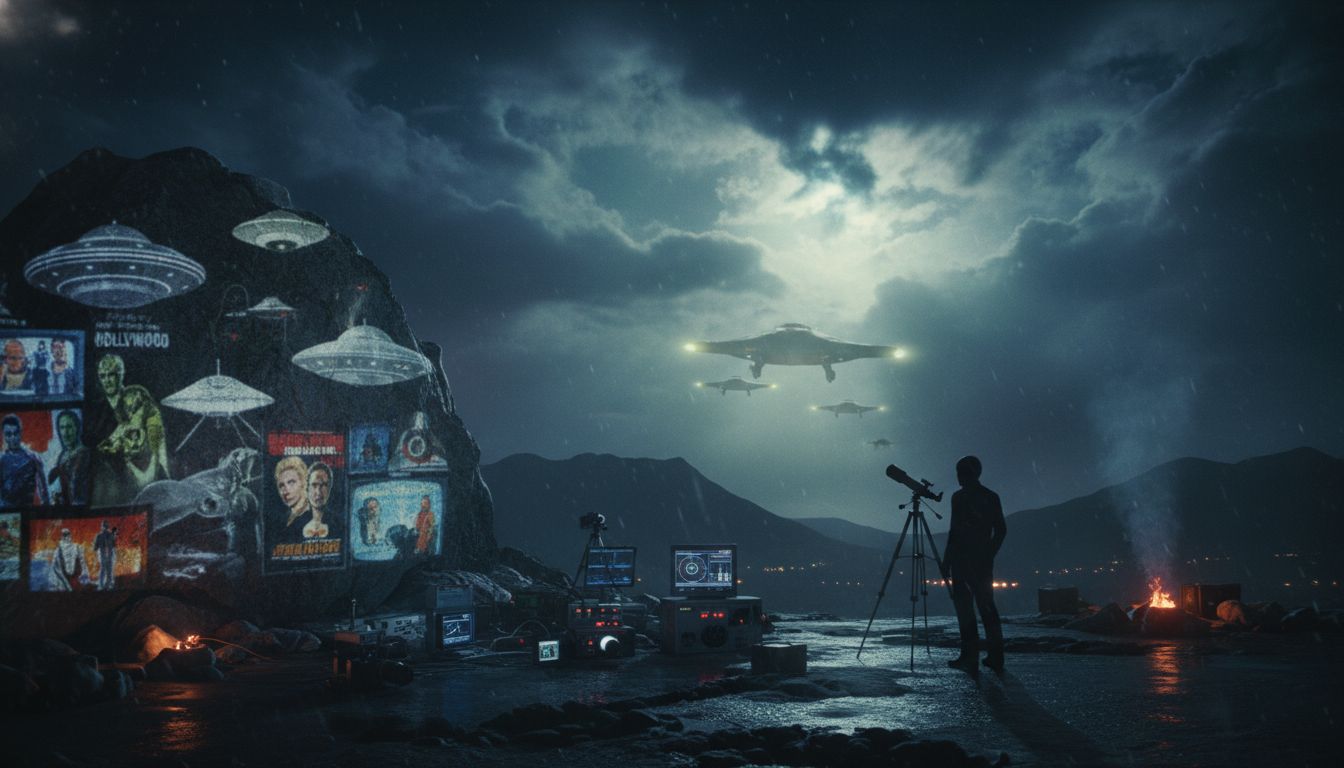
The public’s fascination with unidentified flying objects has long been shaped by a blend of documented encounters and the storytelling power of film and television. Recent analysis by the online cultural‑media outlet Alienated Media underscores how the two streams intersect, noting that “the Cold War era’s surge in sightings reflected deeper anxieties about nuclear threats and government secrecy,” while Hollywood’s sci‑fi blockbusters have turned those anxieties into visual spectacles. By tracing the timeline from the 1947 Roswell incident to the 1977 “Wow!” signal, the article highlights how certain high‑profile reports have become cultural touchstones, spawning both serious investigative efforts and a flood of fictional narratives that reinforce the mythic status of UFOs in the popular imagination.
In the realm of verified reports, the most compelling cases continue to be those backed by multiple witnesses, radar data, and, in some instances, declassified government documents. The 1952 Washington, D.C., sightings, for example, were logged by both civilian observers and the U.S. Air Force’s Project Blue Book, prompting a brief congressional hearing on aerial phenomena. Similarly, the “Wow!” signal—a 72‑second narrowband radio burst detected by the Big Ear radio telescope—has never been explained, prompting ongoing scientific inquiry rather than sensational speculation. Dr. Elena Ramirez, an astrophysicist at the SETI Institute, cautions that “while the signal’s origin remains unknown, it is a data point that encourages rigorous, peer‑reviewed research, not the leap to extraterrestrial visitation.” These examples stand in contrast to the countless dramatizations that dominate the screen, where alien craft are often portrayed as hostile invaders or government conspiracies, reinforcing a narrative that can obscure the nuance of real‑world investigations.
Hollywood’s influence on public perception cannot be overstated. Films such as Close Encounters of the Third Kind (1977) and series like The X‑Files (1993‑2018) have embedded the idea of secretive agencies and hidden agendas into the collective psyche. The article points out that the “flying saucer craze” of the 1950s, spurred by both media coverage and sensationalist journalism, inspired a generation of writers and artists, leading to a feedback loop where fictional depictions amplified public interest, which in turn generated more reports—both genuine and imagined. Cultural critic Maya Patel observes that “the entertainment industry often capitalizes on the mystery surrounding UFOs, but it also provides a platform for dialogue about humanity’s place in the cosmos, even if the storytelling leans toward the dramatic.” This dynamic illustrates how fiction can both illuminate and distort the factual record.
Distinguishing fact from fiction, however, remains a challenge for both journalists and the public. Alienated Media recommends a systematic approach: cross‑referencing eyewitness accounts with radar and satellite data, consulting peer‑reviewed scientific literature, and scrutinizing the provenance of any leaked documents. The piece also warns against “the scientific fringe” that frequently circulates unverified claims on social media, noting that many such reports lack the methodological rigor required for credible analysis. In a recent interview, former Pentagon UFO task‑force member Lt. Cmdr. James O’Leary emphasized that “our job was to filter out the noise—weather balloons, aircraft, misidentified celestial objects—so that only genuinely anomalous cases received further study.” This disciplined methodology is essential to maintain public trust and to ensure that legitimate anomalies are not dismissed outright.
The cultural impact of UFO sightings continues to evolve as new data emerges and media representations shift. While the allure of extraterrestrial drama fuels box‑office hits and streaming series, the underlying reality is anchored in a modest but growing body of evidence that demands careful, scientific scrutiny. As the article concludes, the dialogue between fact and fiction is not merely a battle for credibility but a reflection of humanity’s enduring curiosity about the unknown—a curiosity that, when guided by rigorous inquiry, can expand our understanding of both the universe and the stories we tell about it.