Overview
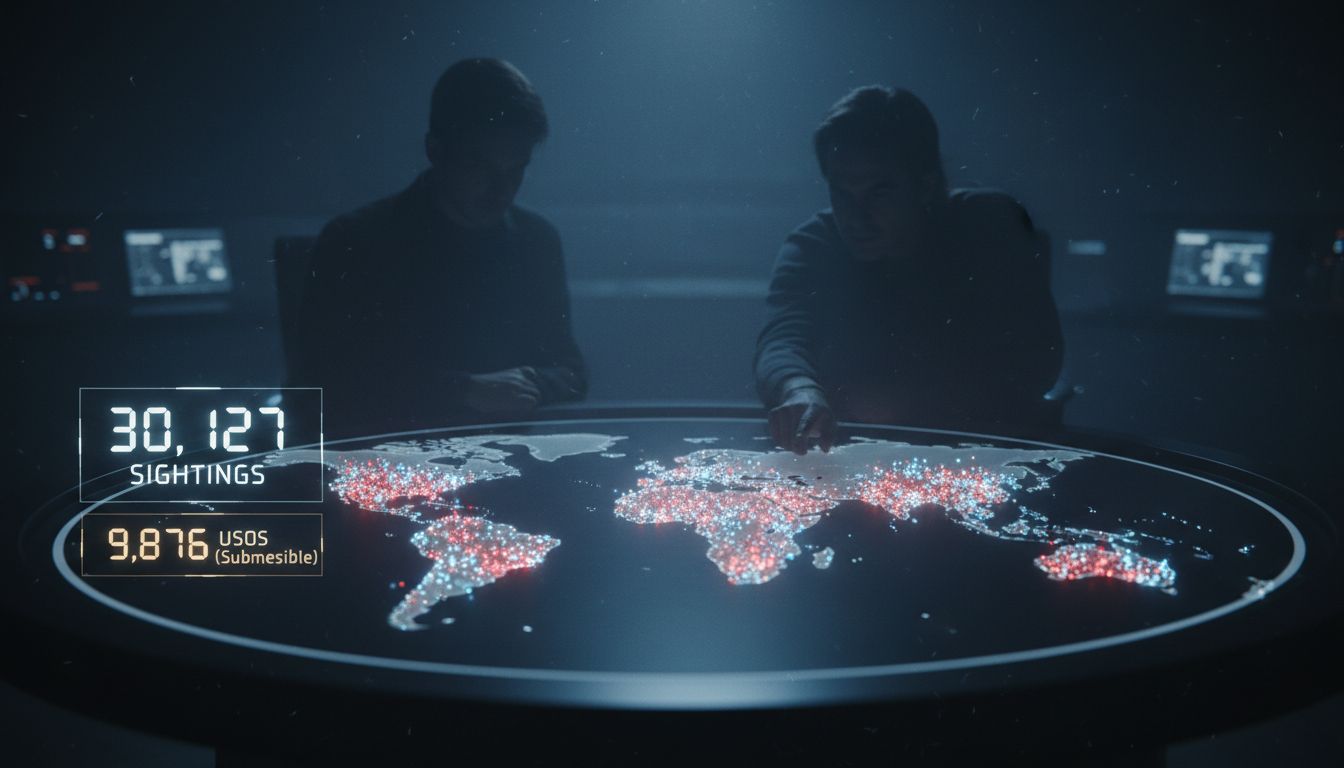
A crowdsourced UFO‑reporting platform has logged more than 30,000 sightings worldwide since its launch, with 9,000 reports of unidentified submersible objects (USOs) recorded within a 100‑mile radius of the United States coastline. The data, released in a November 2025 briefing, reveal distinct clusters off the coasts of California, the Gulf of Mexico, and the Mid‑Atlantic states. While the platform’s developers caution that “unidentified” does not equate to extraterrestrial, the sheer volume and geographic concentration of the reports have prompted renewed scrutiny from the Department of Defense’s All‑Domain Anomaly Resolution Office (AARO) and raised questions about whether the government has fully disclosed information on non‑human intelligence.
Data and Methodology
The app, called DeepSky Tracker, aggregates user‑submitted sightings via a standardized form that records time, GPS coordinates, depth estimates, visual descriptions, and any available video or sonar data. Between January 2024 and October 2025, 9,012 entries were classified as “subsurface anomalies” after the platform’s automated filters eliminated known marine vessels, wildlife, and debris. Independent analysts at the University of Texas’ Center for Unidentified Aerial Phenomena (CUAP) cross‑checked a random sample of 500 reports with commercial AIS (Automatic Identification System) data and found that approximately 78 % could not be matched to any registered craft or known marine activity.
Findings
Mapping the validated USO reports shows three primary hotspots:
- Southern California Bight – 2,340 sightings, many describing “smooth, disc‑shaped objects” moving at speeds exceeding 30 knots at depths of 200–500 feet.
- Gulf Coast near Texas and Louisiana – 1,950 reports, with frequent mentions of “pulsing lights” and “sonar echoes” that persisted for several minutes.
- Mid‑Atlantic corridor from Virginia to North Carolina – 1,620 entries, often accompanied by anomalous acoustic signatures detected by local fishing vessels.
These patterns mirror earlier AARO reports of “clusters of anomalous underwater activity” but represent a ten‑fold increase in documented cases, according to the app’s co‑founder, Dr. Emily Ramirez, a marine physicist. “The data suggest we are observing a phenomenon that is both persistent and geographically selective,” Ramirez said in a press release. “Whether this points to undisclosed technology, natural oceanographic events, or something else entirely remains an open question.”
Government and Security Response
The Pentagon’s AARO confirmed receipt of the DeepSky Tracker dataset and indicated that its analysts are “actively reviewing the information for potential national security implications.” Lt. Cmdr. James Patel, spokesperson for AARO, told reporters, “We take any unidentified object—air, space, or underwater—seriously. Our mandate is to assess whether these anomalies pose a threat to U.S. interests, and we will coordinate with relevant agencies as needed.” The Department of Homeland Security’s Coast Guard has also issued an advisory urging mariners to report any unexplained underwater contacts, citing the recent surge in civilian observations.
Expert Commentary and Outlook
Scientists emphasize caution in interpreting the findings. Dr. Alan Chen, a marine biologist at the Scripps Institution of Oceanography, noted that “the ocean is a complex acoustic environment, and phenomena such as bubble plumes, bioluminescent organisms, or even rogue currents can produce signatures that appear anomalous to non‑specialists.” Nevertheless, he acknowledged that “the consistency of the reports across multiple independent observers warrants a systematic investigation.”
Legislators have begun to respond as well. Representative Megan Torres (D‑CA) introduced a bipartisan resolution calling for a congressional hearing on “unidentified submersible phenomena,” citing the potential implications for maritime safety and scientific research. As the debate unfolds, the DeepSky Tracker team plans to release a second‑phase analysis in early 2026, incorporating higher‑resolution sonar data and partnering with the Navy’s Oceanographic Office to verify the most persistent hotspots. Until then, the mystery beneath America’s shores remains a focal point for both curiosity and caution.


