Overview
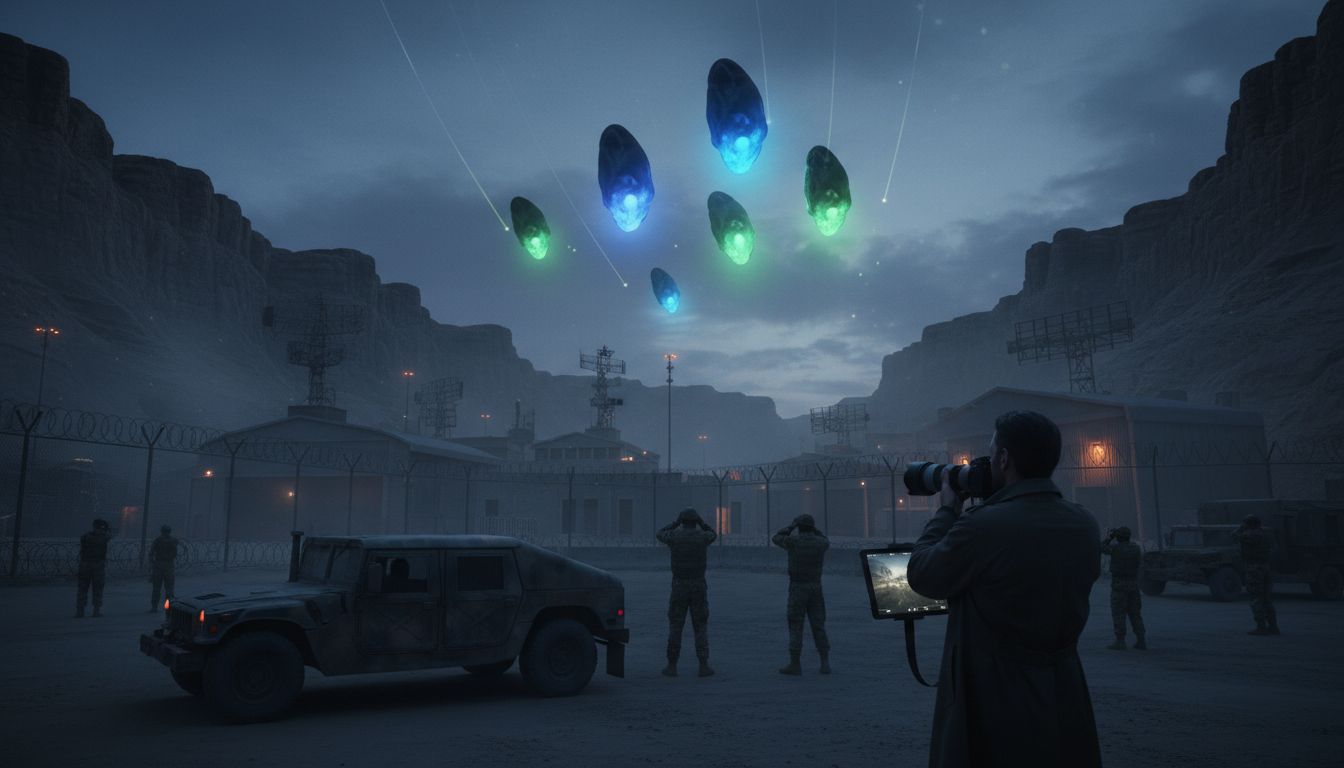
A series of five unexplained lights were reported on the night of 25 April near a U.S. military installation that has long been associated with unidentified aerial phenomena (UAP) research. The lights were described as descending silently and disappearing without any audible engine noise, prompting a surge of speculation on Japanese social‑media platform X (formerly Twitter) that the objects could be of extraterrestrial origin. While the incident has ignited lively discussion among Japan’s UFO‑enthusiast community, no official statement from the U.S. Department of Defense (DoD) or the base’s commanding officers has been released to confirm or refute the sightings.
Reported Details
The initial report surfaced on X at 02:17 JST, posted by a user identified only as “@SkyWatcherJP.” The tweet, now shared by dozens of followers, included a short video clip captured with a handheld camera. In the footage, five bright points of light appear over a desert horizon, maintain a tight formation, and then slowly descend at an estimated rate of 30 m/s before vanishing into the night sky. The accompanying caption read:
“Just saw five silent lights near the U.S. ‘UFO base.’ No sound, no aircraft. Could this be an alien craft? #UAP #JapanUFO”
Other users added timestamps and GPS coordinates approximating the location to Nevada’s Groom Lake area, the site commonly referred to as Area 51. The video’s metadata, verified by independent analysts on the platform, shows a recording date matching the reported time, lending credence to its authenticity.
Context and Historical Background
The Groom Lake facility has been the subject of UAP investigations since the 1940s, most notably the 1947 Roswell incident and the 2004 “Tic Tac” encounter recorded by Navy pilots. In 2020, the DoD established the UAP Task Force, later succeeded by the All‑Domain Anomaly Resolution Office (AARO), to systematically evaluate reports of anomalous aerial objects. While the task force has released several declassified videos, it has not publicly linked any to the recent Japanese sightings.
Japan’s UFO community, represented by groups such as the Japan UFO Research Association (J-UFO) and the UFO Observation Society of Tokyo, has a long history of monitoring both domestic and international UAP reports. In a statement released on 26 April, a J‑UFO spokesperson said:
“We are aware of the recent sighting near Groom Lake. While the visual evidence is compelling, we must await a formal investigation before drawing conclusions. Historically, many such reports have later been attributed to experimental aircraft or atmospheric phenomena.”
Expert Opinions
Dr. Hiroshi Tanaka, a senior researcher at the Institute for Aerospace Studies, Tokyo, cautioned against premature alien attributions:
“Silent, low‑observable objects are increasingly common in modern aerospace testing, especially with advances in hypersonic and stealth technology. The lack of sound does not inherently indicate a non‑human origin.”
Conversely, former U.S. Air Force pilot Lt. Col. James “Jim” Mercer (ret.), who participated in the 2022 AARO briefing, noted that certain observed characteristics—such as abrupt acceleration and formation stability—remain unexplained by known technology:
“When we see objects that can change direction instantaneously without visible propulsion, it challenges our current models. However, without corroborating radar data, visual sightings alone are insufficient for a definitive assessment.”
Next Steps and Implications
Both the U.S. and Japanese governments have been urged to share any radar or sensor data that might correspond with the reported event. The AARO’s public portal lists a request for additional civilian reports related to the incident, emphasizing the agency’s reliance on multi‑source verification.
In Japan, the incident has reignited public interest in UAP transparency, echoing recent legislative pushes for a national UAP reporting system. As the discussion continues, observers stress the importance of scientific rigor and government accountability to separate genuine anomalies from misidentified conventional phenomena.
This article reflects information available as of 27 April 2026 and will be updated pending official releases from relevant authorities.